
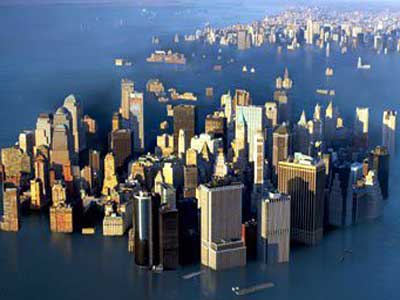
“We’re going to have more people on less land and sooner that we think,” said lead author Charles Geisler, professor emeritus of development sociology at Cornell. “The future rise in global mean sea level probably won’t be gradual. Yet few policy makers are taking stock of the significant barriers to entry that coastal climate refugees, like other refugees, will encounter when they migrate to higher ground.”
Earth’s escalating population is expected to top 9 billion people by 2050 and climb to 11 billion people by 2100, according to a United Nations report. Feeding that population will require more arable land even as swelling oceans consume fertile coastal zones and river deltas, driving people to seek new places to dwell.
By year 2060, about 1.4 billion people could be climate change refugees, according to the paper. Geisler extrapolated that number to 2 billion by 2100.
“The colliding forces of human fertility, submerging coastal zones, residential retreat, and impediments to inland resettlement are a huge problem. We offer preliminary estimates of the lands unlikely to support new waves of climate refugees due to the residues of war, exhausted natural resources, declining net primary productivity, desertification, urban sprawl, land concentration, ‘paving the planet’ with roads and greenhouse gas storage zones offsetting permafrost melt,” Geisler said.
The paper describes tangible solutions and proactive adaptations in places like Florida and China, which coordinate coastal and interior land-use policies in anticipation of weather-induced population shifts.
Florida has the second-longest coastline in the United States, and its state and local officials have planned for a coastal exodus, Geisler said, in the state’s Comprehensive Planning Act.
Beyond sea level rise, low-elevation coastal zones in many countries face intensifying storm surges that will push sea water further inland. Historically, humans have spent considerable effort reclaiming land from oceans, but now live with the opposite – the oceans reclaiming terrestrial spaces on the planet,” said Geisler. In their research, Geisler and Currens explore a worst-case scenario for the present century.
The authors note that the competition of reduced space that they foresee will induce land-use trade-offs and conflicts. In the United States and elsewhere, this could mean selling off public lands for human settlement.
“The pressure is on us to contain greenhouse gas emissions at present levels. It’s the best ‘future proofing’ against climate change, sea level rise and the catastrophic consequences likely to play out on coasts, as well as inland in the future,” said Geisler.
Related Items
Wealthy protect themselves from climate risks, leaving poor vulnerable
Collective action and behaviour change transforming rural sanitation
When bombs fall on the ground, the climate bleeds…