
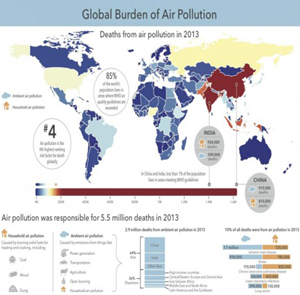
Power plants, industrial manufacturing, vehicle exhaust and burning coal and wood all release small particles into the air that are dangerous to a person's health. New research, presented today at the 2016 annual meeting of the American Association for the Advancement of Science (AAAS), found that despite efforts to limit future emissions, the number of premature deaths linked to air pollution will climb over the next two decades unless more aggressive targets are set.
"Air pollution is the fourth highest risk factor for death globally and by far the leading environmental risk factor for disease," said Michael Brauer, a professor at the University of British Columbia's School of Population and Public Health in Vancouver, Canada. "Reducing air pollution is an incredibly efficient way to improve the health of a population."
For the AAAS meeting, researchers from Canada, the United States, China and India assembled estimates of air pollution levels in China and India and calculated the impact on health.
Their analysis shows that the two countries account for 55 per cent of the deaths caused by air pollution worldwide. About 1.6 million people died of air pollution in China and 1.4 million died in India in 2013.
In China, burning coal is the biggest contributor to poor air quality. Qiao Ma, a PhD student at the School of Environment, Tsinghua University in Beijing, China, found that outdoor air pollution from coal alone caused an estimated 366,000 deaths in China in 2013.
Ma also calculated the expected number of premature deaths in China in the future if the country meets its current targets to restrict coal combustion and emissions through a combination of energy policies and pollution controls. She found that air pollution will cause anywhere from 990,000 to 1.3 million premature deaths in 2030 unless even more ambitious targets are introduced.
"Our study highlights the urgent need for even more aggressive strategies to reduce emissions from coal and from other sectors," said Ma.
In India, a major contributor to poor air quality is the practice of burning wood, dung and similar sources of biomass for cooking and heating. Millions of families, among the poorest in India, are regularly exposed to high levels of particulate matter in their own homes.
"India needs a three-pronged mitigation approach to address industrial coal burning, open burning for agriculture, and household air pollution sources," said Chandra Venkataraman, professor of Chemical Engineering at the Indian Institute of Technology Bombay, in Mumbai, India.
In the last 50 years, North America, Western Europe and Japan have made massive strides to combat pollution by using cleaner fuels, more efficient vehicles, limiting coal burning and putting restrictions on electric power plants and factories.
"Having been in charge of designing and implementing strategies to improve air in the United States, I know how difficult it is. Developing countries have a tremendous task in front of them," said Dan Greenbaum, president of Health Effects Institute, a non-profit organization based in Boston that sponsors targeted efforts to analyze the health burden from different air pollution sources. "This research helps guide the way by identifying the actions which can best improve public health."
Related Items
Wealthy protect themselves from climate risks, leaving poor vulnerable
Cryptocurrency encourages financial risk-taking, especially among poor
Quality ration at affordable prices to devotees at Maha Kumbh