
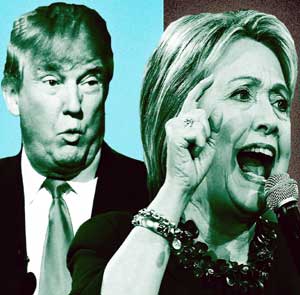
Almost half of all respondents (47%) say they feel “disgusted” about the Republican Party’s nomination of Trump. This is the most common feeling about Trump’s nomination, followed by “afraid” (42%), “hopeful” (40%), “proud” (31%), “angry” (31%), and “enthusiastic” (30%). Among Republicans, 82% feel hopeful and 69% feel proud, versus only 14% who feel disgusted or afraid. Meanwhile, 69% of Democrats feel disgusted and 65% feel afraid, whereas only 14% feel hopeful and 7% feel proud.
Most Trump and Clinton supporters would be very disappointed if their candidate lost. Among those saying they would vote for Trump, 70% would very disappointed and another 17% would be somewhat disappointed. Among Clinton voters, 67% would be very disappointed and 19% would be somewhat disappointed.
Among all those surveyed, 59% have an unfavorable opinion of Trump (with 43% saying very unfavorable and 16% saying mostly unfavorable), compared to 37% who have a favorable opinion (18% very/19% mostly). Republican vice presidential nominee Mike Pence fares better, with 40% viewing him favorably (19% very/21% mostly) and 37% viewing him unfavorably (21% very/16% mostly).
On the Democratic side, 51% have an unfavorable opinion of Clinton (36% very/15% mostly) versus 43% who view her favorably (19% very/24% mostly). Of the respondents interviewed on July 23-24 (N = 506), 37% have a favorable opinion of Democratic vice presidential nominee Tim Kaine (12% very/25% mostly) and 31% view him unfavorably (18% very/13% mostly).
Opinions split sharply across party lines for all four candidates, particularly Trump and Clinton. Among Republicans, 80% view Trump favorably and only 18% view him unfavorably. In contrast, 93% of Republicans have an unfavorable opinion of Clinton, with only 6% holding a favorable opinion. Of the Democrats surveyed, 9% view Trump favorably, whereas 87% view him unfavorably. Meanwhile, 83% of Democrats view Clinton favorably versus 12% who view her unfavorably. Independents rate Pence, Clinton, and (especially) Trump more negatively than positively, but split evenly on Kaine.

Around a quarter of respondents (26%) say they followed the Republican National Convention very closely and 34% followed it somewhat closely, with 19% following it not very closely and 20% not following it at all.
Of the respondents following the convention (845), almost half (46%) say they heard something about it on Facebook. Only 16% say they heard something about the convention from Twitter.

Almost two-thirds of those surveyed (64%) could correctly identify Cleveland as the city hosting the Republican National Convention. Around four in ten (41%) knew that Governor John Kasich did not attend the convention. Only around a quarter (24%) could correctly identify actor Scott Baio as a convention speaker.
Related Items
Why Donald Trump has become the ugly face of capitalism…!
Is India voting… or quietly auditing its rulers…?
Trump, Tariffs and the new Grammar of invisible warfare