
 Santosh Kumar / Gouri S / Vatsla Srivastava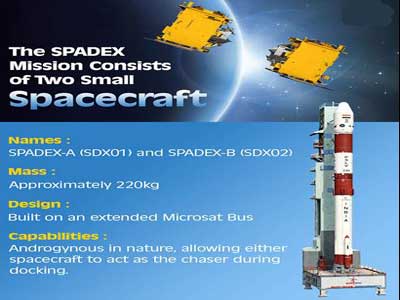
A historic achievement, the Space Docking Experiment, i.e. SpaDeX mission’s docking operation, was completed on 16th January, marking India’s entry into the elite group of nations capable of executing space docking operations.
With this success, India became the fourth country in the world to achieve this technological feat. ISRO started the mission on 30th December last year, successfully launching the SpaDeX spacecrfts using Polar Satellite Launch Vehicle-C60, from the Satish Dhawan Space Centre at Sriharikota. This groundbreaking mission aims to showcase India’s technological prowess in spacecraft rendezvous, docking, and undocking, a critical capability for future advancements such as satellite servicing, space station operations, and interplanetary exploration.
Read in Hindi: अंतरिक्ष अन्वेषण में एक नई क्रांति है ‘स्पैडेक्स मिशन’
The docking process was executed with exceptional precision. The spacecraft manoeuvred seamlessly from the 15-metre to 3-metre hold point, initiating docking with accuracy and leading to a successful spacecraft capture. After this, retraction was completed smoothly, followed by rigidisation for stability. Post-docking, the integrated control of the two satellites as a single object was successfully achieved, showcasing India's technological expertise. In the coming days, undocking operations and power transfer checks are scheduled to validate the system's performance.
SpaDeX is a cost-effective technology demonstrator mission designed to showcase in-space docking using two small spacecraft launched by the 62nd PSLV flight. This mission is pivotal for India's future space ambitions, including lunar missions, sample returns, and the development of the Bharatiya Antariksh Station.
The main goals of the SpaDeX mission are to develop and demonstrate technology for rendezvous and docking using two small spacecraft, showcase controllability in the docked condition, demonstrate the potential for extending the life of the target spacecraft, and test power transfer between docked spacecraft.
The mission demonstrates India’s growing self-reliance in cutting-edge space technologies and reaffirms ISRO’s commitment to advancing its capabilities to meet future challenges in the rapidly evolving field of space exploration.
The SpaDeX mission involves two small satellites, SDX01, which is the Chaser and SDX02, the Target, each weighing approximately 220 kilograms. These spacecraft are androgynous, i.e. either of the spacecraft can act as a chaser during docking. They are equipped with solar panels, lithium-ion batteries, and a robust power management system. The Attitude and Orbit Control System includes sensors such as star sensors, sun sensors, magnetometers and actuators like reaction wheels, magnetic torquers and thrusters.
The satellites will execute a series of complex manoeuvres to demonstrate the docking process in orbit. Post-docking, the two satellites will operate as a single spacecraft. Electrical power will be transferred from one satellite to the other to confirm the success of the docking. After successful docking and undocking, the spacecraft will separate and be used for application missions. During undocking, the spacecraft will separate to begin individual payload operations. These payloads will provide high-resolution images, natural resource monitoring, vegetation studies and on-orbit radiation environment measurements, which find numerous applications.
The SpaDeX mission represents a significant leap in India's space capabilities, positioning ISRO for more complex and ambitious space endeavours in the future.
Space docking is a critical prerequisite for upcoming space missions, such as lunar exploration and the operation of space stations. By successfully executing this mission, ISRO is laying the foundation for autonomous docking, a vital capability for future missions like Chandrayaan-4. Additionally, the SpaDeX mission will play a key role in supporting India's ambitious space goals, such as the Gaganyaan mission, sending an Indian astronaut to the Moon and setting up the Bharat Antariksh Space Station.
This technological breakthrough highlights India's progress in the space sector and opens up new opportunities for more complex missions, strengthening the nation's position as a key player in the global space community. SpaDeX is a testament to India’s strides in indigenous innovation, further solidifying its position on the global space map.
Related Items
An Indian traveller’s eye-opening lessons in the ‘Art of Living’
Are Indian borders just lines on a map!
How the 'Indian Solar Revolution' is transforming rural lives…