
 Brij Khandelwal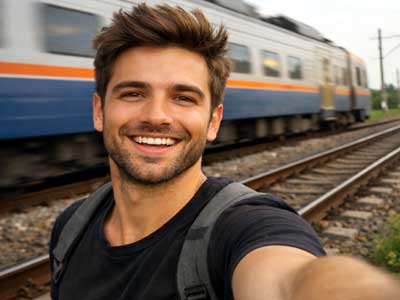
The whistle of a speeding train cuts through the evening air. Four boys stand smiling beside a railway track, their mobile phones held high. One stretches his arm a little further for the “perfect selfie”. They laugh. They pose. They want one dramatic picture for social media. A second later, the train crushes them. Their final photograph never gets uploaded.
This is not a scene from a film. It is the frightening reality of modern India, where the selfie craze has turned into a dangerous social epidemic. From railway tracks to riverbanks, from mountains to rooftops, from waterfalls to moving trains, young people are risking their lives for a few seconds of internet fame.
Read in Hindi: एक ‘तस्वीर’ के लिए युवा खेल रहे हैं मौत का खेल…
Near the Yamuna riverfront in Agra, every evening, around the giant idol of Laddu Gopal at the aarti site, crowds gather with mobile phones. Youngsters dance wildly for reels, strike strange poses, and shoot endless videos. If someone slips or falls nearby, many people first record the scene before offering help. Humanity pauses while the camera keeps rolling. The mobile phone has become both mirror and master.
India is now often described as the world’s “Selfie Republic”. Some critics even call it the “Killfie Culture” because selfies are increasingly becoming linked with death. The tragedies are shocking.
In 2015, three college students near Mathura stopped on a railway track while travelling to the Taj Mahal. They wanted a daring selfie with an approaching train behind them. The train did not stop. Their lives did.
In Delhi in 2017, two teenagers were struck by a train while taking selfies on the tracks. They believed they would jump away at the last moment. Death was quicker.
In Panipat in 2019, three young men tried escaping one train by jumping onto another track. Another train was already approaching from the opposite direction. All three died instantly.
In Kanpur, seven students drowned in the Ganga after one boy slipped while taking a selfie near a dam. His friends jumped in to rescue him. None returned alive.
Recently, in Siddharthnagar of Uttar Pradesh, five boys climbed a tall water tank to shoot a viral reel. While climbing down, the rusted ladder collapsed. One died. Several others were seriously injured.
Yet the madness continues. Why are young people gambling with death for likes and views? Psychologists say this is the dark side of the digital age. Social media algorithms reward danger, drama, and sensation. The more risky the video, the more attention it gets. Every notification, every “like”, and every share gives the brain a brief feeling of excitement and validation. Slowly, the habit turns into addiction.
Today’s generation is no longer simply living life. It is constantly performing life. Everybody wants to go viral. Everybody wants followers. Everybody dreams of becoming famous overnight. Friends push each other too. “Bro, this reel will explode online.” “Go a little closer”. “Stand near the train. It will look thrilling.” And that is how the disaster begins.
What makes the trend even more disturbing is the collapse of basic human sensitivity. Accident victims lie bleeding while crowds record videos. Floods, fires, funerals, hospital scenes, and even moments of death are now treated as social media content. Pain has become entertainment.
Public commentator Prof Paras Nath Chaudhary says this is not only India’s problem. In America, tourists have fallen from cliffs and mountains while taking selfies. Russia had to launch a “Safe Selfie Campaign” after several deaths involving guns, speeding vehicles, and dangerous stunts. Spain and Australia, too, have witnessed tourists dying near oceans and rocky cliffs while chasing dramatic photographs. But India’s crisis is far deeper.
Cheap internet, more than a billion mobile phones, a massive young population, and blind competition for online fame have created a deadly combination. Warning boards and “No Selfie Zones” near railway stations, waterfalls, and tourist spots have had little effect. Addiction cannot be cured by signboards alone. The deeper question is uncomfortable.
Have people become afraid of being invisible? Does every meal, journey, sorrow, celebration, and private moment now need public approval? For many, posting life has become more important than living it.
The mobile camera is the new mirror of society. People now judge themselves through the eyes of strangers online. And that is the greatest tragedy of this selfie age. While trying to capture life, people are losing life itself.
No selfie is worth a funeral procession. No viral reel deserves a human sacrifice.
Related Items
Western Media is ‘tough’ on India but ‘soft’ on China!
How ‘Social Media’ is replacing mainstream media...
Varun Dhawan goes off track the moment he tries to become ‘Govinda’