
 Dharmendra Kumar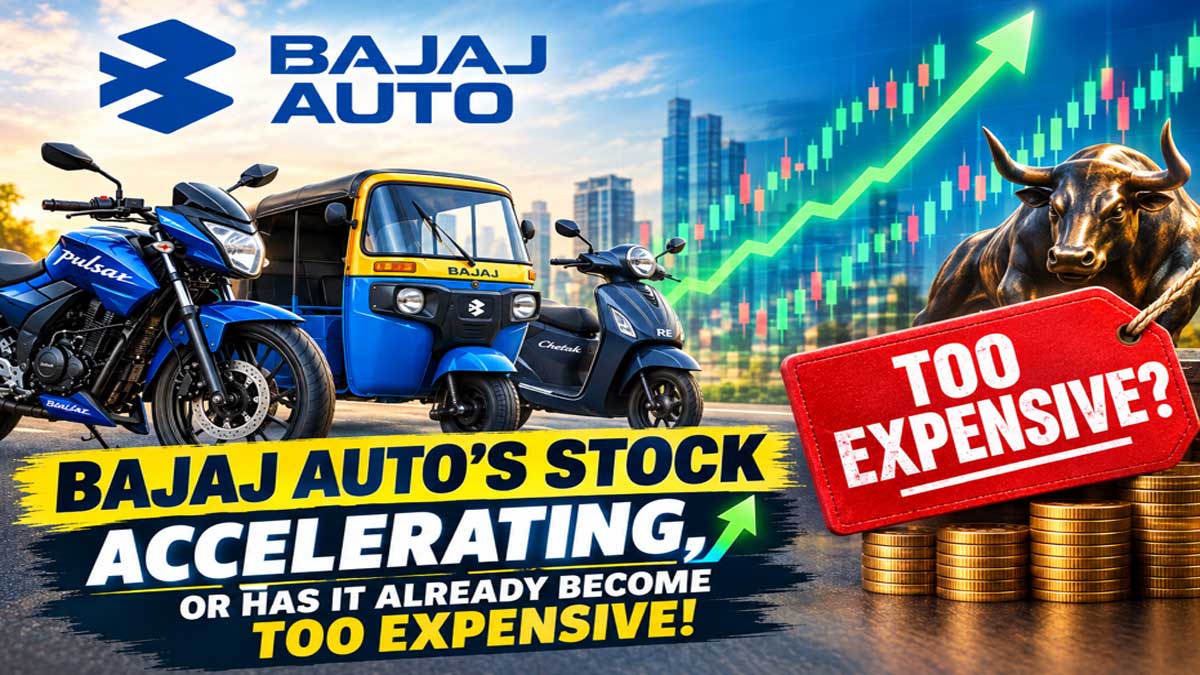
Looking at the prospects for Bajaj Auto’s stock over the next year, the overall picture appears positive, but it would be wrong to consider it a risk-free investment. The company’s recent results have been strong; its export business is showing momentum, its presence in the electric vehicle segment is expanding, and the launch of new motorcycles and brands is aimed at increasing its share of the domestic market.
On the other hand, rising raw material costs, geopolitical uncertainty in export markets, and questions surrounding the stock’s valuation suggest that investors should remain cautious.
Also read: तेज रफ्तार पर सवार, बेहद महंगा हो चुका है बजाज ऑटो का शेयर!
The company delivered a particularly strong performance in the first quarter of financial year 2026-27. According to the results announced in July, Bajaj Auto’s consolidated net profit rose 46 per cent year-on-year to around Rs.3,226 crore, while revenue increased 65 per cent to approximately Rs.21,689 crore, supported by record vehicle sales and export growth.
However, caution is necessary when making direct comparisons with previous figures because of changes in the company’s structure and the consolidation of Bajaj Auto International Holdings. Nevertheless, improvements in sales, exports and product mix at the operational level indicate the company’s underlying strength.
One of the strongest arguments in Bajaj Auto’s favour is its export business. Even if domestic demand in India’s two-wheeler industry slows for some time, markets such as Latin America and Africa could provide Bajaj Auto with a second engine of growth. In its July report, ICICI Securities said that export demand remained strong in both the two-wheeler and three-wheeler categories, while the company was betting on new products to outperform the industry in the segment above 125cc.
The company’s new product launch strategy could also prove important over the next year. Bajaj Auto plans to introduce several new products during the festive season, including new models and brands. If these products succeed with customers, the company could strengthen its position in the domestic motorcycle market, where competition remains intense.
The electric vehicle business represents another potential opportunity for investors. The expansion of the Chetak brand and growing demand for electric three-wheelers could provide the company with additional growth in the future. A better product mix, gains from foreign exchange, operating leverage and improving profitability in the electric vehicle business could help support margins going forward.
Brokerage opinions are currently encouraging, although analysts are not unanimous. In its report dated July 22, ICICI Securities maintained a Buy rating on Bajaj Auto with a target price of Rs.12,650. The brokerage believes that the first-quarter operating performance was better than expected and that margins of around 20.9 per cent remained stable despite rising raw material costs.
Motilal Oswal also upgraded its stance from 'Neutral' to 'Buy' in its July 21 report and set a target price of Rs.12,096. The brokerage cited strong earnings growth, healthy return ratios, good dividend payouts and the strength of the business as the basis for its positive outlook.
Emkay’s report also carries a 'Buy' rating with a target price of Rs.13,700. It considers strong revenue growth, higher vehicle sales and relatively stable EBITDA margins as positive factors. Geojit BNP Paribas had given the stock a 'Buy' rating with a target price of around Rs.11,735 in June. These estimates suggest that many analysts remain positive about Bajaj Auto’s long-term business direction, although the differences in target prices also indicate that there is no complete market consensus about the company’s prospects.
Interestingly, the picture was not quite as encouraging a few months ago. In May, Motilal Oswal had assigned a 'Neutral' rating to Bajaj Auto with a target price of Rs.9,965 and warned that domestic demand could slow while a sharp rise in raw material prices could put pressure on margins. Following the strong first-quarter performance, however, the same brokerage upgraded the stock to 'Buy'. This suggests that Bajaj Auto’s investment story remains highly dependent on rapidly changing sales and cost trends.
When it comes to potential gains, the company has several strong foundations. First, there is the recovery and growth of its export business. Second, new products in the premium motorcycle segment and the category above 125cc could strengthen its market position. Third, the company is expanding in the electric scooter and electric three-wheeler markets. Fourth, it benefits from strong brands and relatively healthy profitability. Fifth, a better product mix and potential foreign exchange gains could further support earnings. Motilal Oswal has also cited strong earnings growth and healthy return ratios as major reasons behind its 'Buy' recommendation.
However, ignoring the risks could prove costly for investors. The biggest risk is the increase in raw material prices. A sharp rise in the cost of metals and other inputs could force the company either to increase vehicle prices or accept pressure on its margins. Repeated price hikes in the domestic market could also affect demand. Several brokerage reports have identified commodity costs and domestic demand as significant risks.
Exports, while offering substantial opportunities, can also become a source of risk. Despite strong demand in Africa and Latin America, currency fluctuations, political instability, wars, trade barriers and local economic crises could affect sales. In May, Motilal Oswal also identified geopolitical uncertainty as a major concern, even while acknowledging the strength of the company’s export business.
Domestic competition will remain another challenge. Hero MotoCorp, TVS Motor and other companies are present in the motorcycle market with new products and aggressive strategies. Competition is also intensifying in the electric two-wheeler segment. Therefore, the success of Chetak and other new products will depend not merely on their launch, but also on pricing, technology, the service network and the overall customer experience.
Another important risk relates to valuation. A strong company and a good investment at every price are not necessarily the same thing. In January and May, several brokerages had maintained 'Neutral' views on the stock, considering it fairly valued or already substantially priced in. Following strong results in July, the outlook shifted towards 'Buy'. This change suggests that when a stock rises sharply, part of its future earnings potential may already be reflected in its price. Therefore, investing solely on the basis of brokerage target prices may not be prudent.
The likely scenario over the next year will depend largely on three factors, that are the pace of export growth, the success of new motorcycles in the domestic market, and the profitability of the electric vehicle business. If the company maintains double-digit export growth, its new products perform well, and margins remain around current levels, Bajaj Auto’s stock could continue to have room for further appreciation. Recent brokerage targets range broadly between Rs.11,700 and Rs.13,700.
Overall, Bajaj Auto could remain one of the relatively strong investment options in India’s automobile sector over the next year, but it should not be viewed as a story of straightforward or guaranteed gains. The company’s strong balance sheet, export capabilities, new products, expansion in electric vehicles and profitability work in its favour.
On the other hand, rising raw material costs, global uncertainty and valuation concerns remain significant risks. In such a situation, a phased investment strategy rather than a lump-sum purchase may help reduce risk. Investors who already hold the stock may find it more useful to closely monitor export growth, EBITDA margins, market share in the domestic 125cc-and-above segment, and Chetak sales in the coming quarters.
* Disclaimer: This article is intended for general information purposes only. Investments in securities and Mutual Funds are subject to market risks, and past performance is not a guarantee of future results. Any Stock, Mutual fund, trading calls or information is for informational purposes only and is not an offer to buy or sell securities or investment advice. It emphasises that all investment decisions are at the user's own risk and may result in the loss of capital. Users should not rely solely on this information but conduct their own independent research before making any investment decisions. Mediabharti and the author are not registered with the Securities and Exchange Board of India (SEBI) as authorised investment advisers or consultants. People associated with the Mediabharti family may have these equities in their personal portfolio. The views, reports, and recommendations shared are for informational and educational purposes only. They should not be construed as investment, legal, or tax advice. Users are advised to carefully consider their financial situation and consult before making any investment decisions. While due care is taken in preparing recommendations, we don't guarantee accuracy, completeness, or returns. Neither SEBI nor we shall be responsible for any losses incurred. Investors must exercise their own judgment and due diligence before acting on any advice. Decisions remain the sole responsibility of the user.
* With inputs from agencies and various financial reports.
Related Items
Bajaj Finance may not deliver spectacular short-term gains…
How Shekhawati’s Marwaris helped build India’s business empires…
RTI law or a new business of extortion…!