
 Brij Khandelwal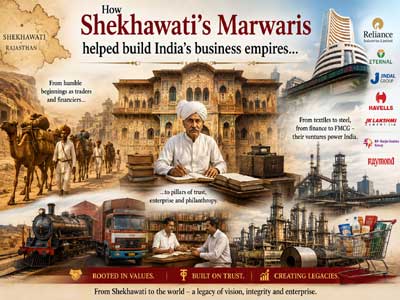
The camera rolls. A grand haveli fills the screen. A portly Seth sits on his gaddi, surrounded by ledgers and cash boxes. Nearby stands the familiar Munimji of old Hindi cinema, Kanhaiyalal, with a sly smile and a thick account book. Someone asks for help; he calculates the cost.
Someone seeks a loan; a fresh page of interest rates opens. For decades, Hindi films fixed the image of the Marwari businessman as shrewd, miserly and forever chasing profit. But that was never the whole truth.
Read in Hindi: शेखावाटी के मारवाड़ियों ने ऐसे खड़े किए भारत के कारोबारी साम्राज्य...
The stereotype may have entertained audiences, yet it reduced a dynamic community to comic or villainous caricature. Marwaris did not merely accumulate wealth. They built factories, created jobs, founded schools and hospitals, and helped lay the foundations of modern Indian industry.
Their story begins in Shekhawati; the dry, rugged belt of Rajasthan spanning Churu, Sikar and Jhunjhunu. Water was scarce, farming uncertain, and summers turned the earth into a furnace. The landscape taught what fertile plains rarely do: how to survive adversity and turn scarcity into enterprise.
From these dusty towns emerged some of India’s most influential business families—Birla, Bajaj, Dalmia, Goenka, Singhania, Poddar, Ruia, Piramal and many others. Over generations, they shaped the country’s industrial, commercial and financial landscape.
Yet Shekhawati’s contribution was never only commercial. Jhunjhunu is also called Shaheedon ki Nagri, the City of Martyrs. Its villages have sent successive generations of young men into the armed forces. On one side stood the soldier defending the nation’s borders; on the other, the entrepreneur strengthening its economic base. Both demanded courage, discipline and endurance.
Look closely at the map and the business history becomes personal. Pilani is linked with the Birlas: Shiv Narain Birla left for Bombay in the nineteenth century, and his descendants built one of India’s largest industrial houses. Chirawa is associated with the Dalmias. Nawalgarh nurtured the Goenkas, Poddars, Kedias, Seksarias and Morarkas. Ramgarh is tied to the Ruias and Poddars; Bagar to the Piramals.
Near Sikar, Jamnalal Bajaj was born at Kashi Ka Bas and later became both a major industrialist and a prominent supporter of the freedom movement. Sadulpur in Churu produced Lakshmi Mittal, who built a global steel empire. The Singhanias, Sarafs, Modis and others followed similar paths.
Most of their fortunes were not made in Shekhawati itself. The desert supplied the roots; Kolkata, Bombay and other commercial centres provided the stage.
The Marwari achievement rested less on mere thrift than on trust, discipline and adaptability. Economic historian Thomas A Timberg identified several decisive features.
Dense community networks formed the first advantage. A young man leaving Shekhawati rarely travelled alone in the economic sense. Relatives introduced him to traders, offered lodging, extended credit and provided apprenticeships. Success of one firm created openings for others. What began as village ties gradually became a national commercial network.
Equally important was sakh or reputation. Cash mattered, but a man’s word often mattered more. A merchant could lose money and recover; loss of sakh could close doors permanently.
Timberg also highlighted rigorous financial discipline. The traditional bahi-khata represented more than bookkeeping; it embodied a culture of daily scrutiny and constant awareness of profit, loss and obligation. This discipline coexisted with a readiness for calculated risk, especially in commodity speculation.
Above all, the community proved adaptable. Marwaris served as financiers under the Mughals, became brokers and intermediaries under British rule, and later moved decisively into manufacturing. Traditional joint-family structures and systems of trust did not obstruct modernisation; they often facilitated the pooling of capital, the spreading of risk and the maintenance of long-term relationships.
Geography reinforced these strengths. In the eighteenth century, local rulers reduced transit duties and encouraged trade. Caravans carrying cotton, wool and spices passed through the region. The arrival of railways in the nineteenth century transformed commercial geography. Kolkata and Bombay became magnets. Shekhawati’s traders followed, first as merchants and financiers, later as owners of mills, factories and large industrial houses.
By the twentieth century they were major players in textiles, jute, steel, cement, automobiles and finance. The desert had taught mobility; the marketplace taught scale.
Scarcity remained a stern teacher. Uncertain rainfall, precious water and limited local opportunities pushed people outward. The same qualities of discipline and endurance that sustained the military tradition also served the entrepreneur.
Religion and community institutions strengthened social bonds. Shrines such as Rani Sati, Khatu Shyamji and Salasar Balaji remain important centres of faith. The painted havelis of Mandawa, Nawalgarh, Fatehpur and Ramgarh tell another story: families who made their fortunes far from home but returned to adorn the desert they had left.
Shekhawati’s history cannot be reduced to caste or commerce alone. Rajput communities developed strong military and landholding traditions, while Agarwals, Maheshwaris, Oswals and other trading groups built powerful commercial networks. Together they contributed two forms of national strength; one that defended the country, the other that helped build its economic muscle.
An old saying captures the spirit: wherever a bullock cart can reach, a Marwari will eventually find his way. Nature offered this region little. Its people created opportunity through trust, reputation, discipline, mobility and persistence.
The desert did not produce billionaires or soldiers by magic. It created conditions in which resilience became habit, and habit, in time, became history.
Related Items
An Indian traveller’s eye-opening lessons in the ‘Art of Living’
Are Indian borders just lines on a map!
How the 'Indian Solar Revolution' is transforming rural lives…