
 Brij Khandelwal
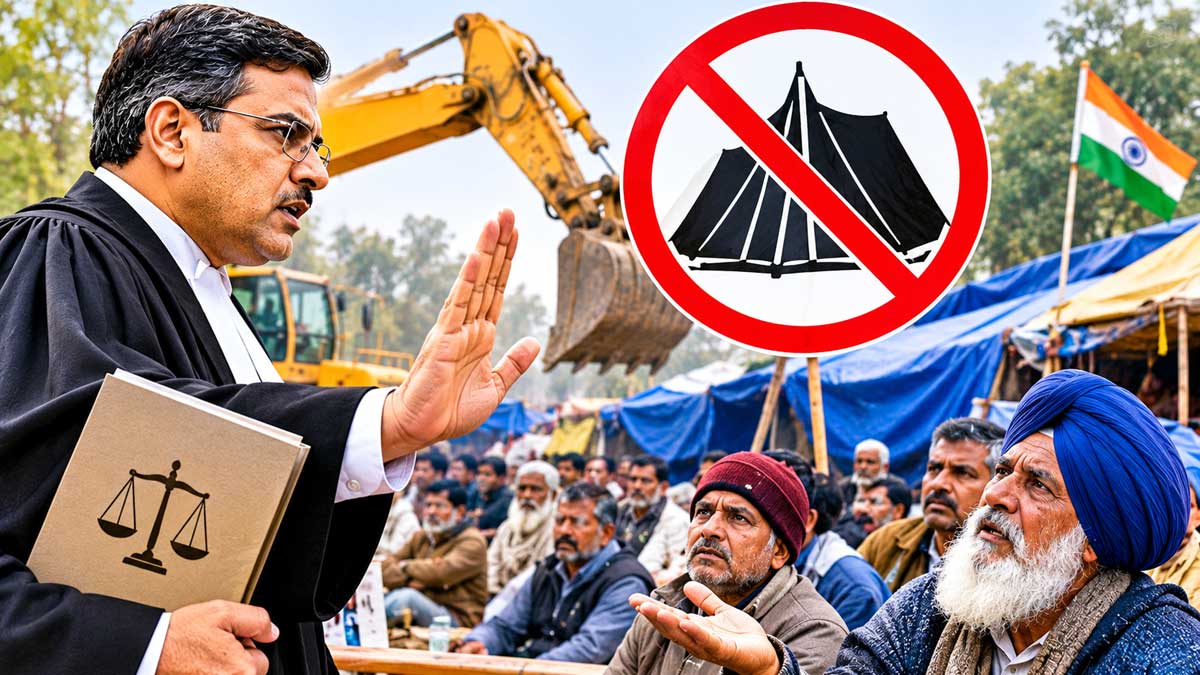
The Supreme Court of India recently made significant observations on the constitutional limits of prolonged protests at designated public spaces, emphasising that no individual, organisation or political group can claim an indefinite right to occupy a protest site.
The Chief Justice made it clear that even designated protest sites cannot be occupied indefinitely. Observing that everyone has an equal right to protest, he questioned where farmers, journalists, trade unions and other groups would go if one organisation occupied a designated venue permanently.
The Court stressed that protest permissions must specify a definite period. Public spaces meant for demonstrations must remain accessible to different organisations and sections of society.
The Bench also highlighted an important constitutional dilemma: the right to peaceful protest and the right to carry on business and earn a livelihood are both legitimate rights. Protecting one cannot mean completely disregarding the other.
The Court suggested that designated public spaces and suitable arrangements must be identified so that demonstrations can take place without unnecessarily disrupting the daily lives and economic activities of others.
These observations are particularly important because they recognise that the right to protest does not automatically include the right to occupy public space without time limits.
When markets suffer, the damage travels down the entire economic chain. Employees lose wages, vendors lose customers, transporters lose business, and small entrepreneurs struggle to survive.
The issue, therefore, is not simply a dispute between protesters and traders. It concerns the rights of thousands of ordinary citizens who depend on uninterrupted economic activity.
Importantly, the Court has not imposed a blanket ban on protests or delivered a final verdict on the dispute. Its observations during the hearing underline the need for reasonable restrictions, clearly defined permissions and fair access to designated protest venues.
The wider proceedings also involve allegations of police excesses, unlawful detentions, surveillance and restrictions imposed during the demonstrations. These issues underline that democratic rights must be protected on all sides.
The Supreme Court's observations carry significance beyond Delhi. India is a democracy where peaceful protest remains an essential constitutional freedom. Citizens must have the opportunity to question governments, oppose policies and demand justice.
But public spaces belong to everyone. A designated protest ground cannot become the permanent property of one political party, organisation or pressure group.
Equally, governments and police authorities cannot use the inconvenience caused by demonstrations as an excuse to suppress legitimate dissent.
The challenge is to establish a fair system. Protest venues should have transparent permission procedures, reasonable time limits and equitable access. Authorities must also ensure that demonstrations do not unnecessarily block markets, essential services, public transport and everyday movement.
The larger message emerging from the hearing is that democracy requires both freedom and responsibility.
The right to protest is essential to democracy. The right to trade and earn a livelihood is equally important. Neither should become a casualty of the other.
The Supreme Court has now placed this important constitutional question under judicial examination. The eventual outcome could help shape a more balanced framework for peaceful demonstrations and the use of public spaces across the country.
Related Items
Rise of India’s Electric Vehicles Ecosystem…
‘Green Crusaders’ or ‘Growth Killers’ of India!
Should India trust Musk with its digital lifeline!