
 Brij Khandelwal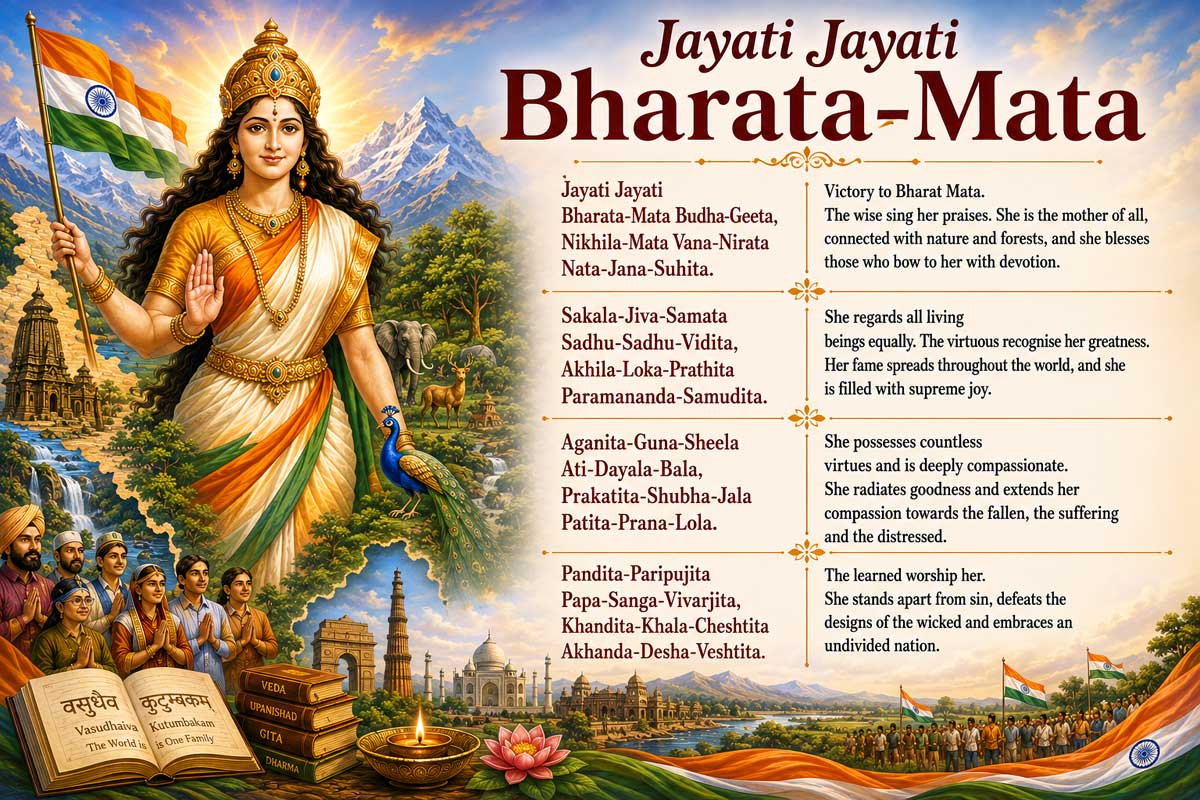
“Jayati Jayati Bharata-Mata!” What a simple, sweet and deeply Indian invocation. Yet, after Independence, when the young nation was searching for symbols of its new identity, why did this beautiful Sanskrit song never make it to the national stage?
Mayuram Viswanatha Sastri (1893–1958) composed the song; a distinguished Carnatic musician from the Mayiladuthurai region of Tamil Nadu, formerly known as Mayuram.
Read in Hindi: संस्कृत का वह गीत जो नहीं बन सका राष्ट्रगान...!
Around the time of Independence, Sastri compiled Bharata Bhajan, a collection of 18 Sanskrit songs praising Bharat Mata and Mahatma Gandhi. “Jayati Jayati Bharata-Mata” was one of them. Its melody is set in Raga Khamas.
The words are simple, but the message is expansive. Bharat Mata is portrayed as the mother of all. She makes no distinction based on caste, language or region. She protects the virtuous and embraces even those who have fallen. The idea of ‘unity in diversity’ runs strongly through the song. So, Why Did It Not Become the National Anthem?
After Independence, India debated its national symbols. Eventually, “Jana Gana Mana” became the National Anthem, while “Vande Mataram” became the National Song. Both had a long history behind them.
“Jana Gana Mana” had been sung at Congress sessions since 1911 and had acquired recognition across the country. “Vande Mataram” had become one of the most powerful emotional slogans of the freedom movement.
“Jayati Jayati Bharata-Mata” was in a different league. It was relatively new, with Bharata Bhajan published only in 1948. Its circulation was largely confined to South India and the Carnatic music tradition. It had not acquired the same presence in Delhi's political circles or in the wider popular imagination.
Choosing a national anthem was never simply a music competition. History, association with the freedom movement, public acceptance, familiarity and suitability for official ceremonies all mattered.
There was another complication. Sanskrit is India's ancient pan-Indian language, deeply connected with temples, philosophy, literature and classical music. But language was a sensitive issue in the early years of Independence.
Hindi, Urdu, English and the many regional languages had to find space in a newly independent India. The choice of national symbols therefore involved cultural and political sensitivities far beyond the beauty of a particular composition.
Public commentator Prof Paras Nath Chaudhary points out, “There is no historical evidence that this particular song was deliberately pushed aside because of political fear. Blaming Nehru or the Congress leadership alone would be an oversimplification of history.”
The fascinating part is that the song did not disappear. The Carnatic music tradition of South India kept it alive. The legendary vocalist GN Balasubramaniam performed it. Madurai Mani Iyer and other musicians helped keep it in circulation. Semmangudi Srinivasa Iyer reportedly sang it on All India Radio around the first Independence Day.
Even today, the song can occasionally be heard in South India during Independence Day and Republic Day celebrations. Social activist Padmini Iyer says, “Its national recognition remains limited. That is the irony. What echoes in Delhi can quickly become a song of the entire nation. What echoes in Chennai, Mysuru, Thanjavur or Madurai is sometimes labelled merely ‘regional’.”
Mahi Heather of Mysuru puts the matter differently, “The praise of Bharat Mata came through Sanskrit. The melody came from South India. But the emotion belonged to the whole country. There is no need to replace the National Anthem or National Song. But India's cultural heritage is not a government file containing only two or three names. The more songs India has for Bharat Mata, the richer India's cultural voice becomes.”
That perhaps is the real point. This is not an argument to replace “Jana Gana Mana” or “Vande Mataram.” It is an invitation to rediscover another part of India's musical heritage.
The song does not present Bharat Mata as the mother of one particular religion, caste or region. It presents her as the mother of all. Equality. Compassion. Respect for nature. Virtue. National unity. These themes give the song a relevance that goes beyond the circumstances in which it was written.
Perhaps, after all these decades, “Jayati Jayati Bharata-Mata” deserves another hearing. Not as a rival to India's national anthem. Not as a political weapon. But as a forgotten musical voice from the country's rich and remarkably diverse cultural past.
Related Items
Western Media is ‘tough’ on India but ‘soft’ on China!
An Indian traveller’s eye-opening lessons in the ‘Art of Living’
‘In Haseen...’ captures melody of love amid beautiful valleys