
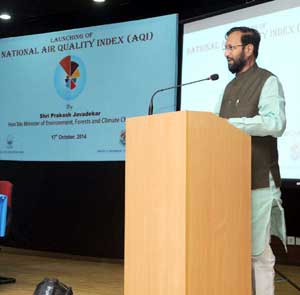
The formulation of the index was a continuation of the initiatives under Swachh Bharat Mission envisioned by the Prime Minister Narendra Modi.
Elaborating further, the Minister stated that the index constituted part of the Government’s mission to introduce the culture of cleanliness. Institutional and infrastructural measures were being undertaken in order to ensure that the mandate of cleanliness was fulfilled across the country. As a part of the process, he mentioned that clean air would be a part of Peoples’ campaignto take up the issue in a mission mode. In order to widen the ambit of the culture of cleanliness, the Ministry proposed to discuss the issues concerned regarding quality of air with the Ministry of Human Resource Development in order to include this issue as part of the sensitizationprogramme in the course curriculum.
Under the new measurement process, Javadekar stated that an effort had been made to include a comprehensive set of parameters. While the earlier measuring index was limited to three indicators, the current measurement index had been made quite comprehensive by the addition of five additional parameters. The initiatives undertaken by the Ministry recently aimed at balancing environment and conservation and development.
Air pollution has been a matter of environmental and health concerns,particularly in urban areas. Central Pollution Control Board along with State Pollution Control Boards has been operating National Air Monitoring Program (NAMP) covering 240 cities of the country. In addition, continuous monitoring systems that provide data on near real-time basis are also installed in a few cities.
Traditionally, air quality status has been reported through voluminous data. Thus, it was important that information on air quality is put up in public domain in simple linguistic terms that is easily understood by a common person. Air Quality Index (AQI) is one such tool for effective dissemination of air quality information to people. An Expert Group comprising medical professionals, air quality experts, academia, advocacy groups, and SPCBs was constitutedand a technical study was awarded to IIT Kanpur. IIT Kanpur and the Expert Group recommended an AQI scheme.
There are six AQI categories, namely Good, Satisfactory, Moderately polluted, Poor, Very Poor, and Severe. The proposed AQI will consider eight pollutants (PM10, PM2.5, NO2, SO2, CO, O3, NH3, and Pb) for which short-term (up to 24-hourly averaging period) National Ambient Air Quality Standards are prescribed.
Based on the measured ambient concentrations, corresponding standards and likely health impact, a sub-index is calculated for each of these pollutants. The worst sub-index reflects overall AQI. Associated likely health impacts for different AQI categories and pollutants have been also been suggested, with primary inputs from the medical expert members of the group.
Related Items
Song that echoed across South India, but never became ‘National Song’
How a 'Master Communicator' turns ideas into National Missions…
Supreme Court calls rivers a national asset; Orders action to save rivers