
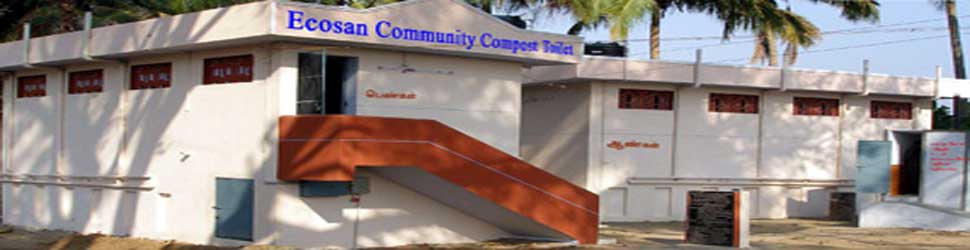
About a decade ago, the Musiri facility shot into fame as a public toilet where users are paid a charge, instead of users paying to use a facility, as happens in some other places. However, that was only to encourage people living in neighbouring localities to try out the new-concept toilets. For these toilets are not linked to a sewage system, neither does it need soak pits or leach pits underneath.
The excreta and urine from this public toilet goes back to the agricultural fields, and helps grow delicious banana and other crops. All this happens through an entirely safe method. The public toilet of Musiri provides sanitation and dignity to people who were forced to defecate in the open earlier. It also contributes to food security, underlining the immense role sanitation programmes can play in improving not just public health, but also public wealth.
All the 14 toilets here are designed to separate urine from faeces. When a user sits on these commodes, the urine slants off a slope in front, going into a little hole. From there, it goes into a storage tank, which is taken to the fields. Urine is largely free of pathogens, and is a rich source of nitrogen and phosphorus. (India is the largest importer of phosphate in the world, and this is a small way to reduce the import bill.)
The faeces fall down into an enclosed chamber, where they stay dry. After defecation, the user steps back to wash herself or himself over a small basin. Water from this is guided to a small charcoal filter, which makes it safe to be discharged into the ground. The users are encouraged to throw down some mud on the faces to further dry it out. There is not much bad smell; one of the reasons for foul odour from toilets is the mixing of urine and faces. If you can separate the two, the smell is not unbearable, the users of the toilet point out.
What happens when the pit underneath fills up? Well, each toilet enclosure has two commodes. When the tank underneath one fills up with faeces, it is closed and the second commode is opened. This allows the faeces to degrade naturally. By the time the other receptacle fills up, the faeces in the first one decompose into mud that is safe to touch. It has no pathogens that naturally occupy our faces. So, by the time one faeces pit fills up, the other gets emptied. This ensures that each toilet enclosure remains functional right through the year. One of the two pits always has faces decomposing naturally and safely.
This mud is rich in carbon, which is applied to farmlands. (The soil of hot regions loses carbon rapidly because of the heat of direct sunlight. It is, hence, important to continually add carbon to the soil to keep it productive, a practice farmers have followed in India since millennia.) This is in sync with the natural cycle of soil nutrients, of which humans are merely one part. In nature, most nutrients of the soil go back into the soil, creating new plants, new life. Water-borne sewage takes soil nutrients – that we consume as food, and evacuate as urine and faces – out of the ground and puts it in water. This impoverishes the soil and contaminates the water.
The Musiri toilet follows the principle of ‘Closing The Loop’, ensuring soil nutrients are returned safely to the soil and water in not contaminated. The public toilet of Musiri does not require water-borne sewerage or underground soak/leach pits. In fact, the story of this public toilet is deeply linked to groundwater.
Situated so close to the Cauvery river, right on the banks of one of its irrigation canals, this part of Musiri has a very high groundwater table. When toilets were being built here under a sanitation drive, underground soak/leach pits turned very inconvenient. Groundwater seeped into them, making the excreta float up. This is when SCOPE, a social organisation in Tiruchirapalli, learned of ‘ecological sanitation’ through some government officials. Since then, SCOPE has built more than 2,000 toilets based on Ecological Sanitation, or EcoSan for short.
EcoSan is based on the work of Swedish architect and town planner Uno Winblad. He developed this in the 1970s, while working in water-scarce Ethiopia. Several parts of Asia, however, have been building toilets based on this concept since ancient times. In India, for example, the traditional toilet in Ladakh – called Chhagra – is designed to collect excreta, which is applied to the soil. In the cold, trans-Himalayan desert of Ladakh, traditional wisdom forbids the wasting of any resources, especially soil nutrients.
EcoSan works in dry areas as well as in flooded areas. It shows why we must learn from those who face serious problems, and find ways to overcome them.
(Author is a journalist and a research fellow at the Gandhi Peace Foundation in New Delhi. The views expressed in the Article are his personal.)
Related Items
Delhi To Get 480 Pubic Toilet Seats At 80 Locations In Next 3 Months