Latest News: Union Budget 2026–27 Highlights: New Income Tax Act, 2025 to be effective from April 2026; simplified tax rules and forms will be notified soon * Safe harbor limit for IT services raised from ₹300 crore to ₹2000 crore * Foreign cloud service providers granted a tax holiday until 2047 * All non-residents paying tax on an estimated basis exempted from Minimum Alternate Tax * Securities Transaction Tax on futures trading increased from 0.02% to 0.05% * Customs duty exemption extended for capital goods used in lithium-ion battery cell manufacturing * Customs duty exemption granted for capital goods required in processing critical minerals * Tariff rate on goods imported for personal use reduced from 20% to 10% * Basic customs duty exemption extended to 17 medicines and drugs * BioPharma Shakti program with an outlay of ₹10,000 crore to build an ecosystem for domestic production of biologics and biosimilars * Proposal for a ₹10,000 crore SME Development Fund to support MSMEs * Public capital expenditure increased from ₹11.2 lakh crore to ₹12.2 lakh crore in FY 2026–27 * Seven high-speed rail corridors to be developed as Growth Transport Links for sustainable passenger systems * Indian Institute of Design Technology, Mumbai to set up AVGC content creation labs in 15,000 high schools and 500 colleges * A girls’ hostel to be built in every district to address challenges faced by female students in higher education and STEM institutions * In partnership with IIMs, a 12-week hybrid training program will upgrade skills of 10,000 guides across 20 tourist destinations * ICAR packages on agricultural portals and practices to be integrated with AI systems as a multilingual AI tool * Tax on foreign travel packages reduced from current five per cent and 20% to two per cent * Customs bonded warehouse framework revamped into an operator-centric system with self-declaration, electronic monitoring, and risk-based accounting * Indian share markets will be open for trading on Sunday, February 01, as the Union Budget is being presented on that day * Key Highlights of Economic Survey 2025–26: GDP & GVA Growth Estimates for FY 2026: First advance estimates at 7.4% and 7.3% respectively * India’s Core Growth Projection: Around 7%, with real GDP growth for FY 2027 expected between 6.8% and 7.2% * Central Government Revenue: Rose to 11.6% of GDP in FY 2025 * Non-Performing Assets: Declined to a multi-decade low of 2.2% * PMJDY Accounts: Over 552 million bank accounts opened by March 2025; 366 million in rural and semi-urban areas * Investor Base: Surpassed 120 million by September 2025, with women comprising ~25% * Global Trade Share: India’s export share doubled from 1% in 2005 to 1.8% in 2024 * Services Export: Reached an all-time high of $387.6 billion in FY 2025, up 13.6% * Global Deposits: India became the largest recipient in FY 2025 with $135.4 billion * Foreign Exchange Reserves: Hit $701.4 billion on January 16, 2026—covering 11 months of imports and 94% of external debt * Inflation: Averaged 1.7% from April to December 2025 * Foodgrain Production: Reached 357.73 million metric tons in 2024–25, up 25.43 MMT from the previous year * PM-Kisan Scheme: Over ₹4.09 lakh crore disbursed to eligible farmers since inception * Rural Employment Alignment: “Viksit Bharat – Jee Ram Ji” initiative launched to replace MGNREGA in the vision for a developed India by 2047 * Manufacturing Growth: 7.72% in Q1 and 9.13% in Q2 of FY 2026 * PLI Scheme Impact: ₹2 lakh crore in actual investment across 14 sectors; production and sales exceeded ₹18.7 lakh crore; over 1.26 million jobs created by September 2025 * Semiconductor Mission: Domestic capacity boosted with ₹1.6 lakh crore invested across 10 projects * Railway High-Speed Corridor: Expanded from 550 km in FY 2014 to 5,364 km; 3,500 km added in FY 2026 * Civil Aviation: India became the third-largest domestic air travel market; airports increased from 74 in 2014 to 164 in 2025 * DISCOMs Turnaround: Recorded first-ever positive PAT of ₹20,701 crore in FY 2025 * Renewable Energy: India ranked third globally in total renewable and installed solar capacity * Satellite Docking: India became the fourth country to achieve autonomous satellite docking capability * School Enrollment Ratios: Primary – 90.9%, Upper Primary – 90.3%, Secondary – 78.7% * Higher Education Expansion: India now has 23 IITs, 21 IIMs, and 20 AIIMS; international IIT campuses established in Zanzibar and Abu Dhabi * Maternal & Infant Mortality: Declined since 1990, now below global average

Handloom: An Integral Part Of Rich Culture, Heritage And Tradition Of India


Apart from providing one of the basic needs of human beings, along with a sizable contribution to GDP and export, this Industry provides direct and indirect employment to lakhs of people in the rural and urban areas. Handloom is one of the largest employment providers after agriculture in India. This sector provides employment to 43.31 lakh persons engaged on about 23.77 lakh handlooms, of which 10% are from scheduled castes, 18%belong to the scheduled tribes, and 45% belong to other backward classes. Production in the handloom sector recorded a figure of 7116 million sq. meters in the year 2013-14. During 2014-15, production in the handloom sector is reported to be 3547 million sq. Meters (April-September-2014)

This sector contributes nearby 15% of the cloth production in the country and also contributes to the export earning of the country. Ninety five percent of the world’s hand woven fabric comes from India. It has been sustained by transferring skills from one generation to another. The strength of the sector lies in its uniqueness, flexibility of production, openness to innovations, adaptability to the suppliers’ requirement and the wealth of its tradition.

However, handloom industry needs to reorient itself for meeting the challenges being posed by rapid economic, social and technological changes. Efforts are required to produce defect free high quality handloom fabrics according to contemporary consumer preferences, and also to ensure reasonable wages so that younger generation opt for this occupation. With a view to promote this industry on a sustainable basis, it is deemed necessary to produce quality fabrics with new design for winning the trust and confidence of the consumers.

“India Handloom Brand” is an endorsement to quality of the handloom products in terms of raw material, processing, embellishments, weaving design and other parameters besides social and environmental compliances for earning the trust of the consumers. Prime Minister Narendra Modi launched the India Handloom Brand at Chennai recently as part of the First ever National Handloom Day celebrations. It seeks to ensure this by giving particular attention to the following:

•         Production of high quality, defect free, hand-woven, authentic “niche product”

•         Zero defect.

•         Authentic traditional design.

•         Zero impact on environment.

•         Social compliance.

Advantages

* Customer will be assured of the quality of the product as per specification

* Bulk buyers and exporters will be able to source quality fabrics as per his/her design produced in time and establish  a distinct market positioning for authentic   hand-woven fabrics of India.

* Weaver will be able to get bulk orders and higher wages by interacting directly with the market.

* Weaver entrepreneur (younger generation) will take up traditional profession of production of quality handloom fabrics in bulk and marketing within and outside the country.

* It will empower women and disadvantaged segments.

Products identified for Branding

1) SARI: Cotton- Jamddani, Tangail, Shantipiri, Dhaniakhali, Bichitrapuri, Bomkai, Kotpad, Pochampalli, Venkatgiri, Uppada, Siddipet, Narayanpet, Mangalagiri, Chetinad, Balaramapuram, Kasergod, Kuthampally, Chendmangalam Dhoti

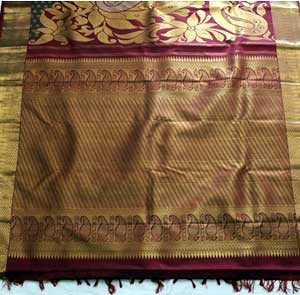
Silk: Baluchari, Mugasilk, Sulkuch silk, Khandua, Berhampuri, Bomkai Silk, Benares        Brocade, Tanchoi, Benarasi, Butidar, Jangla, Benarasi Cutwork, Pochampally, Dharmavaram, Kanchipuram, ArniSilk, Molkalmuru, Paithani, Patola, Champasilk, Ashawali Silk, Salem Silk (Dhoti), Uppada, Jamdani

Cotton Silk Sari: Chanderi, Maheswari, Kota Doria, IIKal, Gadwal, Covai Kora Cotton    

2) DRESS MATERIAL: Cotton- Odisha Ikat, Pochampalli Ikat

Silk: Tanchoi, Benarasi, Cutwork, Odisha Ikat, Pochampally Ikat, Tassar Fabric, Muga Fabric, Mekhala/ Chadar

3) BED SHEET: Odisha Ikat, Pochampally Ikat

4) SCARF / SHAWL / CHADAR: Kani Shawl, Kinnori Shawl, Kulu Shawl, Tangaliya Shawl, Kutch Shawl, Wangkhei  Phee.

(Author is the Deputy Director in PIB Chennai)