
 Dharmendra Kumar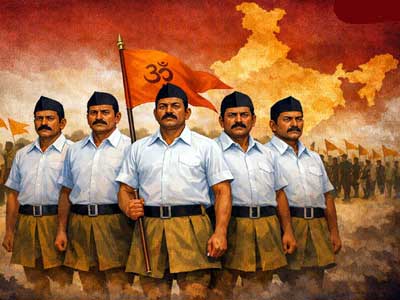
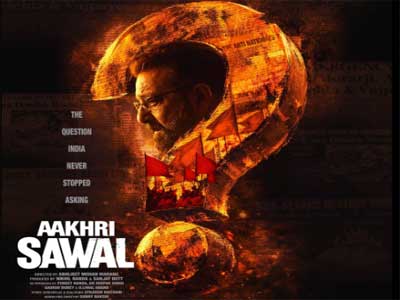
Why did the Rashtriya Swayamsevak Sangh allegedly kill Mahatma Gandhi, and why has the organisation faced bans and seen those bans lifted as many times? Why did the RSS write letters to Indira Gandhi during the Emergency? Why did the RSS demolish the Babri Masjid? What evidence exists of the social-service activities undertaken by the RSS? And why, allegedly, did the RSS have its own volunteers killed in Kerala and West Bengal to portray itself as a ‘victim’? The film 'Aakhri Sawaal' attempts to answer these five questions that are frequently asked about the RSS.
The RSS has perhaps been one of the most influential as well as controversial socio-cultural organisations in Indian politics and society. One section associates the organisation with nationalism, discipline, service and organisational strength, while another raises questions about communalism, political influence, its attitude towards minorities and violent politics. That is precisely why the RSS cannot be understood solely through the perspective of either its supporters or its opponents. The film attempts to bring this complexity to the big screen. Its story presents a debate and ideological confrontation around questions concerning the RSS.
Read in Hindi: ‘आखिरी’ नहीं, राष्ट्रीय स्वयंसेवक संघ से पूरे ‘पांच सवाल’...
What is most interesting about the film is that rather than simply praising or criticising the RSS, it raises questions that require viewers to return to history in search of answers. There is, however, an important caveat. The conclusions presented in the film should not automatically be treated as historical facts; they should be viewed as an interpretation. Many of these questions remain subjects of continuing political and historical debate.
The oldest and perhaps most serious question is whether the RSS was responsible for Mahatma Gandhi's assassination. Mahatma Gandhi was assassinated by Nathuram Godse on 30 January 1948. Soon after the assassination, the government banned the RSS. The organisation's then Sarsanghchalak, MS Golwalkar, was also arrested, and the government declared the RSS a ‘banned organisation’. According to the RSS's own historical record, the ban was imposed on 4 February 1948 and a large number of volunteers were arrested.
Godse was convicted in the Gandhi assassination trial and sentenced to death. Later, the Kapur Commission, which investigated the conspiracy behind Gandhi's assassination, did not hold the RSS responsible as an organisation. The Commission's report is available in the Parliament's digital archives as official material of the Ministry of Home Affairs, Government of India.
In 2018, during proceedings before the Supreme Court on a petition seeking a fresh investigation into Gandhi's assassination, the amicus curiae appointed by the court also told the bench that there was no sufficient evidence of another person or a mysterious second shooter besides Nathuram Godse.
Therefore, historically speaking, it would be more accurate to say that there is no conclusive judicial evidence establishing the RSS as an organisation responsible for Gandhi's assassination. At the same time, Godse's earlier association with the RSS, the ideological relationships among Hindu nationalist organisations of that period, and the hostility towards Gandhi within sections of radical Hindu politics remain subjects of longstanding historical debate.
In other words, the question does not disappear; its nature changes. The question is no longer simply, “Did the RSS shoot Gandhi?” It becomes: what was the actual ideological and organisational role of the RSS and individuals associated with it within the Hindu nationalist politics and anti-Gandhi atmosphere of the 1940s?
After Gandhi's assassination, the political atmosphere in the country was extremely tense. While imposing the ban on the RSS, the government accused it of promoting activities and an environment that it considered a threat to public order and national security.
The RSS's own history acknowledges that the organisation was banned after Gandhi's assassination, but it does not regard the ban as proof of an organisational role in the assassination. According to the RSS, following negotiations and a satyagraha, the ban was lifted on 12 July 1949. It was also during this period that the organisation's written constitution emerged.
An important aspect of this episode is that, in the process of having the ban lifted, the RSS moved towards giving its organisational structure a clearer and more formal shape. Thus, the period of 1948–49 was not merely a political crisis following Gandhi's assassination; it was also a decisive period in defining the relationship between the RSS and the newly independent Indian state.
Another perennial question concerns why the RSS wrote letters to Indira Gandhi during the Emergency. On 25 June 1975, the Indira Gandhi government imposed the Emergency in India. The arrest of political opponents, censorship of the press and restrictions on civil liberties made it one of the most controversial periods in the history of Indian democracy. The RSS was also banned during this period, and many of its workers were arrested.
During this period, Madhukar Dattatraya Deoras, popularly known as Balasaheb Deoras and the successor to MS Golwalkar, was in prison. He wrote letters to Indira Gandhi.
According to available records, in a letter written in August 1975, Deoras praised Indira Gandhi's Independence Day speech and appealed for the ban on the RSS to be lifted, while rejecting the allegations made against the organisation. In another letter, written in November 1975, he objected to linking the RSS with the JP movement and the Gujarat and Bihar movements. This is where a contradiction in the history of the RSS becomes apparent.
On the one hand, thousands of RSS workers participated in underground activities and democratic resistance against the Emergency. On the other hand, the RSS leadership maintained communication with the government and corresponded with it seeking the lifting of the ban.
Therefore, describing these letters simply as “surrender before Indira Gandhi” or merely as a “strategic dialogue” would be an oversimplification of history.
For political organisations facing repression, adopting two parallel strategies is not unusual: resistance on one hand and negotiations on the other. The same dual approach can be seen in the case of the RSS.
The role of the RSS in the demolition of the Babri Masjid has also been a highly contentious issue. On 6 December 1992, the Babri Masjid structure in Ayodhya was demolished. The event became one of the biggest sources of political and social division in independent India.
There have been two sharply contrasting claims about the RSS's role. For a long time, the RSS maintained that the demolition was not the result of a pre-planned organisational strategy, but rather the consequence of the anger of the people gathered in Ayodhya and events spiralling out of control.
On the other hand, the Liberhan Commission, which investigated the demolition, raised serious questions about the role of the RSS and the broader Sangh Parivar. The Commission viewed the Ayodhya movement as a long-term political project of the Sangh Parivar and considered its organisational capabilities important in the background to the demolition.
Therefore, saying that “the RSS alone demolished the Babri Masjid” would also be an oversimplification, while saying that “the RSS had nothing to do with it” would not sit comfortably with the historical record.
The actual picture is considerably more complicated. There were ideological and organisational links between the RSS, Vishwa Hindu Parishad, Bajrang Dal, BJP and other organisations. Each had different roles in the Ayodhya movement. The Liberhan Commission viewed this broader network as the “Sangh Parivar”.
It is also important to remember that the Liberhan Commission was an inquiry commission, not a criminal court. Therefore, its findings and a criminal conviction cannot legally be treated as the same thing.
There is considerable disagreement between critics and supporters over evidence of the various social-service activities carried out by the RSS over the years.
The RSS and organisations associated with it claim that a substantial part of their work is devoted to social services such as education, healthcare, rural development, self-reliance, disaster relief and social awareness.
It would not be appropriate simply to dismiss this claim as “RSS propaganda”, because the organisation and institutions associated with it publish annual reports documenting their service activities.
According to an RSS report for 2024–25, volunteers associated with Seva Bharati participated in 89,706 service activities, including programmes related to education, healthcare, social awareness and self-reliance. In 2025, the RSS also released figures relating to thousands of activities conducted through its service department, including programmes in education and healthcare.
This does not mean that every figure provided by the organisation has been independently verified. But it does indicate that the RSS's service network is not merely a fictional claim. Organisations associated with the Sangh have been conducting genuine social activities in many parts of the country.
Yet an important ideological question remains. Can social service and political ideology really be viewed separately? RSS supporters argue that service is a means of nation-building. Critics ask whether service activities also facilitate ideological expansion. This debate is important for understanding the RSS.
Did the RSS have its own volunteers killed in Kerala and West Bengal? This is a question that requires the greatest caution.
Kerala, particularly Kannur, has a long and bloody history of political violence between the RSS and the CPI(M). A detailed study based on available police and judicial records found that, since 1995, people belonging to both sides, RSS or BJP and CPI(M), have been killed in cases of political violence in Kannur. The investigation also pointed to the cycle of violence between the two sides and serious shortcomings in the judicial process.
Therefore, the claim that “the RSS had its own volunteers killed so that it could portray itself as a victim” is a very serious allegation. Establishing such a claim would require a concrete criminal investigation, documentary evidence or judicial findings. No broad evidence supporting this allegation as an established fact emerges from the reliable sources available here.
Rather, the available record presents a far more complicated picture of political violence. In several cases, CPI(M) workers have been accused of killing RSS workers, while CPI(M) workers themselves have also faced serious allegations of being killed by people associated with the RSS or BJP.
West Bengal, too, has witnessed several phases of political violence. However, it would not be appropriate to accept the claim of a broad conspiracy in which “the RSS had its own people killed” as an established fact.
Perhaps the greatest strength of 'Aakhri Sawaal' does not lie in any single conclusion, but in bringing all these questions together. The assassination of Gandhi, the ban on the RSS, the Emergency, the letters to Indira Gandhi, the Babri Masjid and the organisation's service activities are not isolated episodes. Viewed together, they form a picture of an organisation that has maintained its presence in one form or another throughout almost the entire political history of independent India.
That is why describing the RSS merely as “a cultural organisation” would be incomplete, just as describing it simply as “a political organisation” would also be inadequate. It is a vast structure comprising a social organisation, an ideology, a network of volunteers and numerous affiliated institutions, with an undeniably significant influence on Indian politics.
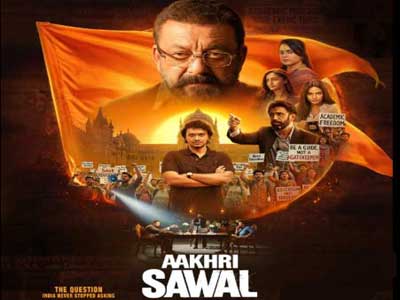
There may be differences of opinion about the film's production quality. But its subject matter has considerable potential to generate political debate. Sanjay Dutt and Namashi Chakraborty play the principal roles. Nikhil Nanda is one of the producers and also plays MS Golwalkar. Abhijit Mohan Warang is the director. Kumar Vishwas has written the songs and Monty Sharma has composed them. When 'Namaste Sada Vatsale' reverberates on the screen, it sends shivers down the spine.
Namashi Chakraborty succeeds in making the audience develop a sense of aversion towards his character. Sanjay Dutt's professor character drives the clash of ideas forward. The film perhaps does not seek to turn the viewer into a member of any political party; rather, it tries to make the viewer ask how much they actually know about the organisation they have formed an opinion about.
After watching the film, however, viewers should not stop at simply accepting its narrative. They should examine the documents relating to Gandhi's assassination, read the Kapur Commission, examine Deoras's letters from the Emergency period, study the Liberhan Commission and court records relating to the Babri demolition, and also read the reports published by the RSS and Seva Bharati themselves. Because the best way to understand the RSS is neither blind support nor blind opposition. Questions must be asked. But their answers must be sought with equal seriousness.
Perhaps that is the greatest message of 'Aakhri Sawaal'. To understand an organisation, hearsay alone is not enough. History, documents, court judgments, the organisation's own claims and independent scrutiny of those claims—all of these have to be considered together before the complete picture emerges.
In fact, the film might have been better titled ‘Five Questions’.
Related Items
The law that gave the right to ask questions…
No evidence of Liver or Kidney Injury with Ashwagandha Root Extract
How ‘Social Media’ is replacing mainstream media...