
 Samiksha Bharti News Service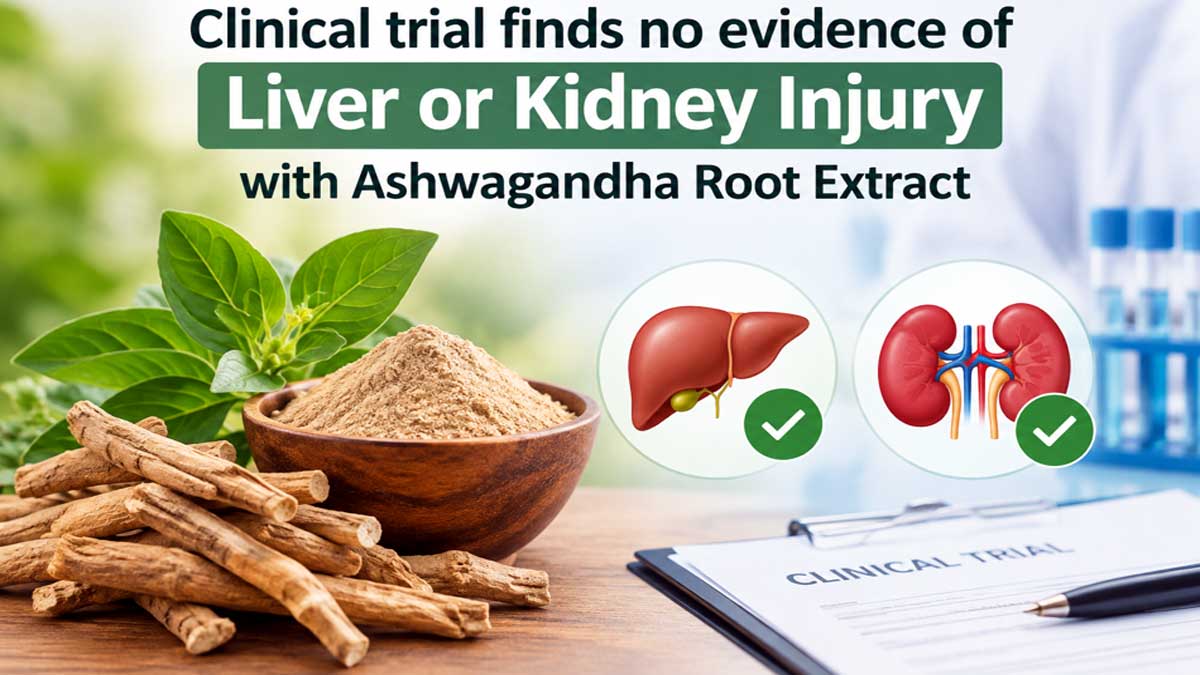
A large multicentre clinical study published recently in ‘Frontiers in Medicine’ has found that daily administration of a standardised Ashwagandha root extract for 24 weeks was well tolerated, with no evidence of treatment-related liver or kidney injury.
The study, titled ‘Safe prolonged prophylactic use and tolerability of Ashwagandha following COVISHIELD vaccination over 24 weeks: a multicentre randomised double-blind placebo-controlled trial’, was conducted by a multidisciplinary team of researchers from nine institutions, including the Central Council for Research in Ayurvedic Sciences; All India Institute of Ayurveda; National Institute of Ayurveda, Jaipur; Ayush Centre of Excellence; Translational Health Science and Technology Institute; Centre for Complementary and Integrative Health; and Interdisciplinary School of Health Sciences, Savitribai Phule Pune University, among others.
Also read: अश्वगंधा मूल अर्क के सेवन से लिवर या किडनी को नहीं है कोई नुकसान...
The study brought together expertise across Ayurveda, clinical medicine, rheumatology, complementary and integrative health and related disciplines. The randomised, double-blind, placebo-controlled trial included 1,200 apparently healthy adults aged 18–70 years who had received a first, second or booster dose of COVISHIELD vaccine.
Participants were randomly assigned to receive either 500 mg of a standardised aqueous Ashwagandha root extract daily, equivalent to four grams of raw root powder, or a matching placebo. The study was conducted across seven study sites in India and included clinical, laboratory and immunological assessments. The trial was registered with the Clinical Trials Registry of India.
Participants received the intervention for 24 weeks and were followed through week 28. Of the 1,200 participants enrolled, 1032, 86 per cent, completed the study.
The study found a favourable safety and tolerability profile for the standardised Ashwagandha root extract over the 24-week intervention period. Liver and kidney function parameters remained within the reported reference ranges, with assessments including liver enzymes, bilirubin, creatinine and blood urea showing no evidence of treatment-related hepatic or renal injury.
No serious adverse events were considered attributable to the study intervention, and no participant withdrew from the trial because of an adverse event.
Vaidya Rajesh Kotecha, Secretary, Ministry of Ayush, emphasised that the findings contribute to the robust scientific evidence supporting the safety and appropriate use of standardised Ayurveda interventions. He observed, “High-quality clinical research strengthens the scientific evidence base of Ayurveda and contributes to a deeper understanding of its potential within contemporary healthcare. The growing body of evidence from rigorous clinical studies is also supporting the responsible global utilisation of Ayurveda and its interventions across health and wellness settings.”
Dr Arvind Chopra, Chief Rheumatologist at the Centre for Rheumatic Diseases in Pune and lead author of the study, highlighted the significance of the findings, stating, “This large, multicentre, randomised clinical trial provides important evidence on the safety and tolerability of standardised Ashwagandha over 24 weeks. Throughout the study, liver and kidney function parameters remained within physiological reference ranges, with no treatment-related liver or kidney injury observed.
The study also demonstrated that Ashwagandha did not interfere with vaccine-induced immunity, with high levels of neutralising activity maintained across both the Ashwagandha and placebo groups. These findings reinforce the importance of evaluating standardised Ayurvedic preparations through rigorous, well-controlled clinical research.”
Prof Bhushan Patwardhan, National Professor of Ayush and co-author of the study, emphasised the significance of generating high-quality evidence for Ayurveda. “This study is an important example of how Ayurveda can be evaluated through robust, contemporary clinical research without losing sight of its traditional foundations. The favourable safety and tolerability findings over 24 weeks add to the clinical evidence on standardised Ashwagandha preparations and underline the importance of evidence-based approaches for their responsible integration into healthcare.”
Prof (Vaidya) Rabinarayan Acharya, Director General, Central Council for Research in Ayurvedic Sciences, emphasised the importance of generating robust clinical evidence for Ayurvedic interventions, stating, “The findings of this multicentre clinical trial provide valuable evidence on the safety and tolerability of a standardised Ashwagandha root extract when administered under controlled conditions for 24 weeks. Such well-designed clinical studies are important for strengthening the scientific evidence base of Ayurveda and for supporting the responsible and evidence-informed use of standardised Ayurvedic preparations.”
Related Items
When treatment becomes a profit-driven business…
A new approach to treatment of liver cirrhosis…
Study reveals how to reduce the carbon footprint of houses