
 Samiksha Bharti News Service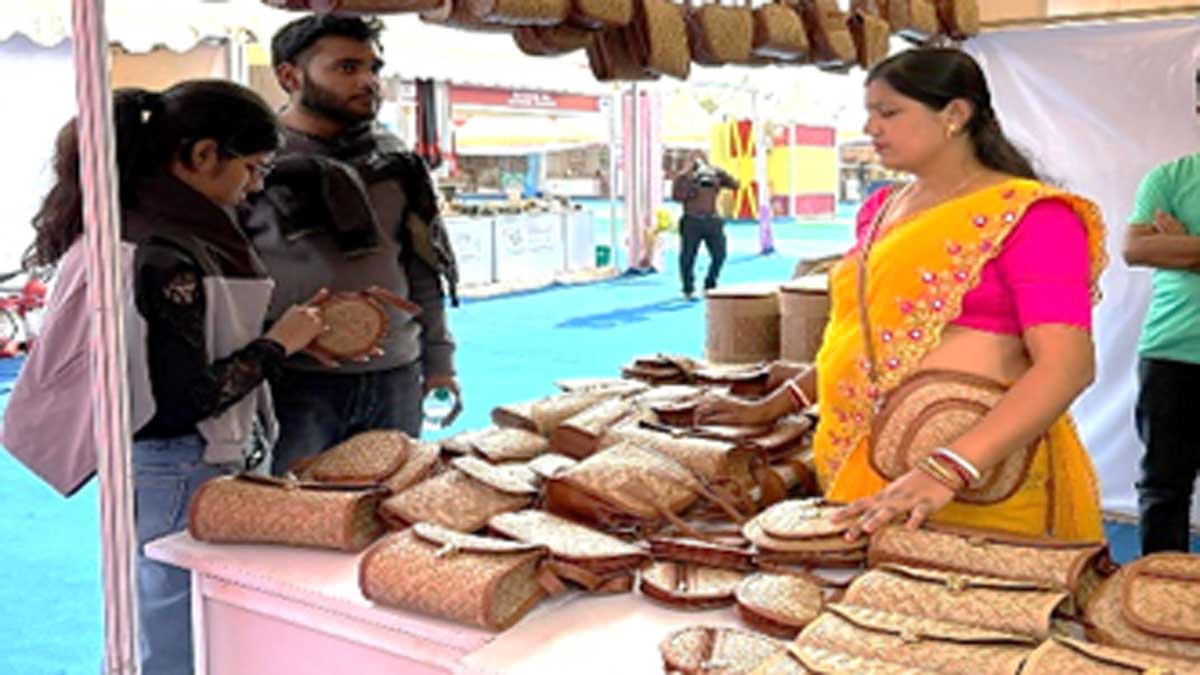
A bamboo bag might seem like an ordinary find at a city market stall. But its journey tells a story that winds from a small village enterprise to a shift in national policy.
For generations, bamboo was closely linked with traditional livelihoods across communities, but an outdated regulatory barrier once held back its true economic potential. Under a British-era law, bamboo was classified as a tree, which made harvesting and transporting it unnecessarily cumbersome for the people who depended on it.
Read also: आजीविका, उद्यमों और अवसरों का नया माध्यम बना बांस
In 2017, the government took a landmark step by removing bamboo from this classification, freeing it from restrictive forestry regulations. This forward-thinking reform opened the doors to greater innovation, entrepreneurship, and value addition in the bamboo sector. The importance of this move is now visible across the country, especially in the Northeast, where bamboo is driving employment, business, and innovation.
One such example is fashion designer and sustainable innovator Chimi Ongmu Bhutia’s Lagstal Design Studio near Gangtok, Sikkim. This women-led manufacturing enterprise makes bamboo handicrafts, incense sticks, furniture, interior décor items, etc. Bamboo here moves beyond traditional craft into contemporary design and enterprise. Chimi’s story is part of a wider movement.
In Tripura, Bijoy Sutradhar adopted technology to improve bamboo product manufacturing. In Nagaland, SHGs around Dimapur are adding value to bamboo-based food products, alongside local enterprises like Khorolo Creative Crafts producing furniture and handicrafts.
Meanwhile, in Mizoram’s Mamit district, teams are advancing scientific cultivation through bamboo tissue culture and poly-house management. These examples point towards the bamboo sector becoming more diverse, innovative, and value-driven.
The National Bamboo Mission focuses on cultivation, processing, and market access for bamboo farmers, manufacturers, and sellers. It also supports nurseries for quality planting material.
In Madhya Pradesh, Vijay Patidar turned to bamboo after repeated losses from conventional farming in 2019. He planted around 4,000 bamboo saplings with support from the bamboo mission. Within two years, he earned approximately ₹75,000 from selling bamboo poles. Bamboo also allowed him to intercrop chilli, capsicum, ginger and garlic. His experience shows how bamboo can become both a crop and a longer-term livelihood asset.
Further, the North East Centre for Technology Application & Reach has supported bamboo technologies across several commercial applications. These include food and agro-processing, construction materials, manufacturing machinery, renewable energy, industrial products, etc. These interventions have generated employment of around 30 million man-days annually. They have also raised value addition for bamboo commodities from 10 per cent to as high as 70 per cent.
For example, engineered bamboo is opening new possibilities in the field of construction. Engineered bamboo is a composite material made by binding and compressing raw bamboo fibers, strips, or particles. Furniture made with new designs and engineered bamboo is gaining popularity and attracting the attention of architects, designers, and interior decorators. Consequently, more than 42 lakh square feet of engineered bamboo structures have been built for disaster relief and rehabilitation.
In Chhattisgarh, 576 school rooms have been made from engineered bamboo, housing about 20,000 children. This shows how bamboo is moving into construction applications once associated only with conventional industrial materials.
The bamboo value chain is expanding in directions beyond product diversification. Women’s groups are becoming important participants across this emerging value chain. Such a story of women’s livelihoods becomes especially visible in Gadchiroli, Maharashtra. A bamboo-based agarbatti initiative, named the Gadchiroli Agarbatti Project, started production centres across the district in 2012.
By 2020, they had 32 centres employing around 1,100 people, and nearly 90 per cent of these workers were women. Monthly earnings reached around ₹5,000 for every woman. Employment also increased from roughly 45-60 days annually to more than 225 days. Work also moved closer to home and became less physically strenuous in nature. Women gained new skills, confidence, and opportunities for leadership. This initiative also reduced dependence on forests as a source of income.
The bamboo story is becoming a story of people, possibilities, and transformation. Across India, bamboo is creating livelihoods, enterprises, and sustainable opportunities. The story of bamboo in India is therefore no longer simply about what bamboo can become. It is about what communities can become when a traditional resource is connected to technology, enterprise and opportunity.
Related Items
Song that echoed across South India, but never became ‘National Song’
How a 'Master Communicator' turns ideas into National Missions…
Can a city die of thirst while a river flows past its doorstep!