Echoing concerns that grew with the World Wide Web itself a decade earlier, the rise of social media has stoked fears of “social displacement” -- the alienation of people from friends and family in favor of Facebook and Twitter.
Read More




Echoing concerns that grew with the World Wide Web itself a decade earlier, the rise of social media has stoked fears of “social displacement” -- the alienation of people from friends and family in favor of Facebook and Twitter.
Read More
More than 20 years later, platforms for pairing up – and the attitudes toward those who use them – have evolved considerably, said Helen Fisher, member of the Center for Human Evolution Studies in the Department of Anthropology in the School of Arts and Sciences at Rutgers University-New Brunswick.
Read More
Spending too much time in dimly lit rooms and offices may actually change the brain’s structure and hurt one’s ability to remember and learn, indicates groundbreaking research by Michigan State University neuroscientists.
Read More
Although many people don’t get enough sleep, a new analysis shows first signs of success in the fight for more shut eye. According to data from 181,335 respondents aged 15 and older who participated between 2003 and 2016, most people averaged an extra 7.5 hours of sleep each year over the 14-year period.
Read More
Internet use may decrease the likelihood of a person affiliating with a religious tradition or believing that only one religion is true, according to a Baylor University study.
Read More
There are more than eight million species of living things on Earth, but none of them — from 100-foot blue whales to microscopic bacteria — has an advantage over the others in the universal struggle for existence.
Read More
Feelings about the frequency of rape or other forms of sexual assault in a neighborhood are significantly tied to women’s—but not men’s—perceptions of its safety, according to new research.
Read More
If your resolution is to be healthier, happier and more fit in the new year, focus first on finding a real purpose in life.
Read More
If your resolution is to be healthier, happier and more fit in the new year, focus first on finding a real purpose in life.
Read More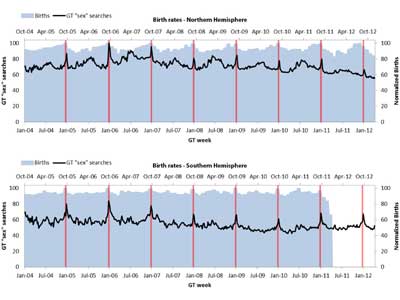
It’s often wryly observed that birth rates peak in September, with many studies citing seasonal changes in human biology to explain this post-holiday “baby boom.” But new research from scientists at Indiana University and the Instituto Gulbenkian de Ciência in Portugal finds that spikes in pregnancies are actually rooted in society, not biology.
Read More