
 Brij Khandelwal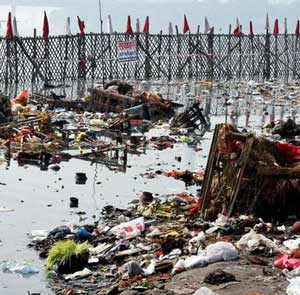
It sounds like a cruel joke. Yet that is the grim reality facing Agra. August has arrived with rumbling clouds and the scent of rain-soaked earth. Instead, the sky has worn a blank face. Farmers scan the horizon with anxious eyes, housewives count every bucket, and tube wells groan a little louder each day.
The Yamuna flows beside the Taj Mahal, yet millions here struggle for dependable water. A river that once nourished civilisations now carries sewage, industrial waste and broken promises, reduced in summer to a tired trickle heading toward the sea. Nature has played its part. But this crisis is largely man-made.
For decades, Agra has treated groundwater like an unlimited inheritance. Borewells multiply like mushrooms after rain, every new colony drills deeper, every hotel welcomes tourists with sparkling bathrooms and manicured lawns, and nobody asks where the water comes from. That invisible treasure beneath our feet is disappearing. Groundwater levels keep falling, year after year, because we keep withdrawing from nature's bank without making a single deposit. Even the richest account eventually runs dry.
The math has changed too. More than five million people now depend on the district's water resources. Add millions of tourists, expanding industries, schools and hospitals, and daily demand runs into hundreds of millions of litres. Our grandparents stored water in earthen pots; we store it in overhead tanks, washing machines, swimming pools and coolers. Modern comfort has quietly become a thirsty customer.
Agriculture tells a similar story. Water-hungry crops have replaced varieties that once respected local rainfall, and farmers, squeezed between uncertain weather and rising costs, pump more groundwater every season. The earth gives, we take, and the balance keeps tilting.
Urbanisation has added its own twist. Roads, parking lots and shopping centres now cover land that once absorbed rainwater like a sponge. When rain finally comes, it races into drains instead of sinking into the soil, so the city complains about floods one week and shortages the next.
In cities like Agra, the greatest tragedy is the quiet disappearance of community ponds. Not long ago, nearly every village around Agra had one, harvesting rain, recharging wells and watering cattle. Today many have vanished under illegal construction or become garbage dumps, surviving only in old revenue records and fading memories. We didn't just lose ponds; we erased our traditional insurance policy against drought.
The Yamuna's tributaries have suffered the same fate, blocked or narrowed into filthy drains. Rivers survive through their tributaries the way families survive through relationships; break enough connections and even the strongest river begins to weaken.
Meanwhile, nearly 300 million litres of sewage are generated in Agra every day, and treatment facilities, though expanding, still fall short, so untreated wastewater keeps entering the Yamuna, turning a sacred river into an unwilling sewer.
There is hope, provided the city chooses wisdom over complacency, and on the sewage front, a concrete plan is already underway.
Agra generates about 286 million litres of sewage daily. Its nine sewage treatment plants now have a combined capacity of over 220 MLD, with three more under construction. The real challenge has always been reuse, and the city's new City Level Reuse Action Plan is built to answer exactly that, treating wastewater as a resource rather than a burden.
The plan is already delivering results. The Jaganpur Dayalbagh STP supplies 14 MLD of treated water for agricultural irrigation, while the Pilakhar STP provides 5 MLD for waste-to-energy operations. The next phase will go further: treated water from the Dhandhupura STP will supply Agra Cantonment Railway Station and eleven metro stations; the Jaganpur STP will serve ten more metro stations, parks and a lake; and the Bichpuri STP will send 21 MLD to Keetham Lake, an important wetland and bird sanctuary. Together, these three priority projects, an investment of roughly ₹93 crore, will put 42 MLD of treated water back to work, irrigating farms, maintaining transport infrastructure and reviving water bodies without drawing a single fresh drop.
The Ganga Jal project, too, has eased pressure on the polluted Yamuna and overworked aquifers. But pipelines and treatment plants alone cannot rescue Agra. The city must revive its ponds, protect wetlands, harvest every drop of rain, restore floodplains, regulate groundwater extraction, repair leaking pipelines and encourage water-efficient farming. Above all, citizens must understand that conservation begins at home, not in government offices, a lesson made more urgent by a monsoon that grows less predictable each year, swinging between long dry spells and cloudbursts that flood streets without recharging a single aquifer.
History remembers Agra for emperors, marble and magnificent architecture. The failed monsoon is not the disaster; it is the warning bell. The real disaster will be if Agra hears it, shrugs, and waits for another cloud to solve a problem that only human wisdom can solve.
Related Items
Walking, a ‘fundamental right’ but a ‘struggle’ in Agra
Agra, where the streets belong to the animals…
India’s Curious Double Life; Clouds, Computers and the Sacred Fire…