
 Brij Khandelwal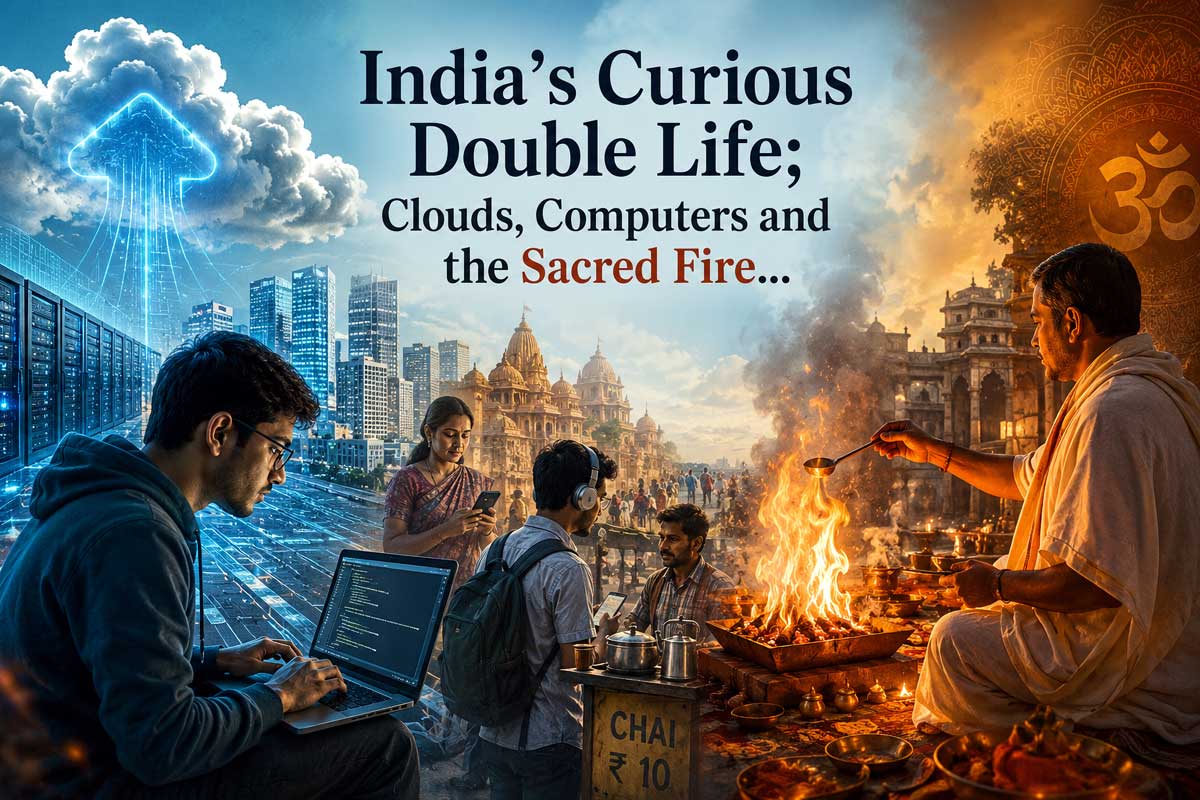
The clouds refused to come. Karnataka looked up at the sky. Then the government looked in two directions. One team turned to aircraft, weather data and atmospheric science. Another turned towards a temple, sacred fire and ancient mantras. And, believe it or not, both were official responses.
The Karnataka government announced a ₹28.52-crore emergency cloud-seeding programme to tackle a serious rainfall shortage. Twenty-nine out of the state's 31 districts were facing a worrying deficit. Aircraft, approved by aviation authorities, would fly into suitable clouds. Scientists would track weather conditions. Hundreds of flying hours were planned.
Read in Hindi: बादल, कंप्यूटर और पवित्र अग्नि : दोमुखी यथार्थवाद में जी रहा है भारत...
On the very same day, another answer to the rain crisis emerged. At the Padi Igguthappa Temple in Kodagu, a Rudra Homa was scheduled early in the morning. Agriculture Minister PM Narendraswamy was to participate. The ritual had reportedly been ordered by Chief Minister DK Shivakumar, with one clear hope in mind: may the rain gods smile upon Karnataka.
What a picture! On one side, cloud seeding. On the other, sacred chanting. One looks at the clouds through scientific instruments. The other looks towards heaven through a column of smoke. Both want rain.
Welcome to India's great double life. We build rockets, but consult astrologers before important journeys. We send satellites to space, but often check the stars before launching a new venture. We produce software engineers for Silicon Valley, yet many business offices are designed according to vastu experts and numerologists.
Science and superstition do not merely live next door here. Sometimes, they share the same bedroom.
Take India's space programme. has won global admiration for its remarkable missions. Indian scientists calculate trajectories with breathtaking precision. A tiny error can send a spacecraft millions of kilometres away.
Yet, before many important events, someone somewhere is still asking, "Is this an auspicious time?" The rocket trusts mathematics. The man trusts Mars and Jupiter.
India's top engineering colleges produce brilliant minds. Their graduates design chips, write complex software and build global companies. But when a new office opens, the direction of the entrance may still worry the owner more than the quality of the engineering. A north-facing door can sometimes cause more anxiety than a failing server.
Then comes the nuclear paradox. India has missiles, nuclear capability and sophisticated defence technology. Yet stories keep circulating about ancient weapons supposedly equal to modern bombs. Some claim ancient India had aircraft more advanced than today's machines.
Pride in history is perfectly understandable. But history is not a magic trunk. You cannot pull out a modern invention whenever evidence becomes inconvenient.
The digital world offers another amusing contradiction. A smartphone can provide weather forecasts, satellite maps and scientific advice. The same phone also sells horoscopes, tantric cures, miracle medicines and predictions.
The internet is a democratic marketplace. Newton and Nostradamus can both open shops there.
India has some of the world's finest doctors and medical institutions. Scientists conduct advanced research into cancer, genetics and infectious diseases. Yet now and then, someone declares that all modern medical discoveries were already known thousands of years ago.
Perhaps some ancient knowledge deserves serious study. Certainly, it does. But respect is not proof. A claim does not become science merely because it is old.
The environment presents an equally uncomfortable story. Scientists warn us about polluted rivers, climate change and shrinking groundwater. Governments spend crores on cleaning programmes. Courts issue strict orders.
Then comes a festival. Tons of material are immersed in the same rivers. Offerings, idols and waste enter already suffering waters. Faith tells us the river is sacred and will somehow purify itself.
The river, sadly, has no public relations department. It simply carries the rubbish away.
Our Constitution encourages the development of scientific temper. Yet horoscopes continue to influence marriages. Caste still shapes social decisions. Astrological advice sometimes enters business and politics too.
A modern degree may sit in one hand. A birth chart remains firmly clutched in the other.
The Karnataka episode is especially striking because the two responses came almost together. Cloud seeding is not magic, of course. Its results depend on suitable clouds and atmospheric conditions. It is a scientific technique, not a guarantee.
A Rudra Homa is a matter of faith and tradition. The real question is not whether people should pray. Of course they can.
Prayer belongs to personal faith. Ritual belongs to culture. Temples are part of India's social and spiritual life.
The problem begins when a government appears unable to distinguish between faith and public policy.
A drought is a physical problem. It needs water management, weather science, irrigation planning, groundwater conservation and better agricultural policies. Prayer may provide hope and emotional strength.
But hope cannot replace hydrology. A homa cannot repair a leaking canal. A mantra cannot recharge an empty reservoir.
India need not choose between culture and science. That is a false choice. A country can respect its traditions and still insist on evidence. It can preserve ancient wisdom without inventing ancient facts.
It can pray for rain in the morning. But by afternoon, it must still build reservoirs. That is the real challenge.
India dreams of becoming a global knowledge power, a technological giant and a Vishwa Guru. Fine dreams. But a teacher of the world must first learn to separate knowledge from belief, evidence from emotion and research from retrospective boasting.
Otherwise, we will continue living in two worlds. One hand will launch a satellite. The other will search for an auspicious hour. One aircraft will seed the clouds. Another official delegation may feed the sacred fire. And, somewhere between the cloud and the smoke, the Indian contradiction will continue to dance.
Related Items
Are Indian borders just lines on a map!
How the 'Indian Solar Revolution' is transforming rural lives…
Indian Ayurveda ensures a healthy future…