
 Brij Khandelwal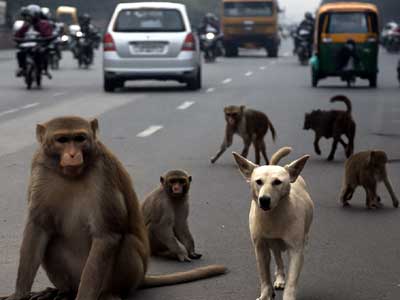
Every morning before the sun climbs over the Taj Mahal, Agra's residents step outside and take stock of a city that no longer quite belongs to them. The roads, from Dayalbagh and Kamla Nagar to Shahganj, Tajganj, Sikandra, Balkeshwar and the Trans-Yamuna colonies, are shared with packs of dogs looking for the next chase, monkeys scanning balconies for an open window, and herds of buffaloes that have simply decided the carriageway is theirs for the afternoon.
For a city that lives off its monuments and its visitors, that is not a small problem. It is a daily hazard that hospitals, motorists and morning walkers now describe less as a nuisance and more as a siege.
Official figures give the scale of it away. According to district hospital and state government records, Agra is home to over 90,000 stray dogs and around 60,000 pet dogs, with roughly 300 dog-bite cases reported every day; a figure that, taken together, dwarfs comparable numbers from far larger cities. By contrast, Delhi's municipal corporation logged only about 1,100 dog-bite cases across six months in 2022, underlining how disproportionately hard Agra has been hit.
Doctors treating the fallout say the pattern is troublingly consistent. A senior physician in the city's Gandhi Nagar area said that most of the dog-bite cases involved children under 15 who had been bitten while playing with or feeding stray dogs, and that private clinics alone handle over a hundred such cases a day, with the bulk of the remaining load falling on the district hospital and smaller health centres.
Municipal officials acknowledge the gap between effort and outcome. The corporation's animal welfare officer has said the civic body's limited sterilisation drive simply cannot keep pace with a population this large using its own resources, which is why authorities are now looking to bring in a private agency to run a city-wide vaccination and sterilisation programme.
Residents say the canine crisis is only one strand of the problem. Around temples, markets and the approach roads to the Taj Mahal, monkeys have become bold enough to snatch food, bags and phones from schoolchildren, elderly walkers and tourists caught off guard.
Along Yamuna Kinara Road, it is buffaloes and cattle that own the carriageway; herds returning from the riverbank often spread across entire lanes, forcing two-wheelers and cars into risky manoeuvres to get around them. At night, when dark-coated animals become nearly invisible against the unlit road, the risk turns into outright danger, and riders report frequent, sometimes serious, collisions.
Morning walkers describe a changed relationship with the city's own parks and riverfront. Senior citizens say they now cut their walks short after being chased by dog packs; parents say they no longer send children out to play unaccompanied.
Agra's crisis is not happening in isolation. Courts have taken note of the broader national picture: in a ruling in May 2026, the Supreme Court declined to soften an earlier order directing the removal of strays from crowded public spaces, holding that citizens have a constitutional right to move freely in public places without living in fear of dog attacks. The bench pointed to a mounting toll of incidents from cities across the country to justify the tougher line, a signal that the pressure on local authorities to act is unlikely to ease.
River Connect campaigners say "For Agra, the stakes go beyond civic discomfort. A city that depends on the goodwill of millions of visitors each year cannot afford a reputation for unsafe streets. Animal welfare workers say sterilisation and vaccination drives are ongoing but underfunded and understaffed relative to the scale of the problem; residents ask, reasonably, why years of spending on animal birth control haven't dented the numbers."
Until sterilisation is scaled up, abandoned cattle are properly rehabilitated, monkey populations are managed scientifically, and errant cattle owners are held to account, the people of the Taj City will keep doing what they already do every day: stepping outside, and watching the road as closely as they watch their own feet.
Related Items
Walking, a ‘fundamental right’ but a ‘struggle’ in Agra
Can a city die of thirst while a river flows past its doorstep!
Zydus Wellness: Analysts bullish but numbers suggest patience