
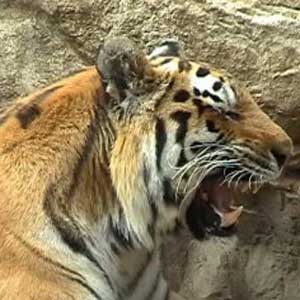
So says the senior author of a new study that shows lions’ and tigers’ loud, low-frequency roars are predetermined by physical properties of their Born fold tissue – namely, the ability to stretch and shear – and not by nerve impulses from the brain.
"Roaring is similar to what a baby sounds like when it cries," says speech scientist Ingo Titze, executive director of the National Center for Voice and Speech, which is administered by the University of Utah. "In some ways, the lion is a large replica of a crying baby, loud and noisy, but at very low pitch."
The study of lion and tiger vocal folds and how they produce roaring – vocalizations used by big cats to claim their territory – was set for publication Wednesday, Nov. 2, in the Public Library of Science’s online journal PLoS ONE.
While the comparison was not part of the study, Titze says a baby “cries to have people come to help it. The lion uses similar attention-getting sound, but mainly to say, ‘I am here, this is my territory, get out of here."
"In both cases, we hear loud, grating sounds that grab people's ears. When a baby cries, the sound isn’t pretty. The sound is basically rough. The vibration isn’t regular."
The same is true of roars by lions and tigers, and, like babies, their vocal folds (commonly called vocal cords) are "very loose and gel-like" and vibrate irregularly to make roars sound rough, Titze says. The main difference: Babies cry at a high-pitched frequency, while big cats have a low-frequency roar.
The new study’s key finding is that lions and tigers can roar loudly and deeply because their vocal folds have a flat, square shape and can withstand strong stretching and shearing. That contradicts a theory that lions roar deeply because the vocal folds are heavy with fat.
Instead, the fat helps give the vocal folds their square shape where they protrude into the airway, unlike triangular vocal folds in most species. The fat also may cushion the vocal folds and provide repair material when they are damaged, the researchers say.
"We were trying to correct a previous assumption that lions and tigers roar at low fundamental frequencies because they have a huge vocal folds," says study co-author Tobias Riede, a research assistant professor of biology at the University of Utah and a research associate at the National Center for Voice and Speech.
"It’s true they have large vocal folds, but the shape and the viscoelastic properties make the roars so loud and deep," he says.
Riede says the scientists "set out to find out the relationship between structure of the vocal folds and how they work to produce the roar in lions and tigers. We tested if the mechanical properties of the vocal folds allowed us to make predictions about the sound."
They did. Measurements of vocal fold resistance to stretching and shearing let researchers accurately predict the "fundamental frequency" ranges at which lions and tigers are known to roar, and the lung pressures needed to produce those roars.
Titze and Riede conducted the research with first author Sarah Klemuk, an adjunct assistant professor of communication sciences at the University of Iowa; and Edward Walsh, director of auditory physiology at Boys Town National Research Hospital in Omaha, Neb. Titze is on the faculty at the University of Iowa and University of Utah, where he is a research professor of otolaryngology and medicinal chemistry. The research was funded by the National Institutes of Health and the National Science Foundation.
"We study a lot of animals – deer, elk, dogs and cats,” Riede says. “Lions and tigers are just interesting examples for very loud and low-frequency vocalization."
These studies have a practical aspect. "If you understand how vocal folds are structured and what effects that structure has on vocal production, then it could help doctors make decisions on how to reconstruct damaged vocal fold tissue" in people such as cancer patients, singers, teachers, coaches and drill sergeants, he says.
The new study analyzed vocal folds from within the larynx, commonly known as the voice box. Larynges were excised from three lions and three tigers euthanized for humane reasons due to advanced disease at the Henry Doorly Zoo in Omaha. They ranged from 15 to 22.4 years old at death. The three lions were females. The tigers were female Sumatran and Bengal tigers and a male Amur (Siberian) tiger.
Vocalization is complex, and involves factors not included in the new study of vocal folds: how air is pushed from the lungs, how sound resonates in the vocal tract, how the tongue and jaw move, and movement of muscles and cartilage of the larynx.
The study included examinations of vocal fold tissue, which is soft connective tissue in the form of elastin, collagen, a lubricant known as hyaluronan, and fat.
Lions and tigers have large vocal folds: about 1 inch high from top to bottom, 1 inch thick side to side and 1.5 inches long front to back. They protrude from the larynx into the airway just above the trachea, forming a triangular shape on each side of the airway in most species but a squared shape in lions and tigers.
Scientists already knew lions and tigers have significant fat within their vocal folds. The new study showed that in big cats, this fat is located deep within the vocal fold ligament, and helps give the folds their flattened, square shape.
That shape "makes it easier for the tissue to respond to the passing airflow," allowing louder roars at less lung pressure, Riede says.
When air moves past the vocal folds to make sound, the folds vibrate side to side and up and down, stretching and shearing the folds – properties the researchers tested.
First, they attached lion and tiger vocal folds to levers that measured force and distance as the tissue was stretched "like the strings of guitar," says Riede.
Next, the researchers put small circular disks of vocal fold tissue between plates and twisted one plate by a few degrees, slowly and quickly, while measuring the force needed to do that. That shows how well the material withstood shearing during roaring.
The scientists then used these measurements of tension and shear strength of big cat vocal folds to predict the lung pressures and "fundamental frequency" range at which the animals roar – the range of rates at which the vocal folds are able to vibrate.
They came up with 10 to 430 hertz, or cycles per second, which is consistent with known roaring frequencies of 40 to 200 hertz in lions and 83 to 246 hertz in tigers, Riede says. Men speak at 100 to 120 hertz and women at a higher 200 to 250 hertz, but big cats are much louder because they more efficiently convert lung pressure into acoustic energy.
It makes sense that lions’ and tigers’ frequency when roaring is a function of the mechanical properties of their vocal folds, not the mass or weight. After all, elk have similarly sized vocal folds, yet they have a high-pitch bugle not a low roar, Titze says.
"It is confirmation that the frequencies of phonation are described by mechanical properties of the vocal folds and not by nerve impulses from the brain," he adds.
A lion’s or tiger’s roar can reach 114 decibels to someone standing a few feet away, which "is about 25 times as loud as a gas lawn mower," Titze says. And roars aren’t delivered one at a time; instead, lions roar about 50 times in 90-second bouts.
"They roar with a sound that is frightening to people because it has this rough and raw quality," Titze says. "Lions and tigers are deemed the kings of the beasts, partly because of their roars. Imagine if they sang beautiful tunes and they were very low-frequency tunes. Who’s going to be afraid of that?"
Related Items
One melody, Four voices and One timeless emotion...
Two voices of love, bridging the 'past' and 'present'...
Land of Lord Krishna crying for every drop of water