
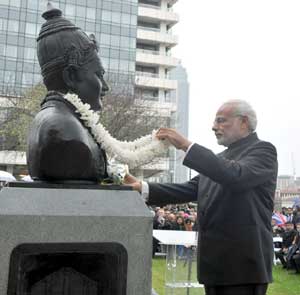
Being a born progressive activist, Basaveshwara revolted against all the social evils of the traditionalistic society and brought a drastic change in various facets. We often talk about the human rights in this twenty-first century, but these human rights were being enjoyed by Sharanas (Citizens of welfare society) during 12th century itself, because of the Socialistic and Democratic approach of Basavanna.
Basaveshwara was born in Bagevadi (of undivided Bijapur district in Karnataka) during 1131 AD. His father was Madarasa and Madalambike was his mother. They belonged to Brahmin community. As a religious tradition, he was initiated with the holy thread ‘janivara’ in Upanayana, (thread ceremony) at the early age of eight years. Basavanna revolted against this tradition, cut threw his janivara, left home and went to Kudalasangama from where he was educated in all respects.
In the later stage, he went to Kalyana, where the Kalchuri king Bijjala (1157-1167, AD) was ruling. Because of his highly intellectual personality, he was appointed as a karanika (Accountant) in the initial stage, in the court of king Bijjala and later he became the Prime minister of Bijjala after proving his administrative ability.
At this stage, Basaveshwara looked around the socio-economic status of the then society, where most of the static, superstitious and anti-social elements were ruling. There was much gap between haves and have- nots and rich people were harassing the poor. Untouchability was rampant and sex discrimination made the lives of women very pathetic. Basavanna revolted against all these evils and he himself started practicing the socialistic norms to bring about drastic change in the society. Hence, he became the guiding path to others in bringing the change. He scripted his practical experiences in a novel form of literature called –Vachana (poetry). This innovative literary form is the main contribution of “Sharanas” through which they expressed their revolutionary and reformist ideology in a very simple Kannada language.
First of all Basavanna tried to change the concept of Temple which was the main centre of various types of harassments. Priests and rich people were exploiting the common folk in the name of God and temple. Thus he tried to convince the society about the real god and temple, which are within and with us only. In one of his vachana he says-
Rich build temples for shiva
What can I a poor man do?
My legs are the pillars
My body is temple
My head makes the golden cupola
Oh, Lord kudala sangama
The standing will perish
The moving will stay on.
By saying so, Basaveshwara gave two important and innovative concepts called “Sthavara’’ and “Jangama’’, the meaning of which is “Static’’ and “Dynamic’’- respectively. Both of these concepts are the main foundation stones of the revolutionary ideology of Basavanna. By ridiculing the physical structure of temple and God; which are perishable, Basavanna gave a new dimension to the human body and soul (inner spirit), by which the self respect of all human beings was boosted.
The firm and final goal of Basavanna was to establish a democratic set up of society. Hence he fought against all types of inequalities which were existing in the rigid society at that time. He raised his voice against untouchability, which was in practice since ages. He not only mingled and mixed with untouchables but also ate food with them at their homes. This gave a new courage to the downtrodden community to come forward along with others. Likewise Basavanna brought the women folk to the forefront of the society and gave them courage to sit along with men and to express their inner feelings along with pains. Anubhavamantapa, which was established by him was a common forum for all, including downtrodden, untouchables and women to discuss about the prevailing problems of socio, economic and political strata including religious and spiritual principles along with personal problems. Hence it was an open platform for all those activists who involved themselves in bringing a radical change in the contemporary society. Thus Anubhavamantapa was the first and foremost Parliament of India, where Sharanas sat together and discussed about the socialistic principles of a Democratic set up. All those discussions of Sharanas were written in the form of Vachanas and they form a dynamic type of constitution where Liberty, Equality and Fraternity are the prominent principles which are aiming towards social justice and progress.
Basaveshwara gave two more very important socio-economic principles. They are - “Kayaka” (Work-Divine work) and “Dasoha” (Distrubution-Equal distribution). According to this, every individual of the society should take up the job of his choice and perform it with all sincerity. There is no discrimination in vocations. All members of the society are labourers (Kayakajeevigalu). Some may be intellectual labourers and others may be manual labourers. Even the Guru and Jangama, who were treated as the superiors of the society also, must work. Kayaka is not mere a work, but it is the way of realising God. It teaches the concept of dignity of labour. Ultimately the Work is worship. Even the Kayaka is equated with kailasa - The Heaven. This concept gave a new movement and people of all walks of the society started loving their work and involved them self in society building task without any feeling of class, caste and sex discrimination.
Kayaka must be followed by an accurate income. The income should not be more or less. There must be an equal income for equal work. The worker (Kayakajeevi) may lead his day-today life by his hard earned income. But he should not preserve the money or property for tomorrow. He must utilise the surplus money for the society and poors. This concept is called – “Dasoha”. Thus by advocating this principle, Basaveshwara gave the concept of equal distribution of wealth to the society. Hence, Kayaka and Dasoha are the major dynamic policies, which were given by Basavanna to the field of economics.
His contribution to the judiciary is also noteworthy. All the social and democratic principles of Basavanna are based on the legal provisions of the Sharana constitution. For an example we may see one of his vachana-
Do not steel, do not kill, and do not utter lies
Do not lose your temper, do not detest others
Do not glorify yourself, do not blame others
This alone is purity within
This alone is purity without
And this alone is the way to please our lord
Kudalasangama.
This vachana of Basavanna, which has been written in 12th century itself, is highlighting the principles of Indian penal code of our present constitution.
Basaveshwara fought against all the evils of the society which were coming in the way of progress. His aim was to give a movement to the stagnated society. Hence he involved the people of all walks of the society in his movement, including women. His intention was to bring a total change in the static world. This clearly indicates that he was a visionary of a total revolution.
There are many preachers, revolutionaries, reformists, socialists, political thinkers, economists, humanists and so on in this world. But Basaveshwra was one combination of all these. Hence he is regarded as one of the greatest human being of the entire world. Mahatma Gandhi says- “It has not been possible for me to practice principles of Basaveshwara which he taught 800 years ago and which he also practiced. I have adopted few of them; I am yet to a seeker in this aspect and not an accomplished one. Eradication of untouchability and dignity of labour were among his core concepts one does not find even shade of castism in him. Had he lived during our times, he would have been a saint worthy of worship. If his followers practice his precepts you could uplift not just Bharat but the world.” -Yes, Basaveshwara was a universal human being, with the vision of Vishvodaya.
(Author is a Retd. Station Director of AIR, Bangaluru. The views expressed are personal)
Related Items
UPI completes 10-years of Digital Payments Revolution
Love’s revolution or a ‘Parade of Packages’
A social revolution India has been waiting for…