
 Samiksha Bharti News Service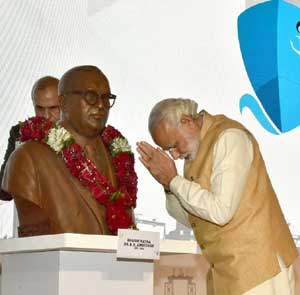
The sparkling life history of Baba Saheb Dr Bhim Rao Ambedkar shows that he was a man of study and action. He acquired a sound knowledge of Economics, Politics, Law, Philosophy and Sociology, in pursuing his studies; he had to face many social odds. However, he did not spend all his life reading and studying in the libraries.
He refused the higher posts with attractive salaries because he never forgot his brothers in the depressed class. He dedicated the rest of his life to equality, brotherhood and humanity. He tried his best to uplift the depressed classes.
Dr Ambedkar was born on 14 April 1891, he was the 14th and last child of his parents. He was the son of British Army’s Subedar Ramji Maloji Sakpal, a follower of Sant Kabir and was also a well-read person.
Dr Ambedkar was hardly two years old when his father retired from service. His mother died when he was only about six. Babasaheb got his early education in Mumbai, then Bombay. Since his school days, he realized with intense shock what it was to be an untouchable in India.
Dr Ambedkar was taking his school education in Satara. Unfortunately, he lost his mother. His aunt looked after him. Afterwards, they shifted to Bombay. Throughout his school education, he suffered from the curse of untouchability. His marriage took place after his matriculation in the year 1907 in an open shed of a market.
Dr Ambedkar completed his graduation at Elphinston College of Bombay, for which he was getting a scholarship from His Highness Sayajirao Gaikwad of Baroda. After his graduation, he had to join Baroda Sansthan according to the bond. He lost his father when he was in Baroda, 1913 is the year when Dr Ambedkar was selected as a scholar to go to the USA, for higher studies. This was the turning point of his educational career.
He got his MA and PhD degrees from Columbia University in 1915 and 1916 respectively. He then left for London for further studies. He was admitted there to the Gray’s Inn for Law and also allowed to prepare for the DSc at the London School of Economics and Political Science. But he was called back to India by the Dewan of Baroda. Later, he got his Bar-at-Law and DSc degrees. He studied for some time at Bonn University in Germany.
In 1916 he read an essay on ‘Castes in India — their Mechanism, Genesis, and Development’. In 1916, he wrote his thesis ‘National Dividend for India — A Historic and Analytical Study’ and got his PhD Degree. This was published after eight years under the title — “Evolution of Provincial Finance in British India.” Then after getting this highest degree, he returned to India and was appointed a Military Secretary to the Maharaja of Baroda to groom him as the finance minister in the long run.
Babasaheb returned to the city in September 1917 as his scholarship tenure ended and joined the service. But after a brief stay in the city till November 1917, he left for Mumbai. The maltreatment he faced on grounds of untouchability had forced him to leave the service.
Dr Ambedkar returned to Bombay and joined Sydenham College as a Professor of Political Economy. As he was well-read, he was very popular among the students. But he resigned his post, to resume his studies in Law and Economics in London. Maharaja of Kolhapur gave him the financial help. In 1921, he wrote his thesis. “Provincial Decentralization of Imperial Finance in British India,’ and got his MSc Degree from the London University. Then he spent some period at Bonn University in Germany. In 1923, he submitted his thesis — “Problem of Rupee Its Origin and Solution”, for the DSc Degree. He was called to the Bar in 1923.
After coming back from England in 1924 he started an Association for the welfare of the depressed classes, with Sir Chimanlal Setalvad as the President and Dr Ambedkar as the Chairman. To spread education, improve economic conditions and represent the grievances of depressed classes were the immediate objects of the Association.
The Bahiskrit Bharat, newspaper was started on April 3, 1927, to address the cause of the depressed classes given the new reform.
In 1928, he became a Professor at Government Law College, Bombay and on June 1, 1935, he became the Principal of the same college and remained in that position till his resignation in 1938.
On October 13, 1935, a provincial conference of the depressed classes was held a Yeola in Nasik District. In this conference, he gave the shock to the Hindus by announcing. “I was born in Hinduism but I will not die as a Hindu” Thousands of his followers supported his decision. In 1936 he addressed the Bombay Presidency Mahar Conference and advocated the renunciation of Hinduism.
On August 15, 1936, he formed the Independent Labour Party to safeguard the interest of the depressed classes, which mostly formed the labour population.
In 1938, Congress introduced a bill making change in the name of untouchables. Dr Ambedkar criticized it. In his point of view changing the name is not the solution to the problem.
In 1942, he was appointed to the Executive Council of the Governor General of India as a Labour member, in 1946, he was elected to the Constituent Assembly from Bengal. At the same time, he published his book, Who Were Shudras?
After Independence, in 1947, he was appointed as a Minister of Law and Justice in Nehru’s first cabinet. But in 1951, he resigned his ministership, expressing his differences on the Kashmir issue, India’s Foreign Policy and Nehru’s Policy towards the Hindu Code Bill.
In 1952, Columbia University conferred upon him the degree of LLD in recognition of the work done by him in connection with the drafting of India’s Constitution. In 1955, he published his book titled ‘Thoughts on Linguistic States’.
Dr BR Ambedkar was awarded a Doctorate on January 12, 1953, from Osmania University. Ultimately after 21 years, he proved true, what he had announced in Yeola in 1935, that “I will not die as a Hindu”. On 14th October 1956, he embraced Buddhism in a historic ceremony in Nagpur and died on 6th December 1956.
Dr Babasaheb Ambedkar was conferred with the title of “Bodhisattva” by the Buddhist monks at the “Jagatik Buddhism Council” in 1954 in Kathmandu. The special thing is that Dr Ambedkar was conferred with the title of Bodhisattva while he was alive.
He also contributed to India’s Independence struggle and its reforms post-independence. Apart from this, Babasaheb played a significant role in the formation of the Reserve Bank of India. The Central Bank was formed on the concept presented by Babasaheb to the Hilton Young Commission.
After having gone through his life history it is necessary and proper to study and analyze his main contribution and their relevance.
Related Items
Divorce late in life can improve men’s mental health
When Politics turns the Ballot into a Pandora's Box…
'Devraha Baba' will reach audiences with ‘Machan Baba’ soon…