
 Brij Khandelwal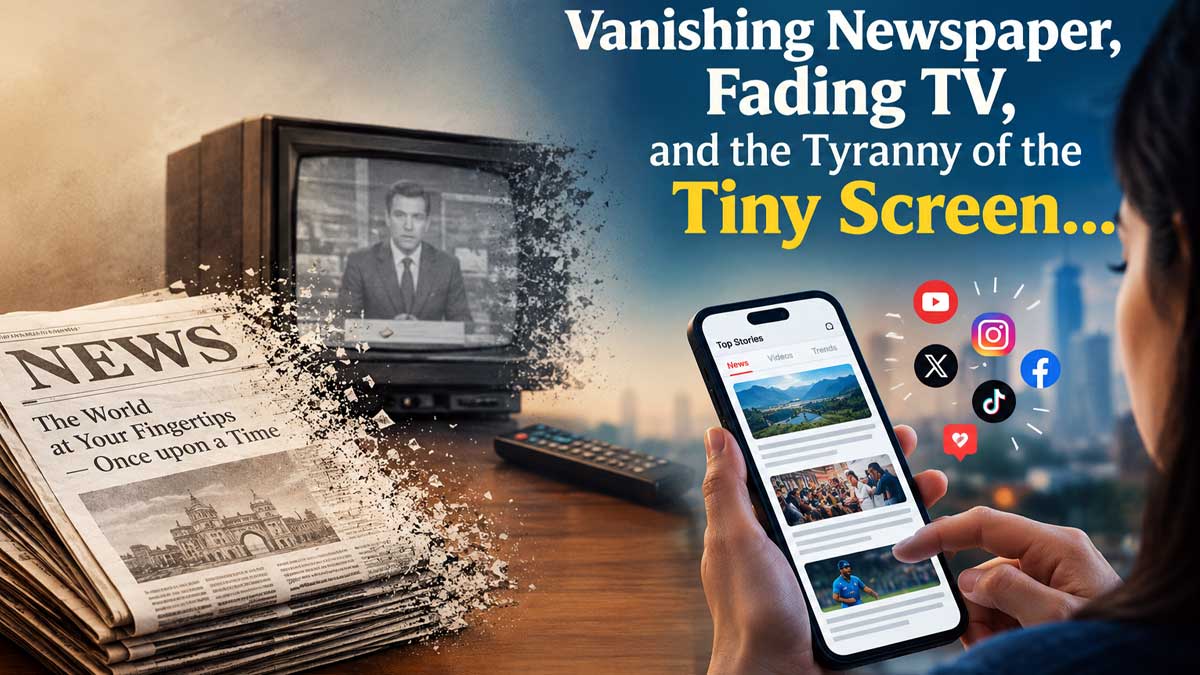
What happens to a society when the newspaper no longer lands with authority at the doorstep, and the television no longer commands silence in the living room?
A quiet funeral is unfolding before our eyes. No drums. No mourning crowds. No official obituary. Yet India’s traditional media ecosystem- especially print and television- is steadily losing its grip on public imagination. The smartphone has emerged as the undisputed king, shrinking the world into a six-inch screen where attention flickers for seconds and algorithms decide what people see, think, buy, and even believe.
Once upon a time, mornings in India began with the rustle of newspapers and evenings ended around the television set. Families debated headlines over tea. Prime-time news anchors shaped national conversations. Cricket matches united entire neighbourhoods. Television and print were not merely mediums; they were institutions of collective experience. Marshall McLuhan’s famous phrase, “the medium is the message,” perfectly captured that age. The medium itself shaped society’s habits, priorities, and emotional rhythms.
Today, the message travels differently. Faster. Shorter. Louder. More addictive. The smartphone has not merely challenged television and print; it has rewritten human behaviour itself.
The numbers tell a troubling story. Television viewership in India has begun slipping steadily. Weekly TV reach reportedly declined from nearly 757 million viewers in FY24 to around 741 million in FY26. Pay DTH subscribers have fallen sharply. Millions have cut the cord. Subscription revenues are shrinking. Advertising growth has slowed. The mighty television industry now stands on uncertain ground. But the deeper wound lies elsewhere, in the collapsing relevance of print journalism.
Newspapers, once the backbone of democratic discourse, are gasping for survival in the digital storm. Younger readers increasingly consume headlines through Instagram reels, WhatsApp forwards, YouTube snippets, and AI-curated feeds. Few possess the patience to sit with a detailed editorial or a long investigative report. The culture of reading is surrendering to the culture of scrolling.
The morning newspaper now competes not with another newspaper, but with endless notifications blinking before sunrise. This decline should concern society deeply.
Print journalism historically offered depth, verification, and reflection. Newspapers forced readers to slow down, absorb context, and confront diverse viewpoints spread across pages. Smartphones reward the opposite — speed, outrage, distraction, and instant gratification. Information now arrives fragmented like shattered glass pieces. The result is a society increasingly informed in fragments but rarely in depth.
The medium has changed. Therefore, the message has changed too. Smartphones today dominate every sphere of life. India already has over 800 million smartphone users, with numbers projected to rise sharply in coming years. Cheap data plans transformed the internet from luxury into necessity. Social media platforms, short-form videos, and streaming apps have created a hyper-personalised universe where every individual now lives inside a customised digital bubble.
Television demanded collective attention. Smartphones encourage solitary consumption. Earlier, families watched one programme together. Today, four members in the same room stare at four different screens. Shared cultural moments are fragmenting into algorithm-driven micro-realities. National conversations no longer emerge organically; they are manufactured, targeted, and amplified digitally.
Attention itself has become the world’s most valuable currency. Advertisers understood this shift before broadcasters did. FMCG giants and major brands increasingly moved their budgets toward digital platforms where every click, swipe, and pause can be measured with surgical precision. Digital advertising now commands the lion’s share of ad spending in India. Traditional television advertising, once the industry’s lifeline, is stagnating.
And newspapers? They are bleeding silently. Circulations are falling in many urban centres. Print advertisements have migrated online. Rising newsprint costs have worsened the crisis. Small and regional newspapers struggle to survive. Veteran journalists worry that society is losing not just an industry, but an intellectual habit, the habit of sustained reading and critical engagement.
Ironically, while information has exploded, attention spans have collapsed. A 30-second reel now competes successfully against a 1,500-word analysis. Viral creators can command larger audiences than established newsrooms. Truth itself often drowns beneath speed and sensationalism. In the digital jungle, visibility matters more than credibility.
Yet declaring television dead would be premature. Television still thrives during major sporting spectacles, elections, and national crises. Cricket remains its lifeboat. Big events continue drawing massive audiences on both television and streaming platforms. Rural India too remains deeply connected to free television services like DD Free Dish.
But television is mutating into a hybrid digital creature. Smart TVs and connected screens now blend traditional viewing with OTT convenience. The battle is no longer between television and digital media. The real war is for human attention; whichever screen captures the eyes longest wins. And the smallest screen currently rules them all.
McLuhan’s prophecy survives with renewed force. The medium still shapes civilisation more powerfully than the content itself. Smartphones have altered memory, concentration, relationships, politics, and even emotions. They democratised content creation, but also accelerated noise, distraction, and polarisation.
A teenager in a remote Uttar Pradesh village can now become a viral influencer overnight. A farmer can upload videos reaching millions. This democratisation is revolutionary and empowering. But it also raises uncomfortable questions. Can democracy survive without deep reading? Can societies think clearly when public discourse is reduced to scrolling reflexes and emotional triggers?
Traditional media now stands at a crossroads. Legacy broadcasters and newspaper houses can no longer survive merely by defending old models. Reinvention is essential. Digital-first storytelling, regional language content, multimedia journalism, podcasts, connected TV ecosystems, and reader-supported journalism may offer survival pathways. But even adaptation carries a painful truth.
The age of media authority is over. The age of algorithmic influence has begun. Families still gather under one roof, but mentally they inhabit separate digital universes. The television still flickers in some homes. Newspapers still arrive at some doors. Yet the centre of gravity has shifted decisively to the smartphone. The emperor of attention now sits in the palm. And with every endless scroll, the old media world fades a little further into the background noise.
Related Items
Liechtenstein: A 'tiny' country and a 'giant' surprise...
When a classical melody wove an immortal love story on screen…
India’s vanishing repair culture and the toxic rise of e-waste