Latest News: Indian share markets will be open for trading on Sunday, February 01, as the Union Budget is being presented on that day * Key Highlights of Economic Survey 2025–26: GDP & GVA Growth Estimates for FY 2026: First advance estimates at 7.4% and 7.3% respectively * India’s Core Growth Projection: Around 7%, with real GDP growth for FY 2027 expected between 6.8% and 7.2% * Central Government Revenue: Rose to 11.6% of GDP in FY 2025 * Non-Performing Assets: Declined to a multi-decade low of 2.2% * PMJDY Accounts: Over 552 million bank accounts opened by March 2025; 366 million in rural and semi-urban areas * Investor Base: Surpassed 120 million by September 2025, with women comprising ~25% * Global Trade Share: India’s export share doubled from 1% in 2005 to 1.8% in 2024 * Services Export: Reached an all-time high of $387.6 billion in FY 2025, up 13.6% * Global Deposits: India became the largest recipient in FY 2025 with $135.4 billion * Foreign Exchange Reserves: Hit $701.4 billion on January 16, 2026—covering 11 months of imports and 94% of external debt * Inflation: Averaged 1.7% from April to December 2025 * Foodgrain Production: Reached 357.73 million metric tons in 2024–25, up 25.43 MMT from the previous year * PM-Kisan Scheme: Over ₹4.09 lakh crore disbursed to eligible farmers since inception * Rural Employment Alignment: “Viksit Bharat – Jee Ram Ji” initiative launched to replace MGNREGA in the vision for a developed India by 2047 * Manufacturing Growth: 7.72% in Q1 and 9.13% in Q2 of FY 2026 * PLI Scheme Impact: ₹2 lakh crore in actual investment across 14 sectors; production and sales exceeded ₹18.7 lakh crore; over 1.26 million jobs created by September 2025 * Semiconductor Mission: Domestic capacity boosted with ₹1.6 lakh crore invested across 10 projects * Railway High-Speed Corridor: Expanded from 550 km in FY 2014 to 5,364 km; 3,500 km added in FY 2026 * Civil Aviation: India became the third-largest domestic air travel market; airports increased from 74 in 2014 to 164 in 2025 * DISCOMs Turnaround: Recorded first-ever positive PAT of ₹20,701 crore in FY 2025 * Renewable Energy: India ranked third globally in total renewable and installed solar capacity * Satellite Docking: India became the fourth country to achieve autonomous satellite docking capability * School Enrollment Ratios: Primary – 90.9%, Upper Primary – 90.3%, Secondary – 78.7% * Higher Education Expansion: India now has 23 IITs, 21 IIMs, and 20 AIIMS; international IIT campuses established in Zanzibar and Abu Dhabi * Maternal & Infant Mortality: Declined since 1990, now below global average * E-Shram Portal: Over 310 million unorganised workers registered by January 2026; 54% are women * National Career Service Portal: Job vacancies exceeded 28 million in FY 2025 and crossed 23 million by September 2026

‘Goods Manufactured In China Not Good For The Environment’


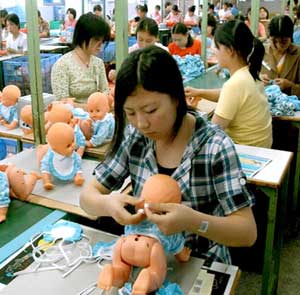
“The amazing increase in Chinese manufacturing over the past 15 years has driven the world economy to new heights and supplied consumers in developed countries with tremendous quantities of lower-cost goods,” said co-author Steven J. Davis, an assistant professor of Earth system science at the University of California, Irvine. “But all of this has come at substantial cost to the environment.”

The researchers, also from Harvard University and the University of Maryland, attribute China’s high emissions intensity – the quantity of CO2 emitted per dollar of goods produced – to the nation’s antiquated manufacturing processes and reliance on coal.

“The CO2 emissions related to China’s exports are large not just because they export a lot of stuff or because they specialize in energy-demanding industries, but because their manufacturing technologies are less advanced and they rely primarily on coal for energy,” said co-author Klaus Hubacek, a University of Maryland professor of geographical sciences.

In an earlier study, UCI’s Davis showed that developed countries were outsourcing both jobs and the problem of industrial pollution by having products manufactured in low-wage economies like China’s. This new work goes a step further to demonstrate that consumption of Chinese-made goods by consumers in advanced economies is potentially accelerating global climate change, a problem without national borders.

For this study, researchers paid particular attention to Chinese regions with high emissions intensity. Steel mills, mineral processors and petrochemical plants in Guizhou, Inner Mongolia, Ningxia, Yunnan and Shanxi are China’s dirtiest industries. Davis and his colleagues suggest that developed countries could do a lot to alleviate carbon pollution by helping improve manufacturing processes in these areas.

“This analysis can help policymakers in China and internationally identify the industries and provinces in which efforts to promote less energy-intensive manufacturing equipment and practices would have the largest leverage to reduce CO2 emissions,” said lead author Zhu Liu, a research associate at Harvard and a Resnick Prize postdoctoral scholar at the California Institute of Technology. “Given the differences we observed within industries and across provinces in China, many opportunities would involve creating incentives to promote the adoption of Chinese best practices.”