
 Brij Khandelwal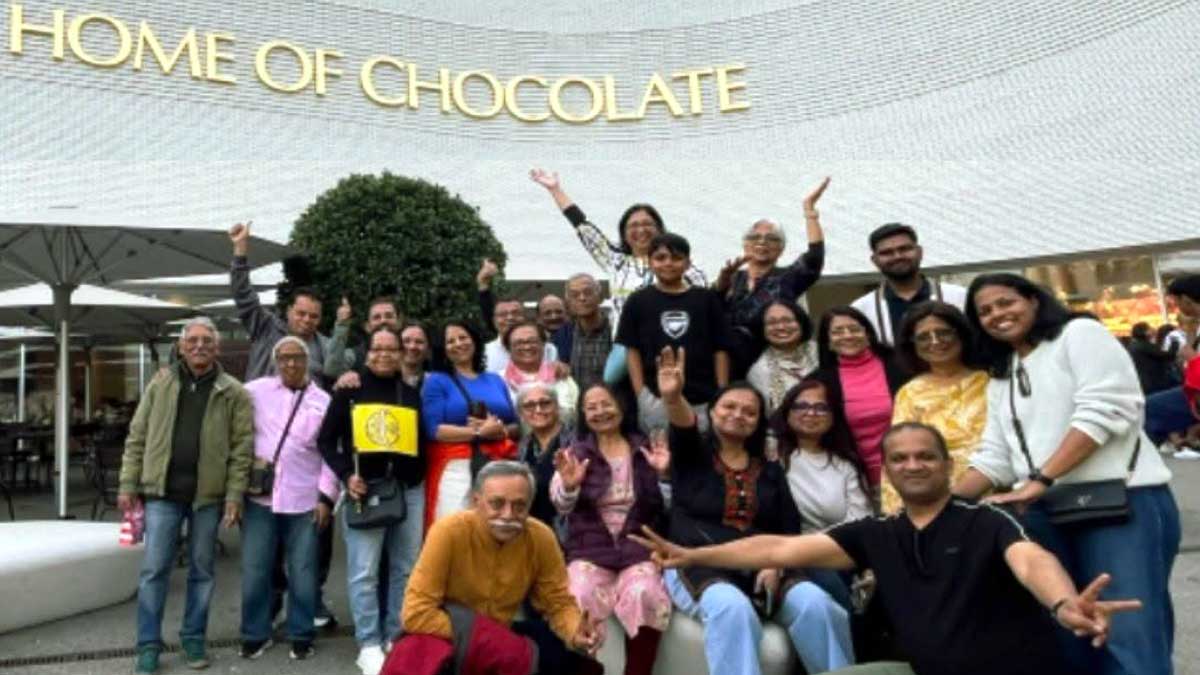
What happens when nature pours all her beauty into one small country, wraps its mountains in snow, and humans build trains that climb slopes steep enough to make even gravity nervous? Welcome to Switzerland.
Here, mountains seem to whisper to the sky, lakes gleam like giant mirrors, and trains run so punctually that even clocks probably stand to attention when they pass.
Our journey through Zurich, Interlaken, the Jungfrau region, Titlis and Lucerne offered a spectacular blend of nature, engineering and Swiss discipline. At the mountaintops, the views were so breathtaking that, for a few moments, even our words froze in the cold. But how long can Indian travellers remain silent? Sooner or later, two subjects are bound to arise: food and patriotism.
Our journey began in Zurich and continued towards Interlaken and the mountains beyond. As the train climbed higher, the landscape changed dramatically. Green valleys slowly slipped behind us, replaced by towering cliffs, steep slopes and snow-covered peaks.
The train itself became part of the spectacle, negotiating the mountain climb with remarkable precision. The tracks twisted upward like a snake making its way towards heaven. We could almost imagine the train politely telling the mountain: “Excuse me, brother. Please make way. The Indians are coming!”
At times, it felt as though the train was carrying not just passengers but our courage as well. Fortunately, Swiss engineering seemed to have everything under control. The mountain remained calm, and the passengers stayed safely on board.
Cable cars added another layer of adventure. Suspended in the air, they carried us steadily above the valleys. The houses below looked like toys, roads became thin pencil lines, and the green fields stretched out like a painting by a master artist.
Looking down, the heart whispered, “What a magnificent view!” The mind, however, quietly asked, “What if the cable car decides to take a day off?”
We trusted Swiss engineering, pushed aside our fears and reached for our cameras. After all, a tourist must capture the view, even when the view is busy taking away the tourist’s breath.
Then came a sight our eyes may never forget: a snow-covered mountain standing like an elderly emperor, wearing a dazzling crown of ice. It had the quiet dignity of a ruler who had watched centuries pass without moving an inch.
Sunlight fell on the snow in flashes of silver and delicate shades of blue. The air was freezing, yet the landscape radiated a warmth that made us wish time would pause.
Every traveller began clicking photographs. Everyone wanted to take home a small piece of paradise. Yet capturing nature on a mobile phone is a curious business: the real masterpiece stands before us, while we search for its miniature version on a screen.
The glacier at Titlis left us spellbound. Its world of snow and ice was magnificent, but it also carried a serious message. Melting glaciers remind us that nature’s beauty cannot be taken for granted. The same mountains that delight us today may look very different to future generations.
Nature seemed to be saying, “Enjoy my beauty, but please take care of me. Otherwise, your grandchildren may see me only in photographs.”
The joy of witnessing such landscapes must go hand in hand with the responsibility to protect them. Switzerland appears to have received an especially generous blessing from nature. Mountains, lakes, greenery, spotless roads and impressive infrastructure come together in a rhythm resembling a beautifully composed poem.
Our knowledgeable tour manager, Martha Gomes, explained that Switzerland’s story is not only about natural beauty. Its organisation, punctuality, cleanliness and technical efficiency are equally impressive.
Trains follow their schedules. Cable cars function in orderly fashion. Machines manage many routine tasks. The entire country seems to move under the guidance of an invisible conductor.
A fellow traveller observed, “India offers a different kind of travel experience. A stranger can begin a conversation within seconds. A cup of tea can lead to discussions on politics, cricket, inflation and relatives. Within five minutes, someone may narrate their life story, and then ask for yours!”
In Switzerland, conversations are often brief and focused. Systems and procedures play a central role in everyday life. India, meanwhile, has its own tradition of spontaneous human connection, warm exchanges and unexpected help from strangers.
One offers the precision of machines; the other offers the warmth of human relationships. Both have their own charm. Then came a memorable Indian moment at a mountain railway station. Indian travellers and members of the diaspora from two groups gathered together. Suddenly, the national anthem and ‘Vande Mataram’ rang out.
Snow-covered peaks surrounded us. A cold breeze swept through the station. And in the middle of the Alpine landscape came a powerful, familiar expression of Indian identity.
For Indians living abroad, such moments reflect a continuing connection with their homeland. Distance may separate people from India, but memories of home and the feeling of belonging remain remarkably strong.
Yet even then, our eyes kept returning to the glaciers, lakes and mountains. Nature, after all, was putting on a show that demanded repeated attention.
Lucerne added a gentler, more romantic chapter to our Swiss journey. Nestled beside the clear blue waters of Lake Lucerne and surrounded by mountains, the city looked as if it had stepped out of a postcard.
The famous Chapel Bridge, with its flowers, wooden beams and old-world charm, drew visitors from every corner of the world. The waterfront was peaceful, the swans moved gracefully across the lake, and the distant mountains stood silently like watchful guardians.
Lucerne has the rare ability to feel lively and tranquil at the same time. Its streets are orderly, its buildings elegant, and its lakefront inviting enough to make one forget the rush of travel. After the dramatic snowfields of Titlis and Jungfrau, Lucerne offered a softer beauty, calm water, historic bridges, colourful facades and a relaxed evening glow. And, of course, it offered something equally important to Indian travellers: delicious Indian food.
No travel story is complete without food. Whether in Agra or Zurich, on a mountain peak or inside a hotel room, the Indian traveller eventually faces one unavoidable question: “What’s for lunch today?”
Indian food is now widely available across Europe. Vegetarian meals, Jain dishes and South Indian cuisine can be found with surprising ease. During our trip, we enjoyed South Indian food more than once.
Looking back, carrying a bottle of pickle from home was probably unnecessary. Indian restaurants here served pickle with meals too.
Our pickle bottle must have wondered, “Why did you drag me all the way from India when I could have stayed comfortably at home?”
Lunch brought us vada pav, pav bhaji and steaming cups of spicy tea. In the chilly weather, hot tea felt like a blessing. One sip, and the tired traveller was ready to conquer another mountain.
The chocolate house was another delightful stop. There were chocolates of every variety, rich, creamy, crunchy and dangerously tempting. Some were so delicious that the tongue immediately demanded a second round. Then came the real jackpot: generous quantities of free chocolate.
Our energy levels suddenly rose higher than the mountain peaks. Smiles spread across the group, hands filled with chocolate, and the Swiss economy revealed its sweetest side.
Who said tourism was tiring? A little chocolate, it seems, is a perfectly respectable form of mountain rescue. After a long day of travel, Lake Zurich offered a peaceful and refreshing experience. The calm water, orderly surroundings and evening atmosphere created a welcome sense of tranquillity. Dinner at another Indian restaurant brought the day to a satisfying close.
The familiar flavours of Indian spices offered a comforting taste of home, even in the heart of Switzerland. Indian food does more than fill the stomach; it carries memories, emotions and a sense of belonging. Give an Indian traveller a hot roti, a spicy curry and a cup of tea, and he may be ready to conquer the world all over again.
Switzerland gave us a rich combination of nature’s poetry, engineering excellence and a distinctive social system. We came to see the mountains, but along the way we discovered chocolate houses, peaceful lakes, historic Lucerne, delicious Indian food and plenty of entertaining experiences.
So far, we have hardly had a chance to miss India. Indian food has been available, Indian faces have appeared, and familiar touches of home have emerged in unexpected places.
India’s pride and the tricolour remain firmly in our hearts. Wherever Indians travel, they carry their food, conversations, humour and spirit with them.
As we returned, we carried memories of snow-covered peaks, peaceful lakes, refreshing green valleys, punctual trains, Lucerne’s quiet charm and the sound of our own country echoing among the mountains.
Switzerland reminded us of something beautiful: when nature smiles, mountains come alive.
Meanwhile, Lady Martha announced, "Tomorrow we shall leave early to visit another country, that is, one of the three smallest countries."
Related Items
Small families, Fractured bonds! Blame it on family planning!
Liechtenstein: A 'tiny' country and a 'giant' surprise...
Dormant Small-Cap Mutual Funds awaken with hopes of revival