
 Dharmendra Kumar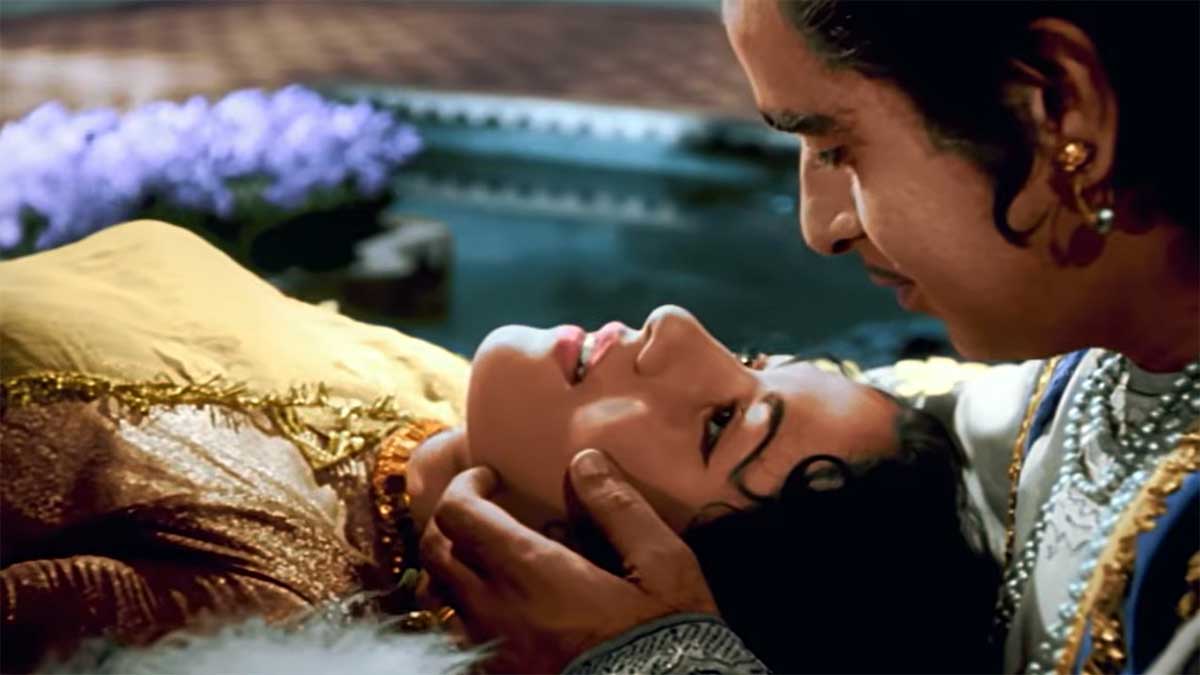
There are some voices that make time seem to stand still. It is as if a love story, imprisoned for centuries within the walls of an ancient palace, suddenly comes alive. As if the tears hidden in the heart of a woman yearning for her beloved emerge as melodies. And as if, before the power of music, royalty, grandeur, and all the glitter of the world seem insignificant.
When K Asif’s film 'Mughal-e-Azam' arrived on screen in 1960, audiences witnessed more than just a love story. They entered a cinematic world of an emperor’s authority, a prince’s rebellion, Anarkali’s love, and music that gave voice to the pain of that love, a resonance that has not faded even today.
Also read: जब शास्त्रीय सुरों ने पर्दे पर रच दी प्रेम की अमर कहानी...
There is a moment in the film when the voice of Ustad Bade Ghulam Ali Khan is heard. The song is 'Prem Jogan Ban Ke…' It is not merely a song; it is the cinematic arrival of a classical musical heritage that not every filmmaker would have dared to embrace.
The story goes that K Asif was unwilling to compromise on his film. He wanted the music of 'Mughal-e-Azam' to possess the same grandeur and dignity as its magnificent scale. Naushad was the film’s music director, and he knew that certain moments in this historical love story called for an extraordinary voice, one that stood apart from conventional film singing. His attention turned to Ustad Bade Ghulam Ali Khan.
But, Khan Sahib was not enthusiastic about singing for films. He was already an established figure in the world of classical music. For him, music was not something to be moulded according to a film’s requirements. His singing had its own dignity, and he wanted to preserve it.
Naushad and K Asif approached Khan Sahib to persuade him. But the maestro was not easily convinced. Bade Ghulam Ali Khan reportedly demanded a substantial fee, hoping to dissuade them. It is said that he asked for ₹25,000 for a single song. This was several times more than what film singers of the period generally received. At the time, even leading playback singers such as Lata Mangeshkar and Mohammed Rafi were reportedly paid around ₹300–400 per song. Khan Sahib is said to have expected the filmmakers to back away when they heard such a large figure.
But, K Asif accepted the condition. For him, the stature of 'Mughal-e-Azam' stood above any compromise. Khan Sahib now had little room to refuse the film’s offer.
The recordings took place, and Bade Ghulam Ali Khan sang two compositions for 'Mughal-e-Azam', 'Prem Jogan Ban Ke…' and 'Shubh Din Aayo Raj Dulara…'. It was, in itself, a remarkable event. The voice of a classical vocalist who generally remained distant from the world of film music was now set to be heard in one of Indian cinema’s most ambitious productions.
But, the arrival of 'Prem Jogan Ban Ke…' on screen became a story of its own. Salim and Anarkali are immersed in love. There is no dramatic commotion in the scene, no war, no royal court, no elaborate dialogue. An unusual stillness fills the atmosphere. Salim gently brushes a feather across Anarkali’s face. The camera lingers on their expressions, and then Bade Ghulam Ali Khan’s voice descends into the scene, 'Prem Jogan Ban Ke…'.
At that moment, the scene ceases to be an ordinary romantic interlude. Feelings of love, hesitation and surrender emerge in Madhubala’s eyes. Dilip Kumar, as Salim, is silent too. The two communicate not through words, but through their eyes and expressions. Behind the images, Bade Ghulam Ali Khan’s voice gradually gives meaning to that silence.
In Khan Sahib’s voice, love does not seem like a fleeting or superficial attraction. There is a profound absorption in it, as though love itself has become a form of devotion. This is the most compelling aspect of 'Prem Jogan Ban Ke…' The depth of classical singing and the tenderness of Madhubala’s performance blend so seamlessly that the audience does not merely listen to the song; it begins to feel it as part of the scene.
The way the song was presented also reflects K Asif’s cinematic sensibility. Known for its vast sets and grandeur, 'Mughal-e-Azam' offers a relatively quiet and intimate moment here. The camera captures the characters’ expressions and allows the music room to breathe within the scene. Bade Ghulam Ali Khan does not appear on screen, yet his voice becomes an unseen presence between the two lovers, a character that is felt, though never seen.
This was the kind of artistic experiment that gave the music of 'Mughal-e-Azam' a distinctive dimension. The film also featured the voices of popular singers such as Lata Mangeshkar, Mohammed Rafi and Shamshad Begum, but Bade Ghulam Ali Khan’s voice had an entirely different character. It connected the film with the tradition of Hindustani classical music, whose depth and dignity suited the film’s Mughal setting.
The role of 'Prem Jogan Ban Ke…' in the success of 'Mughal-e-Azam' should be understood in this context. It would not be accurate to say that the film succeeded solely because of this song. Its popularity rested on several elements, the story, performances, dialogue, magnificent production and music. Songs such as 'Pyar Kiya To Darna Kya…', 'Mohe Panghat Pe…' and 'Teri Mehfil Mein…' helped make the film a household name. But 'Prem Jogan Ban Ke…' added a classical depth to its love story that set it apart from the film’s other songs.
These songs did not mark the beginning of a long career for Bade Ghulam Ali Khan in the world of films. He sang the two compositions for 'Mughal-e-Azam' and then returned to his world of classical music. Regular playback singing never became a part of his musical career. That is precisely what makes his appearance in 'Mughal-e-Azam' all the more special, as though a great artist had lent cinema a few precious moments from his vast musical journey.
Time passed. The sets of 'Mughal-e-Azam' grew old, technology changed, the colours of the screen evolved, and the language of cinema continued to transform. Yet that scene from 'Prem Jogan Ban Ke…' remains in its place.
For a few minutes, Bade Ghulam Ali Khan’s voice carried the love unfolding on screen beyond the boundaries of time. The scene comes to an end, but its feeling lingers. And that is why, when we remember 'Prem Jogan Ban Ke…', 'Mughal-e-Azam' becomes more than a magnificent film. It becomes a love story in which music, too, is a character—one that remains unseen, yet continues to be heard long after the story has ended.
Related Items
‘In Haseen...’ captures melody of love amid beautiful valleys
When the ‘Hanuman Chalisa’ resounded on the silver screen...
Vanishing newspaper, Fading TV, and the tyranny of tiny screen…