
 Samiksha Bharti News Service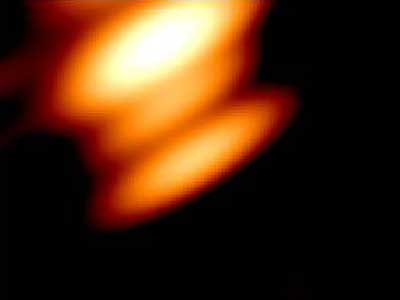
Astronomers have for the first time spotted two black holes circling each other, locked in a cosmic dance.
Black holes are usually invisible, but their surroundings glow brightly as matter falls in. Astronomers have previously imaged just two of them directly: the supermassive black holes in the galaxy Messier 87 and in the heart of our Milky Way, Sagittarius A. Both revealed a shadowy silhouette surrounded by a ring of light.
Using an extraordinary network of telescopes, including one orbiting halfway to the Moon, Mauri Valtonen and associates, including Alok C Gupta and Shubham Kishore from Aryabhatta Research Institute of Observational Sciences at Nainital, and A Gopakumar from TIFR in Mumbai, found something different. They spotted a radio image of a quasar known as OJ287, a distant galaxy powered by not one, but two black holes orbiting each other every 12 years. For decades, astronomers suspected this cosmic duo existed because of the quasar’s rhythmic flickering, a pattern first traced back to 19th-century photographs.
It could be traced through old photographs going back to the 19th century, studied especially by Rene Hudec of the Czech Technical University in Prague, Czech Republic. The periodic behaviour was discovered in 1982, and since then, thousands of astronomers have followed it to get a complete picture of its orbital motion.
The final solution of the orbit was achieved in two publications published in 2018 in the Astrophysical Journal of the American Astronomical Society and in 2021 in the Monthly Notices of the Royal Astronomical Society of the United Kingdom. The leading author of these papers was Lankeswar Dey of Tata Institute of Fundamental Research in Mumbai, supervised by Prof Achamveedu Gopakumar, and partly by Mauri Valtonen of the University of Turku in Finland.
What remained then was to prove that the binary model was correct. The model tells exactly where to find the two black holes with respect to each other at any time. The question was whether both black holes are bright enough to be seen, and if there is an image of high enough resolution that they can be separated spatially.
The answer came in a publication in the Astrophysical Journal by Shubham Kishore and Alok C Gupta, as well as Paul Wiita of the College of New Jersey in the USA, who were able to monitor OJ287 with NASA’s TESS satellite in late 2021.
They discovered a huge brightening in just 12 hours, corresponding to the extra brightness of some hundred galaxies. OJ287 faded away equally fast, and it was confirmed by ground-based observations by several telescopes, coordinated by Staszek Zola at Jagiellonian University of Krakow in Poland. A case was made for having seen the second black hole of the OJ287 system in action.
In the meantime, a radio image of OJ287 was produced, which had an unprecedented resolution which could resolve even higher detail than the images of Sagittarius A and Messier 87 black holes. It was now possible to see both black holes, and the two black hole images were there, just where they were expected, as is now reported by Mauri Valtonen and associates in a new article in the Astrophysical Journal.
The breakthrough came when an international team used the RadioAstron space telescope, an antenna orbiting Earth at vast distances, together with ground-based observatories. This setup provided resolution sharper than any telescope on Earth alone could achieve.
The image revealed not one, but two distinct points of radio emission. Just as predicted, these were the two black holes of OJ287. Even more striking, the smaller black hole was seen launching a jet of high-energy particles. Because it whirls around its massive partner, the jet twists like a ‘wagging tail’ or a spinning garden hose, changing direction as the black hole speeds along its orbit.
The findings in which ARIES, an autonomous institute of the Department of Science and Technology, played a crucial part were published in the Astrophysical Journal. Astronomers will keep watching OJ287 year after year, tracking how the ‘wagging tail’ evolves. Although future observations will rely only on Earth-based telescopes, with lower resolution than RadioAstron’s record-setting view, the pattern of the twisting jet should continue to reveal the dance steps of the two hidden giants.
Seeing two black holes in orbit is more than a stunning image. It is a window into the future of our universe. When black holes eventually collide, they release titanic ripples in spacetime called gravitational waves, the very ripples that observatories like LIGO and Virgo have detected. Studying OJ287 gives scientists a natural laboratory for understanding how such cataclysmic events unfold.
Related Items
Black holes and cosmic jets join forces to shape galaxies
Astronomers map invisible layers of cosmic dust
Mystery behind the sting of the black scorpion decoded