
 Samiksha Bharti News Service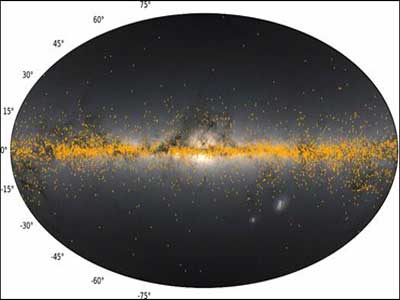
Astronomers have mapped in detail the invisible layers of cosmic dust that veil our Milky Way and redden the light of the stars. This may help trace the locations where the next generation of stars may be forming.
Our galaxy, the Milky Way, is filled with vast clouds of interstellar dust and gas that can block or dim the light from stars. This is called ‘extinction’ of starlight. Understanding how the dust is spread across the Galaxy helps scientists learn more about where stars form and the structure of the Milky Way.
Scientists from Aryabhatta Research Institute of Observational Sciences, an autonomous institute under the Department of Science and Technology, used the data from more than 6,000 open clusters, a type of star cluster, to chart the distribution of this interstellar dust across the Milky Way's galactic plane or disk. Most of these clusters lie close to the Galactic disk, which is the thin plane of the Galaxy where interstellar matter is predominantly concentrated and star formation takes place. Therefore, they act as reliable tracers for mapping the distribution of interstellar dust, which absorbs and dims their light.
The study led by Dr YC Joshi reveals that the dust is not evenly distributed. Instead, it forms a thin, wavy layer that does not align perfectly with the central plane of the Galaxy, but rather lies below it. This ‘reddening plane’, as scientists call it, shifts up and down in a wave-like pattern as one looks around the Galaxy. Most of the dust is found in the direction of Galactic longitude 41°, while the least is around 221°. Interestingly, the Sun is located about 50 light-years above this dusty layer.
The thickness of the dust layer also varies, being denser in some regions, especially toward the Galactic centre, and thinner in others. This uneven distribution points to the dynamic and complex nature of our Galaxy's structure. This mapping gives astronomers a clearer picture of how dust is arranged in our part of the Galaxy, which is crucial for accurately studying stars and other galaxies. It also confirms that much of the dust is packed into a narrow band where new stars are actively forming.
The study highlights the need for future observations, especially of more distant regions, to build an even more complete three-dimensional view of the Milky Way’s dusty structure. Upcoming missions like Gaia’s next data release and the Vera C. Rubin Observatory’s Legacy Survey of Space and Time will play a key role in this effort.
Related Items
The biggest ‘Cosmic Con’ of ‘Power Brokers’
Light-activated nano-robots can help targeted breast cancer therapy
The Odyssey: A timeless epic for every generation…