
 Brij Khandelwal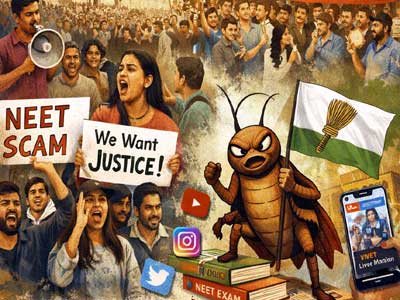
Imagine the final scene of Shyam Benegal's celebrated film Ankur. A little village boy silently watches everything around him: the landlord's authority, the poor's helplessness, and the daily drama of injustice. Then, suddenly, he picks up a stone.
The stone flies towards the mansion. The screen turns red. It is only a small stone, but hidden inside it is the seed of a much larger rebellion. That scene from Ankur comes to mind again in India of 2026.
Read in Hindi: जंतर-मंतर से उठी आवाज पहुंच रही है यूपी के गांवों तक...
This time, the stone is not real. Sometimes it becomes a slogan against examination paper leaks. Sometimes it takes the form of a social-media meme. Sometimes it becomes a crowd of students at Jantar Mantar.
And now, the same voice is reaching schools in the villages of Uttar Pradesh. Children in Unnao, Lucknow, Kannauj and Hamirpur are asking questions. Why is the food not proper? Where is the drinking water? Why are there not enough teachers? Why is there no proper road leading to the school?
In Chandpur and neighbouring villages of Hamirpur, hundreds of children marched to the Collectorate with their demands. They were not asking for the moon. They simply wanted a decent road to reach their school.
Attempts were made to persuade them and put pressure on them. But this time, the children were not ready to remain silent. In truth, the fire had been lit somewhere else.
At Delhi's Jantar Mantar, it began with examination paper leaks. Major entrance examinations, particularly medical tests such as NEET-UG, shook the confidence of millions of young people. Students wondered: if they study for years, spend lakhs on coaching, and somebody can simply steal or leak a question paper, then what is the value of hard work?
Some young protesters jokingly called their group the ‘Cockroach Janata Party’. The name was strange, and so was the method. Instead of traditional student organisations and long speeches, they used memes, Instagram, videos and the noise of social media. But gradually, the anger behind the laughter became impossible to ignore.
Sonam Wangchuk sat on a hunger strike. On July 20, tension arose between protesters marching towards Parliament and the police. The police stopped them, but the protesters continued to maintain pressure. Then came something few people may have expected. The pressure from the streets reached the doors of power.
On July 25, Union Education Minister Dharmendra Pradhan had to resign. It was seen as an extraordinary development in the politics of the Modi era. For the first time, it appeared that the voice of ordinary students standing on the streets could reach the chair of a powerful minister.
A series of actions followed. Nearly 600 officials associated with the National Testing Agency were removed. A new four-level system was introduced to scrutinise examination question papers. Security at examination centres and safeguards for confidentiality were strengthened.
On August 15, Prime Minister Narendra Modi announced free online coaching for competitive examinations and AI training for one crore young people. Ministers then began visiting university campuses directly. Programmes such as ‘One Day, One University’ were launched.
The question is, ‘who made all this happen?’ No major opposition movement. No experienced political party. No established student union. It was done by young people whom politics had often dismissed as immature.
Ironically, the opposition, from which a serious challenge to the government was expected, had long appeared to be searching for direction. The opposition led by Rahul Gandhi continued to struggle with electoral defeats and organisational weaknesses. The INDI Alliance, too, failed to create a clear narrative that could convince the ordinary voter it was a strong alternative.
Parliament saw uproar, protests and slogans. Yet the shine of power remained largely untouched. Then, suddenly, this strange disturbance began at Jantar Mantar.
The ‘cockroach’ spectacle, sharp language, abuses and personal attacks offended many people. Some found the sight of girls using abusive language particularly distasteful; boys, after all, were expected to behave like boys! Yet someone had certainly thrown a stone into the stagnant pond of Indian politics. The ripples began to spread.
It is easy to compare this with Jayaprakash Narayan's movement of the 1970s. Students were then also angry over fees, corruption and a failing system.
Eventually, the movement grew into a call for ‘Total Revolution’. Loknayak Jayaprakash Narayan became its moral face. This time, Sonam Wangchuk too made an unfinished attempt to give moral strength to the anger of the young. But there is a major difference between the two movements.
The JP movement wanted to transform the entire system. The demands of students in 2026 were more direct: stop paper leaks, remove those responsible and repair the examination system.
And, most importantly, their politics was created on WhatsApp, through memes and on Instagram. This was not politics conducted from union offices. This was politics born on mobile phones.
But the story is not over yet. The small stone thrown at Jantar Mantar has now reached the villages of Uttar Pradesh. Children are no longer protesting only against paper leaks. They are demanding roads to their schools, clean drinking water, better food and enough teachers. That is the real test.
Getting a minister to resign is relatively easy. Removing a few officials is also easy. Announcing a new policy is perhaps the easiest thing of all. The difficult task is changing the system.
India's coaching culture is still thriving. The obsession with examinations remains uncontrollable. Schools in many villages are still in poor condition. The gap between a degree and a job remains as wide as ever. Yet one thing has become clear.
When the grown-ups fall asleep, sometimes the children ring the bell. The child in Ankur threw a stone. The children of 2026 have thrown one too.
Now we have to see whether those in power dismiss that stone as mere mischief, or recognise the new ankur: the new shoot of change, growing inside it. Thankfully, the Central government appears to have taken the matter positively and has moved promptly to initiate necessary measures.
Related Items
Wealthy protect themselves from climate risks, leaving poor vulnerable
From village crossroads to global future, English is India's new strength
Sweetest two-month lie we tell our children…