
 Brij Khandelwal
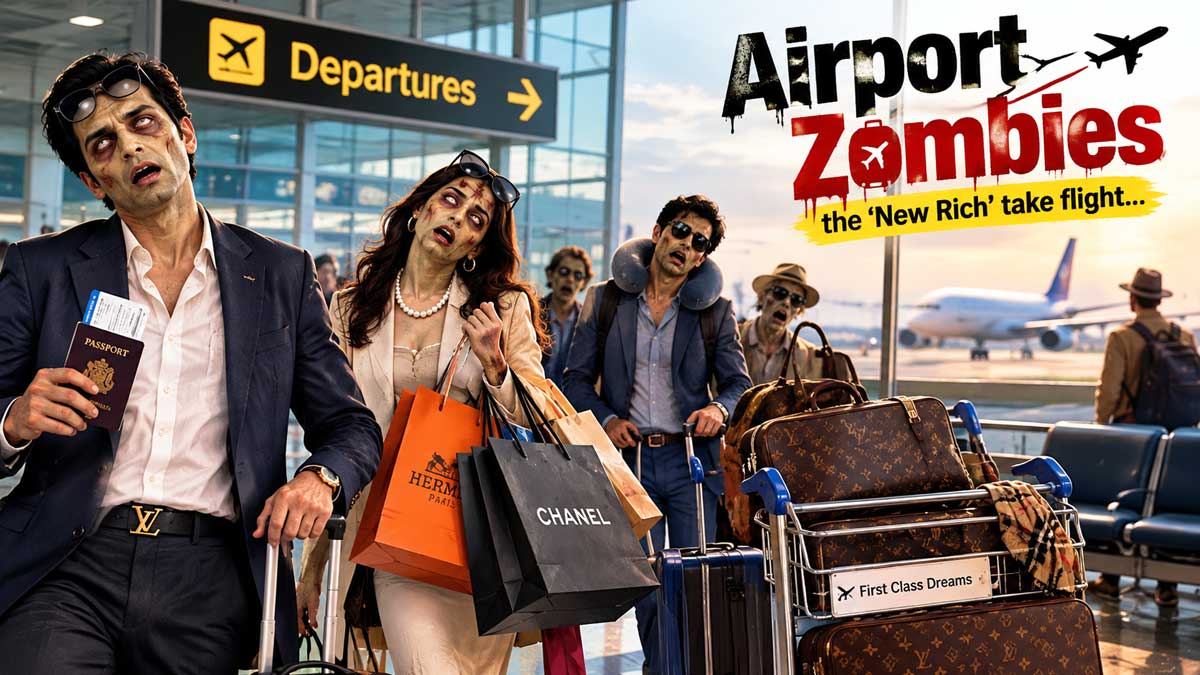
Indian airports have achieved something remarkable. They have turned ordinary citizens into temporary aristocrats or nawabs.
At home, these people are perfectly normal. They ask their wives for tea, instruct their children to carry bags, and discuss vegetables with neighbours. But the moment they pass through the airport gate, something ancient awakens in them: the belief that they have been mistakenly born into the middle class and must now correct the error loudly, in English.
“Dear, please take care.” “Oh, my God!” “Actually, I was thinking…”, “You know, we travel a lot!” One begins to wonder whether the airport is a departure lounge or a reincarnation centre for people who believe they were British viceroys in a previous life.
My flight to Agra carried several fine samples of this species: designer sunglasses, shining shoes, iPhones, branded luggage, and expressions suggesting the aircraft had been inherited from a great-grandfather.
A woman handed her child a glass of milk and announced, “Beta, milk hot hai. Carefully pakdo.” Then she turned to her husband with the gravity of a diplomat: “Dear, what was the name of that hotel in Switzerland?” “The Grand… something.” “Oh, my God! I forgot to say bye to my darling Little Doggy!”
The phone rang. “Hello, Asha Madam? Please tell Huffy from my side… I miss him!” The dog was at home. But its farewell had been arranged to international standards.
The first serious test of airport nawabs is the security queue. There is a line. Everyone knows there is a line. Yet one gentleman keeps leaning forward, placing his tray ahead, and gently advancing the tray of the person behind him.
“Bhai saab, there is a line.” “Oh, sorry!” And with the apology, he moves forward by another half-step. This is a uniquely Indian skill: apologise sincerely while committing the same offence again.
When the officer asks him to raise his hands, he lifts them as though he has been asked to perform a difficult Ashtanga yoga posture. His face communicates a timeless question: Do you know who I am? The officer, who meets this question several times before lunch, remains calm. The new-rich zombie does not.
In the waiting area, the next phase begins: territorial aggression. One gentleman occupies three chairs. One for himself. One for his bag. One for his jacket, sunglasses and snack box. An elderly woman asks, “Son, is this seat empty?” He looks at the bag. Then at the woman. Then at the bag again. “Actually, my wife is coming.” Twenty minutes later, the sulky wife arrives. The bag-seat is vacated for her, naturally.
Elsewhere, a man places his small bag on a chair. “Is this seat empty?” “No, occupied.” “Who is sitting there?” “My stuff.”
But... Use the airport app to complain, the arrogant IT company coolie with Silicon connections says arrogantly, avoiding eye contact.
Then comes the announcement: “Passengers travelling in Zone 3 may now board.” Zone 3 rises.
But Zone 1 is already standing. Zone 2 has infiltrated Zone 1. Zone 5 is at the very front, radiating confidence.
I ask one Zone 5 passenger why he is there. “Just like that.” “Just like that” is not merely an answer. It is a national philosophy. The staff says, “Sir, please wait for your zone.” He replies, “But I am already here.”
As though the airline had not announced a boarding sequence but personally invited him to inaugurate the aircraft.
One woman, Sunita, pleads, “Can you please allow us? We are travelling with two minor children.” The staff gently replies, “Ma’am, there are other families also.”
Her face collapses. Apparently, Sunita had believed hers were the only children ever produced by humans.
Once inside, the phone comes out. Selfie. Window. Seat. Boarding pass. Coffee. Family video call. “Hello, Mummy! We are on the flight.” “Where are you going, Ram Prasad?” “Agra.” “Why?” “Business meeting.”
I sat beside him, smiling. I knew there was no business meeting, as he told someone on the phone a few moments ago. There was a shop inauguration.
But “shop” lacks prestige. “Business meeting” has gravitas. In the new-rich dictionary, a small enterprise is a “business hub,” a scooter is “my ride,” and a trip to Agra becomes “European-style travel.”
One gentleman turned his camera towards his seat during a video call. “See? Business class!” He was in economy. A passenger behind asked where business class was. “Actually, this is premium executive economy class.” The ticket said ordinary economy. But on social media, truth has always travelled in the cheapest class.
The cabin crew announces that electronic devices must be switched off. One gentleman continues speaking into his phone. “Hello? Can you hear me?” Brother, the plane is airborne. Even the ground below is having difficulty hearing itself. “Sir, please switch off the phone,” says the air hostess.
He lowers it and whispers, “You know, I am on an important call.” I assumed the Indian economy depended on that call. Ten minutes later, he was asleep. The important call had ended. The nation had survived.
So, going to see the Taj, I asked his ultra-modern lady. No, we go to Switzerland, she announced, a bit loudly.
Their English is a wonder. The words may be wrong. The pronunciation may be creative. But confidence remains fully business class. “Can I have one veg vegetarian?” Perhaps this is vegetarianism’s international premium version.
“I want hot water, but little hot.” “Where is the washroom toilet?” “I am feeling very hungry stomach.” English has its place. Hunger has its place. Grammar, poor thing, has been left at home with the dog.
The final performance begins before the aircraft has fully stopped. The seat-belt sign is still on. The plane is still moving. Yet three great men have already risen. One opens the locker. One pulls his bag. One goes live on video.
“Please remain seated,” says the announcement. They appear to have heard, “Please stand immediately.” “Please sit down,” says a fellow passenger. “I only need my bag.” “The plane has not stopped.” “Nothing will happen.” Ah, “nothing will happen”, the sacred opening line of many Indian disasters.
By the end of the journey, I realised the problem is not English, money, iPhones or branded bags. The problem is the absence of restraint.
There is nothing wrong with earning well, travelling widely, buying good things, or sending children to good schools. But if money arrives without manners, the journey remains incomplete.
And let us be honest: a little ‘new rich’ lives inside all of us. The airport merely gives it a boarding pass.
Related Items
Integrating more nutrition into nutrient-rich ‘Purple Potato’
An Indian traveller’s eye-opening lessons in the ‘Art of Living’
Are Indian borders just lines on a map!