
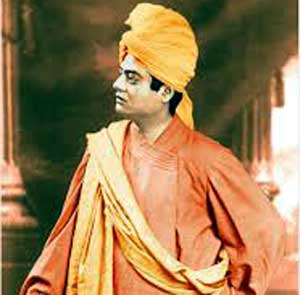
Perhaps, he was the greatest patriot to have ever been born in this country. The testimony of Mahatma Gandhi vouches for this assertion. Mahatma Gandhi visited Belur Math in 1921 and before leaving he wrote in the Visitors’ Book that after reading Swami Vivekananda’s works, his patriotism for the country had increased thousand fold. One of the Western disciples of Swami Vivekananda, Sister Christine, wrote in her reminiscences, “Our love for India came to birth, I think, when we first heard him (Swami Vivekananda) say the word, “India”, in that marvelous voice of his. It seems incredible that so much could have been put into one small word of five letters. There was love, passion, pride, longing, adoration, tragedy, chivalry, himweh, and again love. Whole volumes could not have produced such a feeling in others. It had the magic power of creating love in those who heard it.” In fact, his love for our motherland was perhaps the singular factor which held him tied to this earth. He was a born Yogi. He was a great contemplative and diving deep into meditation was the natural drift of his mind. However, he sacrificed all these to serve our motherland.
Swami Vivekananda knew everything about India like the palm of his hand. What was the source and basis of his knowledge? He was a keen student of history and had a thorough knowledge of India’s glorious past. He was immensely practical in his outlook and that helped him understand the then condition of our country. After the passing away of his Guru and mentor, Sri Ramakrishna, he had gone on a pilgrimage of the entire country on foot. He met people from every segment of the society, from the richest to the poorest, from the most learned to the most ignorant, from high caste priests to those condemned as the low caste, from Maharajas to penniless beggars. The firsthand knowledge which he gained through his explorations gave him a complete understanding of our country including the causes for its downfall. Being a visionary and endowed with an extraordinary intellect and even a more feeling heart, he could find out the cure for India’s maladies and for restoring her to her former glory. He predicted that India’s future glory would far surpass her past glory. He felt deeply concerned and pained by the degradation of our country. He said, “If there are holes in this national ship, this society of ours, we are its children, let us go and stop the holes. Let us gladly do it with our hearts' blood; and if we cannot, then let us die. We will make a plug of our brains and put them into the ship, but condemn it never.” After a stay of four years in the West, during which he achieved extraordinary fame and recognition and was virtually lionized by the society; when he was about to depart for India, a Westerner asked him how he was feeling about returning to his motherland. In reply he said, “India I loved before I came away. Now the very dust of India has become holy to me, the very air is now to me holy; it is now the holy land, the place of pilgrimage, the Tirtha."
Swami Vivekananda clearly identified the causes for our downfall, one of which was the neglect of the masses which he labeled as the great national sin. He said, “The poor, the low, the sinner in India have no friends, no help – they cannot rise, try however they may. They sink lower and lower every day, they feel the blows showered upon them by a cruel society, and they do not know whence the blow comes.” He said that millions were oppressed in the name of religion and one of the chief causes of India’s ruin was the monopoly of education by a few belonging to the privileged classes.
Swami Vivekananda said that the whole difference between the West and the East is in that, they are nations i.e. civilizations, whereas we are not. While the higher classes in India and the West are the same, but there is infinite distance between the lower classes of these countries. He lamented that for centuries people had been taught theories of degradation and have been told that they were nothing. The masses have been repeatedly told that they are not human beings and frightened for centuries till that they have become animals. Laziness, lack of energy, want of sympathy and appreciation for others were at the root of all miseries and that they should be given up.
Another cause according to him was our exclusiveness. India went into her shell as the oyster does, and refused to give her jewels and her treasures to the other races of mankind, refused to give the life-giving truths to thirsting nations outside the Aryan fold. He said that we shut ourselves from the outside world, did not go out and did not compare notes with other nations. One of the drawbacks of our nation according to him was that it totally lacked in the faculty of organization and that we are altogether averse to making a common cause for anything. He said that the first requisite for organisation was obedience which we lacked as a race. He said, “In spite of the greatness of the Upanishads, in spite of our boasted ancestry of sages, compared to many other races, I must tell you that we are weak, very weak. First of all is our physical weakness. That physical weakness is the cause of at least one-third of our miseries. We are lazy, we cannot work; we cannot combine, we do not love each other; we are intensely selfish, not three of us can come together without hating each other, without being jealous of each other.” According to him another major reason for India’s degradation was the trampling of the women. He said that our country is one of the weakest in the world because Shakti was held in dishonor here. In addition to the causes identified by Swamiji, corruption, particularly in public life has become yet another major cause. But, then the solutions given by Swamiji cover this malady also.
What is the way to regeneration? The first step in this regard is uplifting the masses by restoring their lost individuality and faith in themselves. Swami Vivekananda said that we should remember that the nation lives in the cottages and that no amount of politics will be of any avail until the masses of India are once more well educated, well fed and well cared for. He said, “our mission is for the destitute, the poor, and the illiterate peasantry and labouring classes, and if, after everything has been done for them first, there is spare time, then only for the gentry.” He said emphatically that we should feel proud of our past and derive our strength and inspiration from those glorious chapters of the bygone days. Along with this he also advocated respect for the great men of the country. He was of the firm view that material civilization was absolutely necessary to create work for the poor. He said, “Bread! Bread! I do not believe in a God, who cannot give me bread here, giving me eternal bliss in heaven! Pooh! India is to be raised, the poor are to be fed, education is to be spread...” He said that uplift of women deserves utmost priority and only after that can there be hope for any real good for the nation. He said, “All nations have attained greatness by paying proper respect to women. That country and that nation which does not respect women have never become great”.
Swami Vivekananda laid the greatest emphasis on education for the regeneration of our motherland. He said, “Education, education, education alone! Travelling through many cities of Europe and observing in them the comforts and education of even the poor people, these brought to my mind the state of our own poor people, and I used to shed tears. What made the difference? Education was the answer I got.” According to him, a nation is advanced in proportion as education is spread among the masses. But, what was the education that he advocated? According to him “education is the manifestation of perfection already in man and that what a man ‘learns’ is really what he ‘discovers’ by taking the cover off his own soul, which is a mine of infinite knowledge.” Hence he said that our process of education should be such that it helps the students to manifest their innate knowledge and power. He advocated a man-making character-building education. He said, “We want that education by which character is formed, strength of mind is increased, the intellect is expanded, and by which one can stand on one's own feet.” He said that education must make the students self-reliant and help them face the challenges of life. He was highly critical of the so-called educated who do not care for the poor and downtrodden. He said, “So long as the millions live in hunger and ignorance, I hold every man a traitor who, having been educated at their expense, pays not the least heed to them.” According to him, three things are necessary to make every man great, every nation great and that is we should have conviction in the powers of goodness, the absence of jealousy and suspicion and helping all those who are trying to be and do good.
Swami Vivekananda had immense faith in the youth of this country and said that they would work out his ideas like lions. “That you may catch my fire, that you may be intensely sincere, that you may die the heroes' death on the field of battle — is the constant prayer of Vivekananda.”
Related Items
India building its semiconductor future…
India indulges in building its space future…
Landmark Cars: Quietly building momentum…