
 Dharmendra Kumar
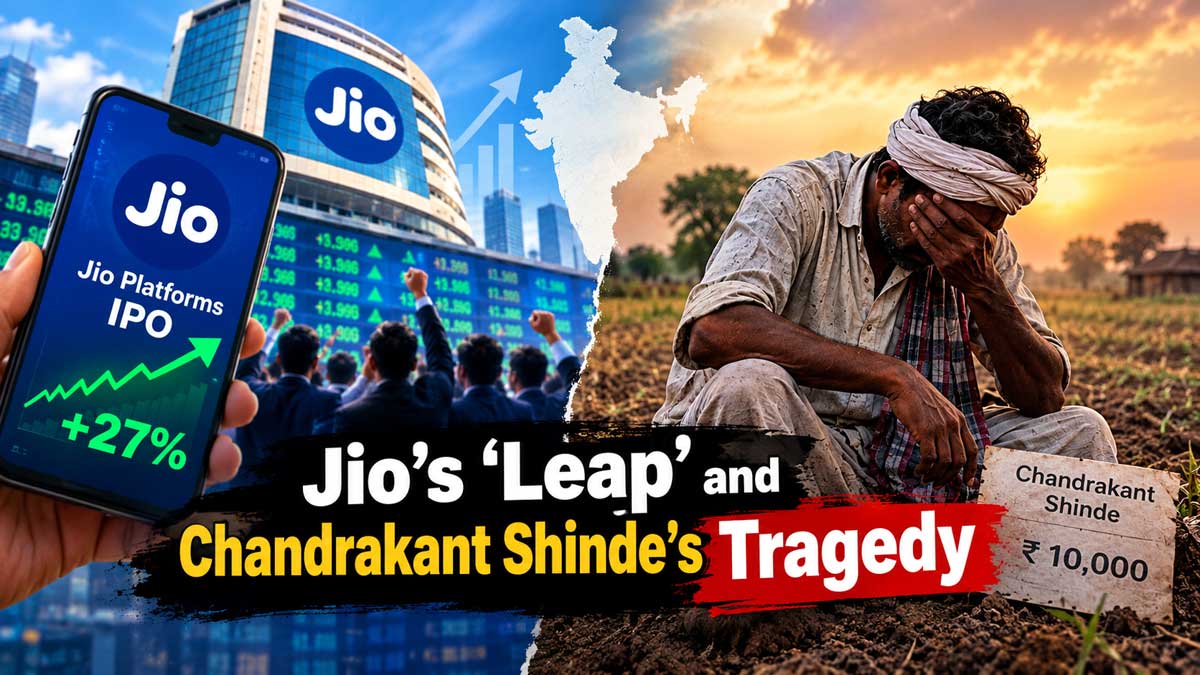
Two contrasting images of India’s economy have emerged on the same day, forcing us to reflect on the deep divide between economic growth and inequality. The country’s largest-ever IPO, Jio Platforms, made its debut on the stock market, opening with a gain of around 21 per cent over its issue price and climbing to nearly 27 per cent by the end of the trading day, sparking enthusiasm among investors.
On the other hand, the case of Chandrakant Shinde, a farmer from Nanded in Maharashtra, comes to light in connection with an alleged debt of ₹10,000. His family has alleged murder, and the police have registered a case of murder and kidnapping. For now, it would be inappropriate to describe the incident as a case of suicide. Nevertheless, this dispute involving a relatively small sum raises serious questions about the economic insecurity faced by rural communities.
Also read: जियो की 'छलांग' और किसान चंद्रकांत शिंदे की मौत का 'मलाल'
On one side, the value of investments rises significantly within hours in the capital market; on the other, a dispute involving an equally small amount pushes a farming family into deep distress. Together, these two images raise a fundamental question: are the benefits of India’s economic progress reaching all sections of society equitably?
The launch of a major IPO is an important event for the national economy. It provides companies with capital, gives investors an opportunity to participate in their growth and opens up possibilities for business expansion. Strong returns on the first day may also indicate market confidence and robust demand. However, it would be a mistake to regard a stock market rally as proof of prosperity across society. Market indices may rise, company valuations may soar, and investors’ wealth may increase within hours, while a farmer somewhere in the country continues to struggle to meet basic needs.
The most important point in this comparison is that ₹10,000 does not mean the same thing to everyone. For an investor with surplus capital, this amount may represent only a small portion of the money available for risk-taking. An investor can accept the possibility of losses alongside potential gains because some degree of financial security may already be in place. In contrast, for a farmer struggling with limited land, uncertain yields, rising cultivation costs and mounting debt, even ₹10,000 can assume extraordinary significance. The challenge is not merely to arrange the money, but also to safeguard the next crop, meet family expenses, fulfil social obligations and preserve hope for the future.
This is why poverty cannot be viewed merely as a lack of income. Economic insecurity becomes more severe when people have limited options for recovering from a crisis. An investor who suffers losses in the market may be able to wait, sell another asset or adjust their portfolio. A farmer facing crop failure, inadequate prices for produce or an approaching debt repayment deadline often has far fewer alternatives. Limited access to institutional finance, uncertain monsoons, market volatility and the terms of borrowing can further aggravate the situation. Economic inequality, therefore, is not merely a gap between the rich and the poor; it is also a divide in opportunities, financial security and the ability to recover from adversity.
Given the importance of agriculture to India’s economy, a farmer’s predicament cannot simply be dismissed as an individual failure. Farming is not merely an occupation; it is the foundation of livelihood for millions of families. Yet a farmer’s income depends on several factors beyond their control. Even after bearing the costs of seeds, fertilisers, diesel and labour, the income earned from crop production and sales remains uncertain. Natural disasters, crop diseases, falling market prices and delayed payments can upset the entire financial equation. When a farmer faces a serious crisis involving a relatively small loan or a dispute related to it, the issue concerns not only individual finances but also the effectiveness of social protection and the resilience of the rural economy.
Without establishing the circumstances surrounding a particular incident, it would be inappropriate to claim that debt was the sole cause of a farmer’s predicament. Economic pressure, alongside personal, family and social circumstances, can contribute to a tragedy. Nevertheless, such incidents provide an opportunity to examine how effectively the system protects rural families from financial distress. Preventing citizens from reaching a point where economic pressure threatens their lives and their families’ security is a responsibility shared by both the government and society. Economic policies should also be assessed by how much support they provide to the most vulnerable when a crisis strikes.
Prime Minister Narendra Modi’s government has set the goal of transforming India into a developed nation by 2047. The significance of this ambition lies not merely in strengthening India’s position among the world’s largest economies, but also in ensuring that the benefits of economic power reach a broad cross-section of society. The idea of a developed India cannot be confined to higher growth rates, modern infrastructure, global corporations, digital services, stronger manufacturing and expanding capital markets. It must also ensure that farmers receive fair prices for their produce, young people have access to decent employment, small businesses enjoy financial security and poor families are not left helpless when unexpected crises arise.
India’s progress towards 2047 cannot be assessed solely by the size of its gross domestic product or the valuations Indian companies command in global markets. We must also ask what circumstances farmers will face when dealing with small debts, how stable rural household incomes will be, and how easily people will be able to access healthcare, education and social security. If the benefits of economic expansion remain concentrated among those who already possess capital, assets and opportunities, impressive growth figures may coexist with a fragile social foundation.
In this context, rather than placing the IPO and the farmer’s case in opposition to each other, it is more important to understand the economic disparity between them. A successful IPO is not inherently a problem. Strong capital markets can provide funding to industries, create jobs and expand economic activity. The real question is how widely the benefits of this expansion reach society. Does the wealth generated through investment improve ordinary citizens’ lives through employment, better wages, local businesses and government revenue? Does financial development also strengthen the rural economy? Or is the distance between rising asset values and insecure sources of income continuing to widen?
The government’s responsibility is not to control every gain made in the stock market or view private investment with suspicion. Its responsibility is to create an economic environment in which market dynamism and social welfare reinforce each other. Accessible and affordable institutional credit for agriculture, effective crop insurance, timely compensation, improved irrigation, storage facilities, transparent procurement of agricultural produce and direct access to markets can all contribute to this objective. Equally important are non-agricultural employment opportunities in rural areas, financial assistance for small enterprises and timely social protection for families facing distress. Announcing schemes is meaningful only when their benefits reach the intended recipients at the right time.
The government introduced the 'Ayushman Bharat' scheme to provide eligible citizens with health coverage of up to ₹5 lakh. Yet the scheme’s actual implementation and effectiveness on the ground deserve serious scrutiny. Imagine the financial relief that every household could receive if this single initiative were implemented effectively. Today, a significant number of hospitals reportedly refuse to provide treatment under the scheme. Can the government make participation in the scheme mandatory for every small and large hospital? This question deserves careful consideration, particularly because access to affordable healthcare can determine whether a family remains financially secure or is pushed into debt by a medical emergency.
Reducing economic inequality does not mean making every citizen’s income identical. The objective should be to ensure that a person’s birth, occupation or economic background does not deprive them of opportunities for a dignified life. Investors have the right to take risks and earn profits, but farmers must also have enough financial security to ensure that bad weather, low crop prices or a small debt do not jeopardise their families’ futures. Entrepreneurship and welfare, capital formation and social protection, global competitiveness and rural prosperity need not be competing priorities. Sustainable development requires a balance among all of them.
India has considerable opportunities to make its economy more productive, modern and prosperous by 2047. However, the real success of this journey will depend on how quickly those left behind in the race for development are brought into the mainstream. The creation of thousands of crores of rupees in market value on a given day may represent an economic achievement, but a farmer’s family becoming embroiled in a crisis involving a relatively small sum is a warning that must not be ignored. The contrast between these two images reveals how much remains to be done to bridge the gap between national prosperity and individual financial security.
A developed India in 2047 will be meaningful only if the celebration of economic success is accompanied by a genuine commitment to addressing the causes of financial insecurity. The measure of the country’s progress should not be limited to how rapidly an investor’s money grows; it should also reflect how effectively a citizen in distress is protected. The day a ₹10,000 investment becomes a symbol of opportunity, while a ₹10,000 debt no longer leaves a farmer feeling helpless, India will have taken a significant step towards a more inclusive and humane model of development.
Related Items
Building the infrastructure for growth in Jammu and Kashmir…
An Indian traveller’s eye-opening lessons in the ‘Art of Living’
Are Indian borders just lines on a map!