
 Brij Khandelwal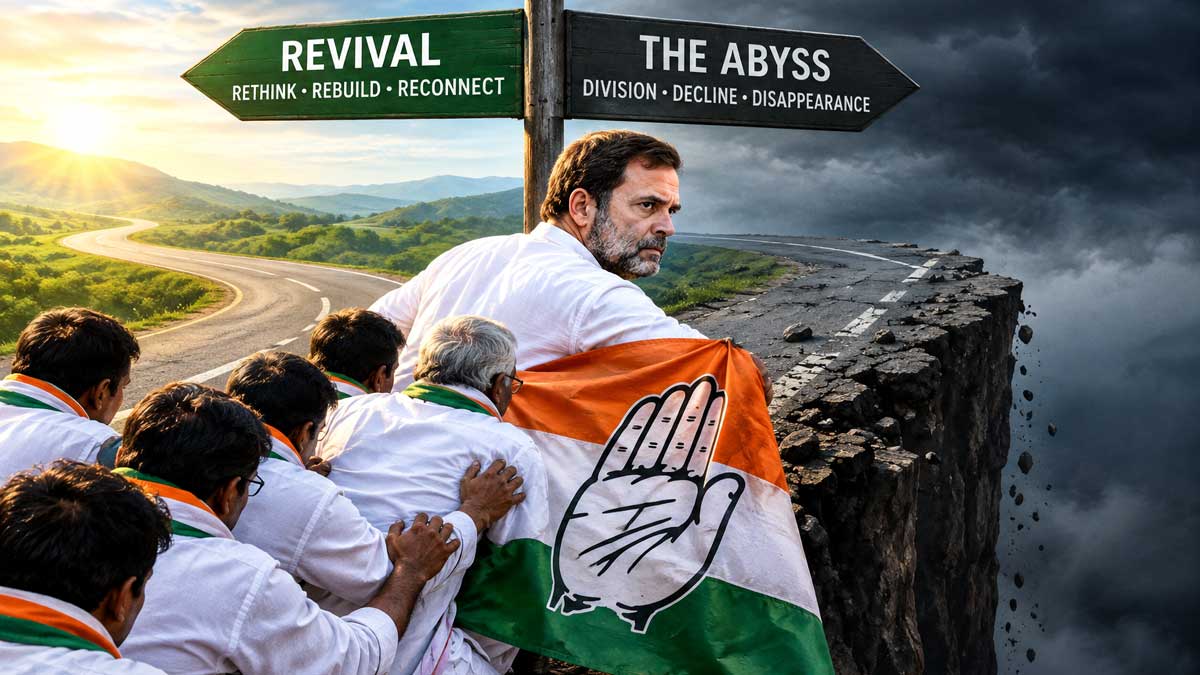
Congress politics today resembles a caravan lost in the wilderness, the path unclear, the guide uncertain. Under Rahul Gandhi's leadership, the party repeatedly stages what can only be called political ‘crow feasts’, where every half-baked statement, every hasty decision, and every weak strategy hollow out its credibility a little more. The country wants a strong opposition, but Congress often appears like a wounded traveller, one more interested in finding excuses than reaching a destination.
The greatest crisis is not one of leadership, but of trust. Congress no longer has the kind of robust, honest, and grassroots regional machinery that can build a voter base on its own strength. Old faces are exhausted. New faces are not allowed to rise. Internal democracy is locked behind closed doors. The dust of dynastic politics has settled so thick that talent cannot find sunlight.
Also read: कांग्रेस का नेतृत्व कर रहे हैं राहुल गांधी या पार्टी को ले जा रहे हैं गर्त की ओर...
Congress's current political stance seems trapped in a strange kind of waiting. Sometimes hoping the government stumbles into a crisis. Sometimes banking on inflation to inflame public anger. Sometimes trusting that foreign policy entanglements will weaken the ruling dispensation. But politics is not merely a game of opposition. People want an alternative. They want a vision. They want to believe.
Political observers note that while Rahul Gandhi's aggressive statements do grab headlines, without a strong organisation, without a booth-level network, and without a coherent economic vision, they resemble arrows fired into the wind. Congress has yet to decide what it truly stands for; is it the party of the poor, a supporter of liberal markets, or simply a platform for anti-BJP sentiment?
If the party does not swiftly transform its leadership culture, bring forward young leaders with clean images, and present a fresh economic and federal vision, its national base will shrink further. Sporadic victories in a handful of states may come, but regional parties will rapidly fill the vacuum Congress leaves behind in national politics.
The warning bells are no longer ringing softly. They are screaming like a fire alarm in a burning building. The party that dominated Indian politics for decades now resembles a tired elephant labouring up a hill, gasping for breath, while its rivals gallop ahead like thoroughbreds.
The West Bengal elections laid bare Congress's condition with particular brutality. The BJP put up a strong performance while Congress virtually disappeared from the picture. Once the banyan tree of Indian politics, the party today looks, in many states, like a dusty old signboard; noticed, but no longer read.
Congress appears to face four possible paths. The first is a slow drift into regional irrelevance. The party will not collapse, but it will keep shrinking, confined to pockets like Karnataka, Himachal Pradesh, Telangana, and Kerala. Elsewhere, it will hobble along on the crutches of regional allies. In Uttar Pradesh, Bengal, Odisha, and Delhi, Congress is already becoming a party of spectators.
The second path is reconstruction. It is difficult, but not impossible. This would require the Gandhi family to loosen its grip on day-to-day affairs, restore genuine internal democracy, empower state-level leaders, and promote non-dynastic young faces. Most critically, Congress must sharpen its ideological identity. Right now, its message swings back and forth like an old radio dial searching for a signal.
The BJP has successfully fused Hindu identity with welfare nationalism into a single, emotionally resonant brand. Congress has failed to construct any comparable narrative. Secularism alone no longer works electoral magic. Welfare promises alone are not enough. Today's voter wants identity, nationalism, development, and aspiration, packaged together.
The third path is the most dangerous. It is internal fracture and disintegration. History has already flashed these warning signs. The Trinamool Congress and the NCP both broke away from Congress. Across states, many leaders feel that the Delhi high command is suffocating their political oxygen. When loyalty is valued above ability, quiet discontent eventually becomes an explosion.
If the losing streak continues, more leaders may defect to the BJP or regional parties. Politics is not a game of standing too long on a sinking ship. Workers follow power. Leaders follow opportunity. Ideology, more often than not, arrives later, at the press conference.
The fourth path is a long but diminished political existence. Here, Congress does not die, but never returns to the summit either. It remains a pivot of opposition coalitions, wins enough parliamentary seats to stay relevant, forms governments in a few states, and occasionally plays kingmaker. This may be the most realistic scenario. But mere survival does not inspire a political movement.
Public commentator Prof Paras Nath Chaudhary puts it starkly, "Congress today resembles an old theatre troupe still performing the same plays, while the audience has migrated to digital platforms. Young voters identify Congress less by what it does today and more through social media jokes, old corruption scandals, and debates about dynastic politics. That is an extremely dangerous sign."
Yet it would be premature to write Congress off entirely. Indian politics has seen many players return from political death. But comebacks are not built on legacy, notes political analyst Venkat Subramanian, "they are built on hunger, discipline, humility, and reconstruction."
Ultimately, Congress's biggest battle is not electoral; it is psychological. Does the party still believe it is capable of leading India? Or has it quietly made peace with being a permanent opposition?
The truth is, a political party that has lost faith in itself becomes a kite without wind. It may appear in the sky for a while, but in the end, gravity always wins.
Related Items
When Politics turns the Ballot into a Pandora's Box…
BRICS’ evolution, cooperation and India's leadership…
Indian politics changing faster than desert sands in a storm