
 Dharmendra Kumar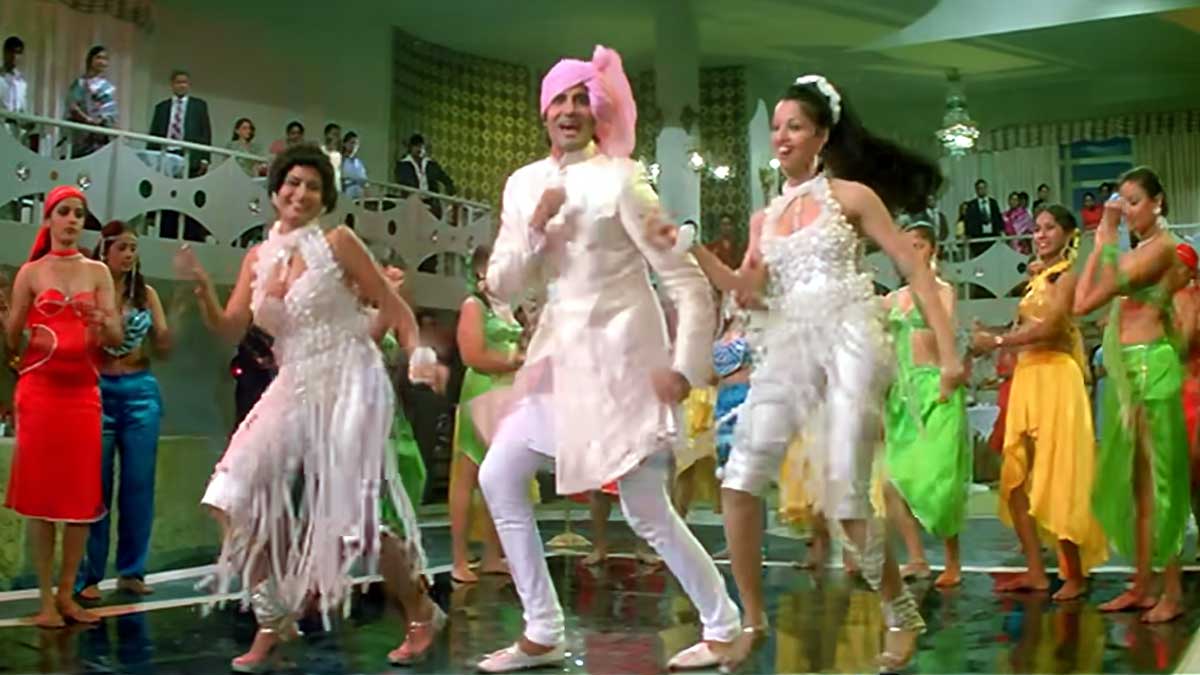
Some songs are not merely heard; they become memories of an era. ‘Pag Ghungroo Baandh…’ is one such song. When this nearly twelve-minute-long song from Prakash Mehra’s 1982 film ‘Namak Halaal’ first appeared, perhaps no one imagined that its blend of classical sargam, disco beats, qawwali influences, dramatic dialogue and Kishore Kumar’s playful voice would create a song that, decades later, would be remembered not merely as an old film song but as a cultural memory.
The story of how the song began is fascinating in itself. When Prakash Mehra approached Bappi Lahiri for the music of ‘Namak Halaal’, he had with him the famous line associated with Meera, ‘Pag Ghungroo Baandh…’. Mehra wanted the line to be developed in the style of a classical composition and then transformed into something completely different for a Hindi film song. Bappi Lahiri’s mother, Bansuri Lahiri, was also present at the time. She was a trained classical singer. She sang the line in a classical style, and Bappi immediately began adding his familiar musical touches to it. Mehra loved the combination, and the basic idea for the song was born.
Also read: ‘पग घुंघरू बांध…’ में किशोर की आवाज़ और सरगम की कहानी
But what emerged from that seed was no ordinary song. Bappi Lahiri brought several musical traditions together in one composition. There was sargam, there was qawwali, and there was disco. When Kishore Kumar heard the nearly twelve-minute composition, he jokingly complained that it seemed as though he had been given four songs to sing at once. The recording consequently took 3-4 more days.
The main verses of the song are full of fun and cinematic exuberance, but the famous sargam section in the middle makes remarkable use of the classical flavour of Raga Darbari and Raga Pilu. Not only that, but Bappi Lahiri also used the famous theme music from the renowned 1961 Hollywood film 'Come September' in it.
Read also: When September comes, India dances to ‘Come September’
For Kishore Kumar, singing the song was never going to be easy. When Bappi Lahiri played it for him for the first time, his reaction was reportedly: Is this a song or a story? At one point, he even refused to sing such a long song. He eventually agreed after Bappi Lahiri persuaded him, but the real challenge was still ahead—the elaborate sargam in the composition.
Kishore Kumar was not formally trained in classical music and had received no conventional training in singing either. He was, in many ways, a self-taught singer. The classical passage in the middle of the song therefore pushed the limits of his singing style. He certainly tried to sing it, but eventually admitted that the ‘difficult’ sargam was beyond what he could comfortably manage.
The question then arose: who would sing this particular section? After considerable discussion, it was decided that the sargam should be sung by Pandit Satyanarayan Mishra. He was brought into the recording.
Pandit Satyanarayan Mishra was not a conventional studio singer. He is a highly accomplished Hindustani classical vocalist with deep connections to the rich musical traditions of Banaras and Kashi. Live recordings of his performances at prestigious classical platforms such as the Shri Kashi Sangeet Samaj remain preserved in Indian music archives.
Later, alongside classical music, Pandit Mishra recorded a large number of devotional songs. He also lent his voice to several albums alongside celebrated singers such as Alka Yagnik, Sapna Mukherjee and Mohammed Aziz. In recent years, he has also remained active in cultural preservation through Bagheli folk traditions and traditional Ramayana bhajans.
Although he never emerged as a major Bollywood playback star, he has been deeply respected in musical and classical circles. He later became associated with films such as Mohra (1994), Gupt: The Hidden Truth (1997), Saajan Chale Sasural (1996), Pyaar Ishq Aur Mohabbat (2001) and Vinashak (1998). Kishore Kumar’s son, Amit Kumar, studied classical music under him for nearly eight years.
In this scenario, his selection for the demanding classical passage becomes easier to understand. Ultimately, Pandit Satyanarayan Mishra provided the voice for the classical section, and his voice was recorded alongside Kishore Kumar’s.
Despite this, Pandit Satyanarayan Mishra’s name was not included in the original official credits, even though his contribution to the song was significant. Several explanations have circulated over the years. One account suggests that Kishore Kumar had refused to sing if he had to share the credit with another singer. It has also been said that Kishore Kumar was particularly sensitive about his professional identity and sharing of credits. On another occasion, he reportedly became upset when Amitabh Bachchan’s name was placed before his in the album credits for the Sharaabi (1984) song ‘Jahan Chaar Yaar Mil Jaayen…’, and temporarily refused to sing for him.
According to some people associated with the music business at the time, there was also no established practice of separately crediting accompanying or guest classical vocalists in studio recordings. Interestingly, later music references have continued to identify Pandit Satyanarayan Mishra as a co-singer on the song. His contribution has also been openly acknowledged and appreciated by people in the music world, including Bappi Lahiri.
Listen carefully to the structure of the song and it appears remarkably unconventional for its time. Kishore Kumar begins almost as though he is telling a story with the words, ‘Buzurgon ne farmaya...’. The narration gradually turns into singing. Then comes Meera’s famous line, followed by dramatic dialogue, romantic elements, a qawwali-like presentation and finally the celebrated classical sargam. Bappi Lahiri had created a remarkable fusion in which the energy of popular music was brought together with the complexity of classical music.
There is another important aspect to the song. ‘Pag Ghungroo Baandh…’ was not an entirely new idea. The line has existed for centuries within the devotional tradition associated with Meera and was later adapted to a cinematic setting by lyricist Anjaan. By adding the line ‘Aur hum naache bin ghungroo ke…’, he connected Meera’s spiritual image with Amitabh Bachchan’s playful, confident and comic screen persona. A devotional line was thus transformed into a modern popular film song.
The song also makes generous use of familiar idioms. The line ‘Ram-Ram japna, paraya maal apna…’ comes from an old Hindi saying and had already appeared in films before. ‘Namak Halaal’ incorporated it into the song in its own satirical and playful manner. In this way, the composition brought together colloquial language, traditional idioms, devotional memory and modern cinematic humour.
And then comes the magic of Kishore Kumar. His voice prevents the song from being confined within the discipline of classical music. While the sargam carries the classical training of Pandit Satyanarayan Mishra, Kishore Kumar gives the rest of the song its dialogue, acting, humour, pauses, dramatic rises and sheer theatrical energy. That contrast becomes one of the song’s greatest strengths. On one side is a classical sequence such as ‘Sa Sa Sa Ga Ga Re Re Sa Ni Ni Ni Sa Sa Sa…’; on the other is Kishore’s voice, capable of making the listener laugh only a moment later.
The visual presentation of the song was another major factor in its popularity. Amitabh Bachchan performed it with a combination of dance, acting and humour. The song does not demand the kind of concentration associated with a serious classical performance; instead, it keeps offering the audience something new. Despite its length, it never feels monotonous. This was one of the things that set it apart from the three- or four-minute film songs that were more common at the time.
One of the reasons ‘Pag Ghungroo…’ eventually became a cult song is that its meaning changed with time. In the 1980s, it was part of Amitabh Bachchan’s larger-than-life star image and Bappi Lahiri’s new musical universe. For later generations, it became an example of Kishore Kumar’s extraordinary versatility as a singer. For students of music, its attraction lies in its sargam and classical elements. For lovers of vintage Hindi film music, it represents the meeting of Kishore Kumar and Bappi Lahiri. And in popular culture, it remains inseparable from Amitabh Bachchan’s distinctive performance. This many-layered appeal is what can turn a hit song into a ‘cult’ classic.
There is also an intriguing irony at the heart of the song. The very sargam that made Kishore Kumar acknowledge his limitation has become an inseparable part of the song’s identity. The voice of the classical singer whose name was not clearly included in the original credits can still be heard in one of the song’s most demanding passages. And the very length about which Kishore Kumar joked became part of what made the song so extraordinary.
The song achieved immense popularity, and Kishore Kumar won the Filmfare Award for ‘Best Male Playback Singer’ for it in 1983.
Perhaps the real story of ‘Pag Ghungroo Baandh…’ is that it cannot be confined to a single musical tradition. Its roots lie in Meera’s devotional world; its classical shadow reaches towards Raga Darbari; its body carries the sparkle of disco; its presentation contains elements of qawwali and cinematic humour; and at its heart is Kishore Kumar’s extraordinary naturalness, which could make even the most demanding composition sound effortless. Pandit Satyanarayan Mishra’s classical sargam gave the song its musical depth, while Kishore Kumar carried it into popular memory.
That is why, more than four decades later, when ‘Pag Ghungroo Baandh…’ begins to play, it is not merely an old film song that comes alive. Along with it return the Hindi cinema of 1982, the era of Amitabh Bachchan, Bappi Lahiri’s musical experimentation, Kishore Kumar’s incomparable voice, the centuries-old image of Meera—and the largely untold story of a classical vocalist whose name may have remained small in the credits, but whose voice became permanently embedded in one of the song’s most difficult and memorable passages.
Related Items
'Kabhi Tanhaiyon Mein...’, a song that still echoes in solitude...
‘Humein Tumse Pyar Kitna...’, a song of Love and Reincarnation...
From 'Beacons' to 'Landmarks', India’s changing ‘Lighthouse’ story…