
 Dharmendra Kumar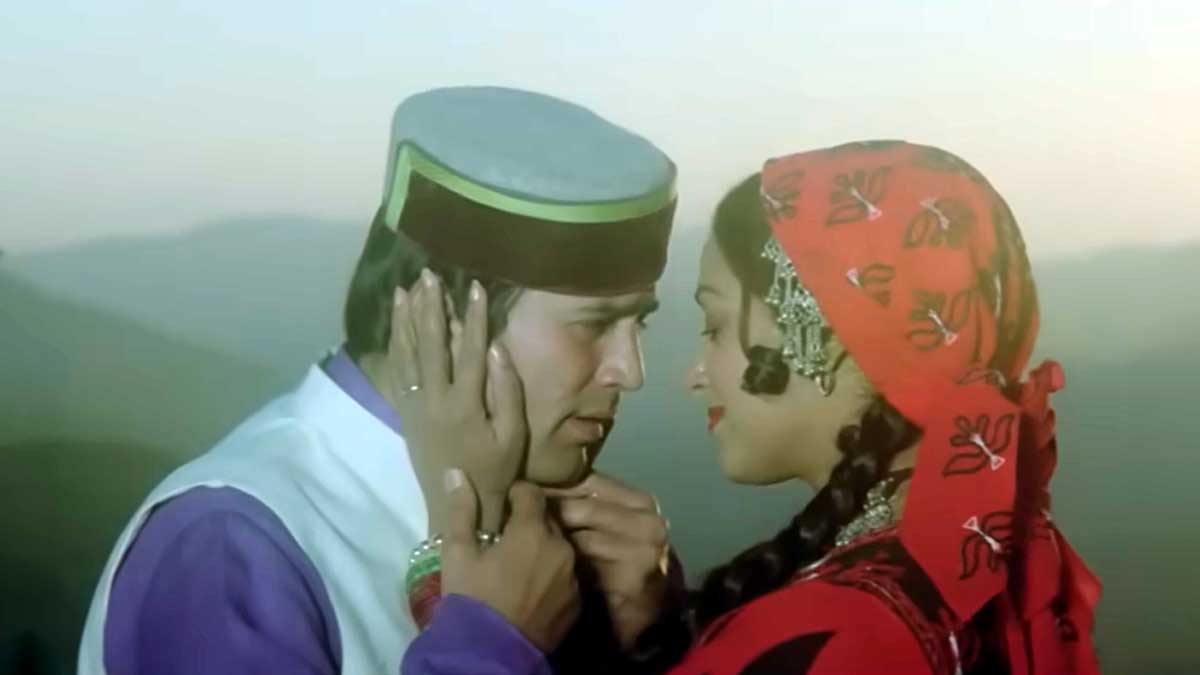
Some songs allow a young person in love to hear the voice of their own heart, while someone who has lived through the experiences of age finds in them the ache of days gone by. The song 'Humein Tumse Pyar Kitna...' from the 1981 film 'Kudrat' belongs to this rare category. Its lyrics convey the depth of love, its melody carries an unspoken restlessness, and its singing has an emotional stillness that connects listeners with their inner selves.
Directed by Chetan Anand, 'Kudrat' was among the films of its time that wove a love story together with reincarnation, mystery and memories of the past. Featuring Rajesh Khanna, Hema Malini, Raaj Kumar, Vinod Khanna and Priya Rajvansh, the film begins amid the hills of Shimla before unfolding into the complexities of past-life relationships and unfulfilled desires. Chandramukhi, the film's heroine, experiences events in her present life that seem connected to an earlier existence. This mystery linking the past and the present prevents the film from remaining merely a love story; it also raises questions about destiny, memory and justice.
Also read: प्रेम और पुनर्जन्म की कहानी सुनाता है ‘हमें तुमसे प्यार कितना...’
It is against this emotional backdrop that the significance of 'Humein Tumse Pyar Kitna...' becomes apparent. The song is not merely an expression of a lover's attraction towards the beloved. It also captures a form of love whose depth even the person experiencing it cannot fully articulate in words. The central idea of the song is that love cannot be measured by any standard. A person may feel the restlessness within their heart, but cannot determine its limits. As shadows of the past begin to influence relationships in the present, the song's emotional resonance becomes even more profound.
The music was composed by Rahul Dev Burman, while the lyrics were written by Majrooh Sultanpuri. The song was presented in two distinct vocal styles. The male version, sung by Kishore Kumar, became widely popular, while the renowned classical vocalist Begum Parveen Sultana rendered the female version in her distinctive style. Both interpretations give different shades to the same emotion. Kishore Kumar's singing conveys spontaneity, intimacy and the personal confession of someone deeply in love. Parveen Sultana's voice, on the other hand, brings the depth of classical music, an expansive range of notes and an emotional ascent that lends the composition a different kind of grandeur.
A distinctive aspect of Rahul Dev Burman's musical genius was his ability to weave the subtleties of Indian classical music into popular film melodies in a way that appealed to both trained musicians and ordinary listeners. 'Humein Tumse Pyar Kitna...' is a remarkable example. The melody is associated with Raga Bhairavi, one of the most popular ragas in Hindustani classical music. Its use of komal, or flattened, notes can effectively convey emotions such as pathos, longing, affection and intimacy. However, film music often employs ragas with considerable creative freedom, so it would not be appropriate to regard every film song based on a raga as being bound entirely by the rules of a classical composition.
The distinctive quality of Raga Bhairavi lies in its ability to evoke familiarity and warmth while also bringing out the sadness hidden within the heart. In 'Humein Tumse Pyar Kitna...', the sweetness of love is accompanied by the apprehension of separation and a sense of emotional dependence. The melody neither makes these feelings unnecessarily dramatic nor diminishes them to the point where they lose their impact. This balanced expression is what makes the song an experience that remains memorable long after it has been heard.
In Kishore Kumar's version, the melody flows with a relative ease and directness. The song reaches an emotional high as early as its first verse after the opening refrain. His voice carries such warmth that it feels as though someone is speaking to their beloved without pretence, expressing what lies within their heart. Parveen Sultana's version, by contrast, brings out the possibilities of melodic expansion and 'alaap', reflecting her grounding in classical music. In this way, a single composition becomes two distinct experiences of love. The difference is not merely between a male and a female voice; it also reflects two different musical traditions of expression. Parveen Sultana won the Filmfare Award for 'Best Female Playback Singer' in 1982 for this song, while Kishore Kumar also received a nomination for the male version.
Majrooh Sultanpuri's lyrics are equally important to the song's success. One of the finest qualities of this composition is that expressing love does not require grand metaphors, difficult words or extraordinary imagery. Its lyrics touch upon an experience that almost everyone can relate to, regardless of their circumstances. A heart immersed in love wants to understand the depth of its own feelings, yet at the same time realises that words may never be sufficient to convey the experience completely.
The song's recurring presence in the film further enhances its significance. Its melody does not merely serve as entertainment; it strengthens the film's emotional atmosphere. In 'Kudrat', the connections between the past and the present gradually unfold. Against this backdrop, the song evokes memories, separation and relationships whose influence does not fade even with the passage of time. The film's mystery keeps viewers curious about the truth behind the unfolding events, while the song draws them into the emotional world of its characters.
The younger generation associates this song with the excitement of first love, attraction or an unspoken relationship. For older listeners, it becomes a means of revisiting memories of another time and reliving moments that have left a lasting impression on their lives.
In this composition, the voice, lyrics and music complement one another rather than compete for attention. No specialised knowledge of music is needed to appreciate it. Yet listeners familiar with classical music can also enjoy its raga influences, the subtlety of its notes and the differences between the two vocal interpretations.
Some listeners may prefer the warmth and natural ease of Kishore Kumar's voice, while others may be drawn to the classical depth of Parveen Sultana's rendition. The opportunity to experience the same composition in two different ways makes the song worth returning to time and again.
Ultimately, the timelessness of a song cannot be measured by its popularity alone. What matters is whether the emotions it expresses retain their meaning as time changes. 'Humein Tumse Pyar Kitna...' remains relevant because it does not present love as an achievement or a claim. Instead, love emerges as an experience that can be felt but never fully understood. It is this uncertainty that makes the song so deeply human.
Even after more than four decades, the song continues to attract listeners because its melody carries the sweetness of classical music, its lyrics retain their simplicity, and its singing conveys emotional sincerity. Perhaps that is why every new listener discovers something personal in it and finds a connection with a song that has travelled across generations.
Related Items
From 'Beacons' to 'Landmarks', India’s changing ‘Lighthouse’ story…
Magic of love remains same, Methods changed…
Kishore’s voice and the story of ‘Sargam’ in ‘Pag Ghungroo Baandh’