
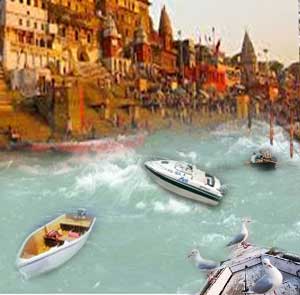
The stretch of Ganga covers a length of 2525 kilometers across five states namely Uttarakhand, Uttar Pradesh, Bihar, Jharkhand and West Bengal. It has a catchment area of 8,61,404 square km covering over a quarter of country’s land area and sustaining 46% of the total population of the country. It touches 118 towns and 1657 Gram Panchayats across 66 districts of 5 states of India.
National Mission for Clean Ganga (NMCG), created in June, 2014, is being supported by State level Programme Management Groups (SPMGs) of Uttar Pradesh, Uttarakhand, Bihar, Jharkhand and west Bengal. The main activities undertaken under Namami Gange include sewage and effluent management including creation of new and rehabilitation of existing STPs, complete sanitation coverage of Gram Panchayats, development of model cremation/dhobi ghats, development of decision support system in GIS platform for efficient planning and monitoring and creation of an IT based monitoring centre with capabilities of real time alerts and prediction. For long term protection and rejuvenation, a provision has been made for 100% funding for the entire life time cost of the treatment of assets created including O&M cost for 10 years. Due importance has also been accorded to bio diversity, conservation, maintenance of flow in the river and afforestation along river side with medicinal and native plant species along with conservation of aquatic species.
The expenditure incurred on Namami Gange in the first three years, (ie; 2014-2015 to 2016-17) is ₹3673.00 crore. For the current year (2017-18), an amount of ₹2300 crore has been allocated in the budget. It is however, observed that the pace of utilization of fund under this programme has not been satisfactory. The slow implementation of project is attributed to delay in tendering, retendering, non- availability of land, legal issues, natural calamities, delay in permission for road cutting, crossing, local festivals, higher fund requirement and pending approvals of state Cabinet etc. Regular monitoring meeting of NMCG with concerned state is expected to help in expediting the pace of the projects implementation and eliminating bottlenecks in making land available and clear the projects through tendering.
The Order issued through the Gazette of India on 7thOctober, 2016 constituting River Ganga (Rejuvenation, Protection and management) Authorities under the Environment (Protection) Act, 1986 lays down a new institutional structure for policy and implementation in fast track manner and empowers NMCG to discharge its functions in independent and accountable manner. The said Authority has its jurisdiction spread over 5 states along the main stem of Ganga and 5 states and Union territory of Delhi along the major tributaries of the river Ganga.
The key principles identified for the Authority are:
1) Maintaining the continuity of the flow without altering the natural season variations.
2) Restoring and maintaining the integral relationship between the surface flow and sub-surface water (ground water),
3) Restoration and maintenance of the property and quality of water in time bound manner.
4) Regenerating and maintaining the lost natural vegetation in catchment area,
5) Regeneration and conservation of the aquatic and riparian biodiversity in river Ganga basin,
6) To keep the bank of river Ganga and its floodplains as construction free zone to reduce pollution sources and maintain its natural ground water recharge functions
7) Making public participation as integral part of process of rejuvenation, protection and management of the river.
River surface cleaning work has been undertaken in major cities on the bank of River Ganga in collaboration with corporate bodies and Public Sector undertakings. Under Rural Sanitation programme, NMCG has provided ₹263 Crore to Ministry of Drinking Water & Sanitation for construction of toilets. About 11 lakh toilets have been constructed so far. For renovation/modernization and construction of crematoria based on standard design, initially, 20-25 urban local bodies (ULBs) are being taken up with the target of developing 100 crematoria in a year’s time.
River front / ghat development work has been taken up in seven towns of Kedarnath, Haridwar, Delhi, Allahabad, Kanpur, Varanasi and Patna in addition to repair and modernization of existing ghats. Under medium term plan Effluents Management activity, real Time Effluent Monitoring stations have been installed in 508 out of 764 grossly polluting industries of distillery, pulp and paper; tanneries; textile and sugar. Regarding Zero Liquid Discharge, action plan has been under implementation for distilleries since the last quarter of 2016. Vigilance squad of Central Pollution Control Board is closely monitoring for improved compliance.
Biodiversity Conservation is being implemented in association with Wildlife Institute of India to cover Golden Mahaseer, Dolphins, Crocodiles, Turtles and Otters etc under conservation programme. 30,000 Hectares of land is targeted to be covered under afforestation programme. For water quality monitoring, in addition to 57 Manual monitoring stations, 113 Real-time monitoring stations are being set up with display boards at selected locations. Steps are being taken for public outreach. Resource materials such as posters, flyers, brochures, pamphlets, hoardings etc. have been circulated / displayed among stake holders.
In view of multi stakeholder nature of the Ganga rejuvenation challenge, seven Ministries of Govt of India are working together on an action plan since June, 2014. Besides, MoU has also been signed between NMCG and 11 Ministries of the Govt of India to ensure convergence of their activities in protection and rejuvenation of river Ganga. MoU has also been signed with National Remote Sensing Centre, a department under Indian Space Research Organization ISRO.
For Pollution abatement and cleaning exercise in river Ganga, the policy making authorities at higher level have emphasized the need of close monitoring, focus on minimizing waste generation and disposal of waste in eco- friendly manner and publicizing the use of electric crematoria for enhancing its acceptability among the masses. Uploading the monitoring reports in public domain has been recommended.
A number of decisions taken recently indicate that the pace of project implementation has picked up momentum for pollution abatement and making the flow of river incessant but still much more have to do. State Ganga Committees and District Ganga Committees have been formed to ensure effective implementation and Participation of people in protection &rejuvenation of Ganga.
(Author is an independent researcher. These are the author’s views.)
Related Items
Song that echoed across South India, but never became ‘National Song’
How a 'Master Communicator' turns ideas into National Missions…
Supreme Court calls rivers a national asset; Orders action to save rivers