
 Brij Khandelwal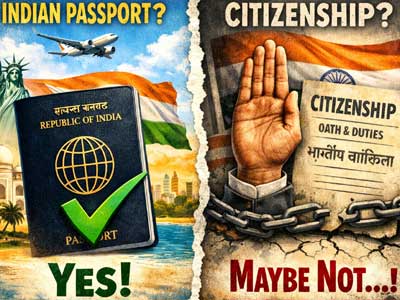
Congratulations! You now own an Indian passport. The first page declares, with all the confidence of a motivational poster: "Nationality: Indian."
Don’t break out the sweets yet. It turns out this little booklet can get you onto planes and through airport lounges, but it cannot, reliably, prove that you are legally an Indian citizen. Bravo, paperwork democracy!
In one context, you are plainly Indian; board a flight, and immigration will nod approvingly; get stuck abroad, and the embassy will treat you like one of their own. But if a certain official wakes up on the wrong side of the desk, that same passport morphs into "merely a travel document." Citizenship? Oh, that’s filed somewhere else, in a drawer marked Maybe.
Wonderful system: you can be both a citizen and not a citizen at the same time. Your nationality hangs in bureaucratic limbo until some clerk decides to open your file.
The common person is left wondering: what proof will finally do the job? Aadhaar? No. PAN card? No. Voter ID? No. Ration card? No. Passport? Nope, not enough, either. So what will suffice?
Maybe your grandmother’s midwife’s affidavit. Or a certificate from the peepal tree under which your grandfather first saw your grandmother. Next directive might demand a handful of village soil, three neighbour affidavits, your childhood slate, and your old underwear; just to be safe.
Our bureaucracy is nothing if not imaginative. First: police verification. Then: document scrutiny. Then: fees. Then: months that pass like long, dusty trains. Finally, you receive a gleaming passport with a smile, and a cheerful aside: "Bon voyage! Oh, and one small thing... this does not establish citizenship."
It’s like a doctor handing you a fitness certificate that says at the bottom: "Patient appears healthy, though this should not be legally construed as ‘healthy’."
Soon, Indians may bury birth certificates in time capsules, or laminate them and mount them on the wall like holy relics. Future generations will not dig for gold; they'll dig for birth certificates.
In many countries, a passport is the final word on identity. In India, it’s the most expensive illusion: a handsome, glossy book with your photo and "Nationality: Indian" printed inside, while the real question of citizenship remains pending.
We landed on the moon, digitised huge swathes of life, and boast one of the fastest economies, they say. Yet the quest to prove you're Indian carries on, as if we are a nation still searching for its own ID.
Be warned. Next time someone asks, "Are you an Indian citizen?" don’t whip out your passport. First ask: "Sir, which proof is currently in vogue?"
And brace yourselves. The next government circular might read: "Along with passport, Aadhaar, PAN, voter ID and birth certificate, please attach the audio recording of your first baby's cry, an affidavit from the midwife, proof of smallpox vaccination scar from childhood, and a character certificate from neighbour Sharma ji."
Picture an immigration queue: the officer says, "Your passport is fine, but do you have proof that your great-grandfather did not accidentally take a holiday in Nepal in 1912?" People stand in line with sacks of files. Luggage trolleys carry bundles of documents, not suitcases. Travel agents now sell "Switzerland tours" bundled with "citizenship-proofing consultation." The poor Indian wonders if only citizenship came with a railway-style waiting list—at least then you'd know if you were confirmed or still stuck in RAC.
Maybe the government should launch a 'Citizenship Verification App' that pings you every five years: "Please reconfirm you're still you." In the brave future, perhaps DNA tests and soil reports from your birthplace will be mandatory—just to prove you are your own citizen.
Related Items
An Indian traveller’s eye-opening lessons in the ‘Art of Living’
Are Indian borders just lines on a map!
How the 'Indian Solar Revolution' is transforming rural lives…