
 Dharmendra Kumar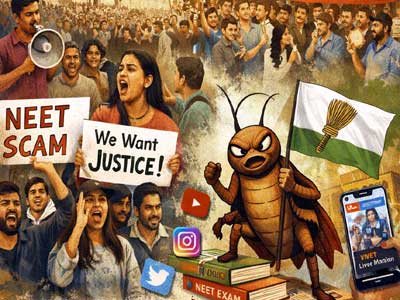
The greatest strength of Indian democracy lies in the fact that whenever the people wish, they can transform their voice into a movement. Sometimes this voice topples governments, sometimes it gives birth to new politics, and sometimes it becomes a demand for systemic reform.
Jayaprakash Narayan’s 'Indira Hatao' movement, Anna Hazare and Arvind Kejriwal’s anti-corruption crusade, and the Cockroach Janata Party’s student protest against the NEET paper leak are three distinct links in this tradition.
Read in Hindi: जनता की पुकार, 'जेपी' से लेकर 'कॉकरोच' तक...
Each of these movements shook politics in its own time. The JP movement taught Indian society that standing against power is a democratic right. It was not limited to political change alone; it awakened a new political consciousness among the people. The slogan 'Indira Hatao' became a cultural memory of that era. Songs, slogans, and posters carried the spirit of rebellion, and even today it remains a symbol of democratic resistance in the Indian psyche. It gave the youth cultural confidence to participate actively in politics.
In 2011, when Anna Hazare began his fast at Delhi’s Ramlila Maidan demanding the Jan Lokpal Bill, it was more than just a protest; it was the moral cry of the urban middle class. Social media and television channels carried it into every household. Activists like Arvind Kejriwal gave it political direction, leading to the birth of the Aam Aadmi Party. This movement did not demand a direct change of government but sought transparency and accountability in governance.
The Anna movement became the moral voice of the urban middle class. It turned anti-corruption into a cultural discourse. Memes on social media, relentless media coverage, and the crowds at Ramlila Maidan created a new urban political culture. It showed that civil society could alter the course of politics. Since then, transparency and accountability have ceased to be mere political issues; they have become cultural expectations. Today, in every election, people assume that leaders must promise honesty and transparency. That is the lasting cultural legacy of the Anna movement.
In today’s digital age, student anger erupted against the NEET paper leak. The Cockroach Janata Party organised this protest. It did not rely on the support of major opposition leaders, nor did it carry an agenda of regime change. Its demands were straightforward: transparency in the examination system and protection of students’ futures. Social media clips, YouTubers, and Instagram influencers became its strength. This movement shows that the new generation wants to fight its battles independently, without leaning on traditional politics.
It also reveals how the new generation is shaping its voice through digital culture. The NEET paper leak protest questioned the credibility of the examination system and turned education into a cultural discourse. A stronger belief is now emerging that education is not merely a means to obtain degrees, but a right to transparency and justice. This movement has become a confluence of digital culture and political consciousness among Indian youth.
Movements in Indian democracy are mirrors of public discontent. A comparative study of these three shows that dissatisfaction surfaces in different forms at different times. The JP movement changed power and created a cultural memory of democratic rebellion. The Anna movement gave birth to a new kind of politics and turned transparency into a cultural expectation. And now, the Cockroach movement has made the demand for education reform an integral part of digital culture.
This vitality is what makes Indian democracy resilient. Every movement reflects the greatest concern of its time—sometimes a direct rebellion against power, sometimes the foundation of new politics, and sometimes a call for institutional reform. And their impact does not remain confined to politics alone; it reshapes society’s thinking, culture, and collective consciousness. The people today hold the capacity to transform their voice into a movement in every era.
Related Items
An Indian traveller’s eye-opening lessons in the ‘Art of Living’
When Politics turns the Ballot into a Pandora's Box…
Are Indian borders just lines on a map!