
 Samiksha Bharti News Service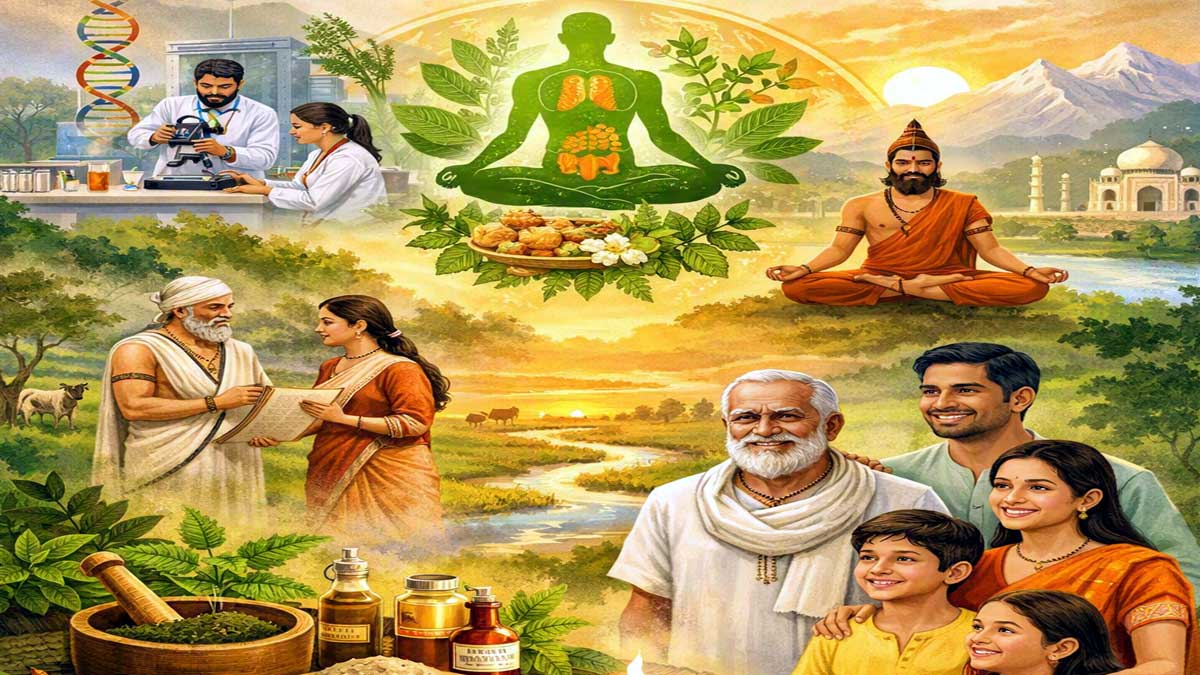
Ayurveda is moving from the margins of global health conversations towards the mainstream. India’s expanding Ayush economy, growing domestic use of traditional systems and rising interest in wellness and medical value travel are creating new opportunities for Ayurveda, even as the global health community places greater emphasis on traditional medicine, research and evidence.
As India marks the 11th Ayurveda Day on September 23, the moment is significant. The theme, ‘Ayurveda for a Healthier Tomorrow’, comes at a time when India is seeking to connect its centuries-old knowledge system with modern research, quality standards and international healthcare frameworks. The challenge now is not simply to take Ayurveda to the world, but to build the evidence, credibility and institutional foundations that can support its responsible global growth.
Also read: स्वस्थ भविष्य को सुनिश्चित करता भारतीय आयुर्वेद
Over the past decade, the Ayush sector has witnessed significant economic expansion, creating a stronger foundation for the growth and wider adoption of Ayurveda. The Ayush market grew from USD 2.85 billion in 2014 to USD 43.4 billion in 2023, while Ayush exports increased from USD 1.09 billion to USD 2.16 billion during the same period.
India is also seeking to leverage the growing global demand for holistic healthcare through medical value travel. A dedicated Ayush Visa was introduced on July 27, 2023, for foreign nationals seeking treatment under Ayush systems. The global medical value travel market, estimated at USD 115.6 billion in 2022, is projected to reach approximately USD 286.1 billion by 2030. Ayurveda and other traditional systems can therefore become an important component of India’s medical value travel and wellness ecosystem by bringing together healthcare services, wellness offerings and tourism.
India’s efforts to strengthen Ayurveda are also closely linked with its wider engagement in global traditional, complementary and integrative medicine. The WHO Global Traditional Medicine Strategy 2025–2034, adopted by the 78th World Health Assembly in 2025, provides a global framework for strengthening evidence, ensuring safety and regulation, integrating traditional medicine into health systems and optimising its wider cross-sectoral contribution.
India has played a significant role in this global movement. The WHO Global Traditional Medicine Centre in Jamnagar, Gujarat, was established in 2022 with India as its lead investor. India committed an estimated USD 250 million towards its establishment, infrastructure and operations.
Another important development has been the inclusion of Ayurveda, Siddha and Unani in global health classification frameworks. In January 2024, WHO launched Traditional Medicine Module 2 of ICD-11, covering morbidity codes for these systems and enabling their conditions to be documented and reported through an internationally comparable framework. WHO has clarified that such inclusion does not constitute an endorsement of the scientific validity or efficacy of individual traditional medicine practices. Work is also progressing towards the classification of interventions, with India and WHO working on intervention codes for Ayurveda, Siddha and Unani.
The emerging picture is therefore one of an Indian traditional health system moving into a new phase of global engagement. A rapidly expanding Ayush economy, growing domestic adoption, new opportunities in medical value travel, stronger international cooperation, global classification frameworks and increasing emphasis on research and quality standards are collectively creating new avenues for Ayurveda.
As the country marks the 11th Ayurveda Day, the focus on ‘Ayurveda for a Healthier Tomorrow’ provides an opportunity to highlight the system’s potential contribution to preventive healthcare, wellbeing and sustainable living. At the same time, its future global journey will increasingly depend on evidence, innovation, quality, professional capacity and responsible globalisation, strengthening Ayurveda’s place in the evolving landscape of health and wellness.
Related Items
Divorce late in life can improve men’s mental health
An Indian traveller’s eye-opening lessons in the ‘Art of Living’
Are Indian borders just lines on a map!