
 Brij Khandelwal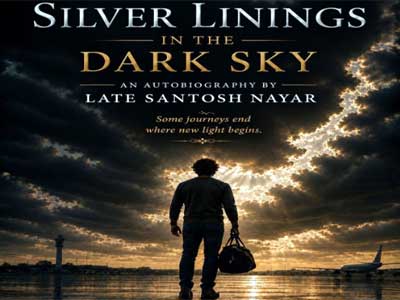
The American Dream comes with fine print. Santosh Nayar discovered it the hard way. He went to America with ambition, professional qualifications and hopes of building a better life. What he got was a package nobody would willingly order: career success, three marriages, bipolar disorder, alcohol, broken relationships, courtrooms and prison. Hollywood might have turned it into a blockbuster. Nayar turned it into a book. And remarkably, he managed to laugh along the way.
Silver Linings in the Dark Sky, published by Pink Lotus of Varanasi, is not a conventional autobiography. It is part memoir, part confession, part social commentary and, surprisingly often, part dark comedy. That is what makes it compelling.
Read in Hindi: अमेरिका में सपने टूटे, भारत में मिली कहानी…
Nayar was a chartered accountant, intelligent, ambitious and professionally accomplished. America seemed to offer exactly what ambitious Indians had long been promised: opportunity, prosperity and a fresh beginning. Instead, his life gradually unravelled.
Bipolar disorder brought periods of mania and depression. Alcohol complicated matters. Relationships suffered. Poor decisions accumulated. Eventually, the law intervened, and prison followed. Yet Nayar refuses to portray himself either as a victim or a hero. He admits his mistakes. He records his failures. He exposes his own absurdities.
Sometimes he comes across as wise. Sometimes reckless. Sometimes strangely innocent. And sometimes so funny that one wonders whether life had given him a secret membership card for the Wrong Decisions Club.
His chapter titles reveal the same wicked sense of humour. His first marriage is called “Made in Heaven, Deep Fried on Earth.” The second becomes “Until Mania Do Us Apart.” And prison? His “Favourite Alma Mater.” Most people graduate from college. Nayar graduated from prison with a manuscript. The joke is funny. The reality behind it is not.
One of the book’s most important contributions is its portrayal of bipolar disorder. The condition is still poorly understood and heavily stigmatised. It can cause extreme changes in mood, energy, judgement and behaviour. During manic episodes, a person may become extraordinarily energetic, impulsive and confident.
The mind races. Judgement struggles to keep up. It is like driving an expensive sports car with bicycle brakes. Nayar sometimes forgot his medication, after which his behaviour could become aggressive, rude or disturbing. His experiences demonstrate how easily society can judge the behaviour without understanding the illness behind it.
That raises uncomfortable questions. When does illness become behaviour? When does behaviour become a mistake? And when does a mistake become a crime? There are no easy answers. The book wisely avoids pretending that there are.
Yet it would be a mistake to reduce Nayar to his illness. He was much more than bipolar disorder. He was a professional, husband, father, friend and immigrant. He was curious, intelligent, ambitious and talented. He had a sharp mind and an even sharper sense of humour.
Most importantly, he retained the ability to laugh at himself. That makes the memoir different from many accounts of mental illness. It is not simply a catalogue of suffering.
It is a portrait of a complicated human being. And complicated human beings are rarely convenient. The justice system gets its share of scrutiny; Nayar’s prison experiences raise troubling questions about how legal systems deal with people suffering from mental illness.
What happens when the law encounters behaviour that is partly shaped by a disturbed mind? Does punishment solve the problem? Or does it simply punish the visible consequences of an invisible illness? Nayar does not provide a courtroom verdict. He provides a personal experience and leaves readers to wrestle with it. That is perhaps more powerful.
The book also avoids another familiar trap. It does not turn Nayar’s suffering into a motivational sermon. There are no ten commandments of success. No “believe in yourself” on every second page. No neatly packaged wisdom saying that every failure is secretly a blessing. Life does not work that way. Sometimes failure is simply failure. Sometimes people make terrible decisions. Sometimes illness wins a round. Sometimes relationships collapse. And sometimes, after all that, a person gets up and tries again. Nayar’s story is powerful precisely because it does not pretend otherwise.
The story of the book itself is almost as remarkable as the story inside it. Nayar began writing the manuscript while in prison. In 2013, he sent it to Dr Alok Gupta. After returning to India, Nayar was allowed to work at Glowtronics. It appeared that a second innings was beginning. But illness returned. The job disappeared. The manuscript disappeared too.
Then came 2024. Nayar died. The story seemed finished. But in 2026, Dr Gupta rediscovered the manuscript. A forgotten voice suddenly returned. Nayar was no longer alive to explain himself, defend his decisions or rewrite uncomfortable chapters. His words therefore remain raw and unfiltered. The manuscript became a book. And the man who had lost control of so many chapters of his life finally regained control of one thing: his narrative.
Nayar’s life was neither a triumph nor a tragedy in simple terms. It was both. There was professional success and personal collapse. There were opportunities and terrible mistakes. There was illness, but also intelligence. There was prison, but also writing. There was failure, but also persistence. Most importantly, there was humour. That humour does not make the pain disappear. It simply makes the darkness bearable.
Silver Linings in the Dark Sky is therefore not about defeating darkness. It is about finding something human inside it. Nayar lost relationships. He lost opportunities. He lost years. He lost his health. Eventually, he lost his life. But his story survived. And perhaps that is the book’s most poignant irony.
Santosh Nayar could not completely reclaim the life he had once imagined in America. He could not undo his mistakes. He could not rewrite his past. But, years after his death, a forgotten manuscript travelled from a prison cell to a publisher’s desk.
The man may have lost his American dream. But India found his story. And sometimes, when life has taken almost everything away, having your story remembered is the last silver lining left in the dark sky.
Book: Silver Linings in the Dark Sky
Pages: 278 pages
Language: English
Publisher: Pink Lotus, Varanasi
Author: Santosh Nayar
Editor: Dr Alok Gupta
Related Items
From 'Beacons' to 'Landmarks', India’s changing ‘Lighthouse’ story…
“Only five minutes…” has shaken France and forced India to think…
India building its semiconductor future…