
Now add to that list psychological distress, which University of Washington researchers have found is also associated with air pollution. Higher the level of particulates in air, UW-led study show, greater the impact on mental health.
The study, published in the recent issue of Health & Place cross-referenced with pollution data at the census block level, to evaluate the connection between toxic air and mental health.
"This is really setting out a new trajectory around the health effects of air pollution," said Anjum Hajat, an assistant professor of epidemiology in the UW School of Public Health. "The effects of air pollution on cardiovascular health and lung diseases like asthma are well established, but this area of brain health is a newer area of research."
Where a person lives can make a big difference to health and quality of life. Scientists have identified "social determinants" of physical and mental well-being, such as availability of healthy foods at local grocers, access to nature or neighborhood safety.
Air pollution, too, has been associated with behavior changes – spending less time outside, for instance, or leading a more sedentary lifestyle – that can be related to psychological distress or social isolation.
The UW study looked for a direct connection between toxic air and mental health, relying on some 6,000 respondents from a larger, national, longitudinal study, the Panel Study of Income Dynamics. Researchers then merged an air pollution database with records corresponding to the neighborhoods of each of the 6,000 survey participants. The team zeroed in on measurements of fine particulate matter, a substance produced by car engines, fireplaces and wood stoves, and power plants fueled by coal or natural gas. Fine particulate matter (particles less than 2.5 micrometers in diameter) is easily inhaled, can be absorbed into the bloodstream and is considered of greater risk than larger particles. (To picture just how small fine particulate matter is, consider this: The average human hair is 70 micrometers in diameter.)
The current safety standard for fine particulates, according to the U.S. Environmental Protection Agency, is 12 micrograms per cubic meter. Between 1999 and 2011, the time frame examined in the UW study, survey respondents lived in neighborhoods where fine particulates measured anywhere from 2.16 to 24.23 micrograms per cubic meter, with an average level of 11.34.
The survey questions relevant to the UW study gauged participants' feelings of sadness, nervousness, hopelessness and the like and were scored with a scale that assesses psychological distress.
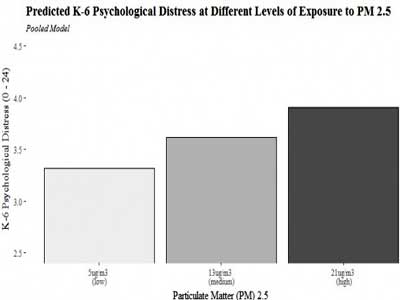
The UW study found that the risk of psychological distress increased alongside the amount of fine particulate matter in the air. For example, in areas with high levels of pollution (21 micrograms per cubic meter), psychological distress scores were 17 percent higher than in areas with low levels of pollution (5 micrograms per cubic meter). Another finding: Every increase in pollution of 5 micrograms per cubic meter had the same effect as a 1.5-year loss in education.
Researchers controlled for other physical, behavioral and socioeconomic factors that can influence mental health, such as chronic health conditions, unemployment and excessive drinking.
But some patterns emerged that warrant more study, explained primary author Victoria Sass, a graduate student in the Department of Sociology. When the data are broken down by race and gender, black men and white women show the most significant correlation between air pollution and psychological distress: The level of distress among black men, for instance, in areas of high pollution, is 34 percent greater than that of white men, and 55 percent greater than that of Latino men. A noticeable trend among white women is the substantial increase in distress — 39 percent — as pollution levels rise from low to high.
Precisely why air pollution impacts mental health, especially among specific populations, was beyond the scope of the study, Sass said. But that's what makes further research important.
"Our society is segregated and stratified, which places an unnecessary burden on some groups," Sass said. "Even moderate levels can be detrimental to health."
Air pollution, however, is something that can be mitigated, Hajat said, and has been declining in the United States. It's a health problem with a clear, actionable solution.
But it requires the political will to continue to regulate air quality, Sass added.
"We shouldn't think of this as a problem that has been solved," she said. "There is a lot to be said for having federal guidelines that are rigorously enforced and continually updated. The ability of communities to have clean air will be impacted with more lax regulation."
Related Items
Divorce late in life can improve men’s mental health
How broad should your waist be for better health...
Desert bacteria ride in the wind to affect health in the Himalayas