
 Brij Khandelwal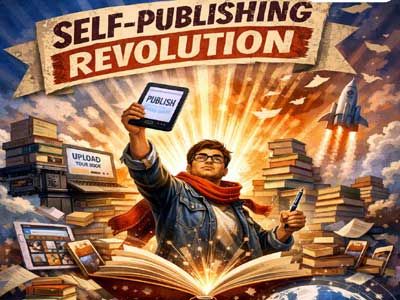
When Johannes Gutenberg invented the movable-type printing press in 1455, he could hardly have imagined a future where publishing a book would become so simple that almost every writer could become their own publisher.
Gutenberg's invention liberated knowledge from the walls of monasteries, royal courts, and elite libraries, placing books within the reach of ordinary people. More than five and a half centuries later, self-publishing is taking that revolution to an entirely new level.
Read in Hindi: ‘स्व-प्रकाशन’ ने बदल दी है किताबों की दुनिया...
Today, the publishing landscape is overflowing with self-publishing companies. Browse social media, Google, or YouTube, and you will be greeted by advertisements promising, "Publish your book," "Become a bestselling author," or "Launch your book in just a few days." These companies offer everything a writer needs under one roof: editing, proofreading, cover design, ISBN registration, e-book conversion, printing, Amazon listing, marketing, and promotional support. Packages begin at around ₹2,999 and can go beyond ₹50,000. Faced with such affordable and convenient options, almost anyone is tempted to ask, "Why shouldn't I publish my own book?"
Not very long ago, writing a manuscript was only half the journey. The real challenge was persuading a publisher that your work deserved to be printed. Writers spent years researching, writing, rewriting, and polishing their manuscripts, only to receive a polite rejection or worse, complete silence.
Countless remarkable books never reached readers because they failed to match a publisher's commercial expectations or personal preferences.
Traditional publishing has undoubtedly enriched world literature. It introduced generations of great writers to readers and produced many timeless classics. Yet publishers also served as literary gatekeepers. They decided which voices would be heard and which would remain unheard. Their decisions often shaped the literary landscape for decades.
The world might have lost some of its greatest literary treasures. History is almost certainly filled with gifted writers whose manuscripts disappeared into obscurity simply because no publisher believed in them. That world has changed dramatically.
Digital technology, inexpensive printing, print-on-demand services, e-books, and online marketplaces have transformed publishing forever. Writers no longer need permission from a publishing house to reach readers. They can publish independently, decide the price, design their own covers, retain ownership of their work, and sell directly to readers across the globe. The monopoly once enjoyed by a handful of publishers is steadily fading.
The numbers tell the story. In the United States alone, more than four million books were published during 2025. Nearly three and a half million of them were self-published. Independent publishing has now grown to more than five times the size of traditional publishing in terms of annual titles released. While conventional publishing has expanded slowly over recent years, self-publishing has experienced explosive growth.
Over the past few months, I have met more than a dozen authors who chose to publish their own books. Each proudly presented me with a signed copy. Their confidence was unmistakable. They no longer depended on a publisher's approval. They had taken complete control of their creative destiny.
Self-publishing is no longer an alternative reserved for rejected manuscripts. For thousands of writers, it has become the first choice.
Until a few years ago, authors relied almost entirely on publishers to print, distribute, and promote their books. Today, that dependence is rapidly disappearing.
Platforms such as Amazon Kindle Direct Publishing, Amazon, Kobo, and Google Play Books have turned the entire world into one open marketplace. An author sitting in Agra, Mysuru, or Kochi can upload a manuscript in the morning, and within hours readers in New York, London, or Sydney can purchase it.
Print-on-demand technology has reduced financial risk as well. Publishers and authors no longer need to print thousands of copies and fill warehouses with unsold books. A copy is printed only after a customer places an order. This eliminates inventory costs and makes publishing economically viable even for niche subjects and first-time authors.
Book promotion has undergone an equally dramatic transformation. Earlier, writers depended largely on the marketing efforts of their publishers.
Today, every author has access to a global stage through social media. A thoughtful review, a podcast interview, a YouTube discussion, an Instagram Reel, or a viral post can introduce a book to thousands of readers overnight.
Artificial Intelligence has added another powerful dimension to this publishing revolution. It can help with research, brainstorming, outlining chapters, improving language, editing, proofreading, formatting, designing covers, creating illustrations, translating text, and generating promotional material.
Tasks that once required weeks of effort and considerable expense can now be completed in a matter of minutes. As a result, new writers are no longer intimidated by technical hurdles. They can focus more on writing and less on the mechanics of publishing.
Many years ago, when photocopying technology was still new, an executive at Xerox reportedly predicted, "One day every person will become their own publisher." At the time, the idea sounded like science fiction. Today, it has become reality.
The greatest achievement of self-publishing is not the sheer number of books being produced. Its greatest success is creative freedom. Writers working in regional languages, authors exploring niche subjects, historians documenting forgotten stories, poets experimenting with new forms, and thinkers presenting unconventional ideas all have an opportunity to reach readers without waiting for institutional approval.
For the first time in publishing history, a writer's success depends less on whether a publisher approves the manuscript and more on whether readers embrace it.
Readers have become the ultimate judges. If a book is compelling, insightful, and well-crafted, it has every opportunity to find its audience.
The printing press gave birth to the modern book. The internet carried books into every corner of the world. Self-publishing has completed the journey by making publishing truly democratic.
And that may well be the greatest literary revolution of the twenty-first century.
Related Items
Heidelberg, from Banks to Books and a Little Seductive Romance…
India’s foray into the world of silicon…
Has the World started revolving around the bedroom?