
 Brij Khandelwal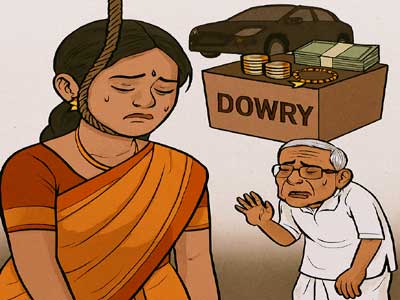
On 28 November, the Supreme Court delivered a judgment that shook the country to its core. The court cancelled the bail of a man accused of poisoning his wife to death barely four months after marriage, and in doing so, it issued a moral and legal reprimand of rare sharpness. A bench of Justices BV Nagarathna and R Mahadevan stressed that ignoring the statutory presumption under Section 113B of the Evidence Act in dowry-death cases is an “unjust and distorted approach.” The judges made it unmistakably clear that dowry killing is not a personal family tragedy; it is a public crime, a blow to the collective conscience, and a direct assault on the very idea of humanity.
Every time a bride is burnt, beaten, or poisoned for dowry, it is not just one home that is destroyed; it is an entire civilisation that stands condemned. The debate is no longer about whether dowry is evil. The real question is whether we still possess the courage to uproot this poison from our social bloodstream.
Read in Hindi: दहेज हत्या निजी त्रासदी नहीं, खुला सामाजिक जुर्म है...
The scale of the crisis is devastating. NCRB data shows that more than 6,000 women are killed in India every year in the name of dowry. The laws exist, the Dowry Prohibition Act, IPC 498A, but their implementation remains weak and inconsistent. Police indifference, careless handling of evidence, frightened or silenced witnesses, and lacklustre prosecution combine to push conviction rates below 15 per cent. In a country where daughters are still killed by fire, toxins, and daily brutality, what is needed is not gentle reform but a societal revolution.
Recent cases reveal an unbroken pattern of cruelty. In Greater Noida, 26-year-old Nikki was set ablaze with petrol by her husband and in-laws. Despite receiving an SUV, gold, and cash at the time of marriage, they continued to demand ₹36 lakh more and a luxury car. With 90 per cent burns, Nikki died before reaching the hospital. In Belagavi, Karnataka, 27-year-old Shilpa Panchangavi lived through a cycle of beatings, starvation, and humiliation, accused of bringing ‘insufficient dowry’. She ultimately died by hanging, her bruised body speaking for her. In Bihar, 25-year-old Laxmi Kumari’s body was thrown into a river after she was strangled, her death disguised as suicide because she could not bring money for her husband’s shop.
Tamil Nadu witnessed one of the most chilling cases when 24-year-old Rithanya was allegedly fed milk laced with cyanide. Her in-laws had already taken 4.5 kg of gold but still demanded dowry worth ₹100 crore. Her diary documented starvation, restrictions, and everyday torment. In Chandigarh, a newlywed bride was beaten, abused, and starved for months. Her death, too, was packaged as suicide until defensive wounds tore apart the fabricated story. In Ponneri, Tamil Nadu, a 20-year-old woman consumed pesticide just four days after marriage, overwhelmed by incessant demands for jewellery and cash. Odisha saw a woman burnt alive in her own kitchen because she refused to bring money for her husband’s ‘promotion’.
In Uttar Pradesh, a pregnant woman was beaten to death with sticks; the unborn child also could not survive. And in Delhi, a 26-year-old woman died of sepsis after being attacked with acid by her in-laws; before they killed her, they erased her face.
There is no reliable count of how many such deaths are quietly categorised as ‘accidents’ or ‘suicides’. Families remain afraid, neighbours avert their eyes, and society maintains its suffocating silence. This silence, more than anything else, becomes the shield of the perpetrators.
Dowry in India is not a ritual; it is a slow, corrosive poison that erodes the foundations of thousands of families every year. Confronting it demands not half-hearted gestures but a sweeping social awakening. The need of the hour is unwavering commitment—from the state, from communities, from every individual—to ensure that dowry, in practice and in spirit, becomes socially unacceptable. This means swift and specialised judicial processes, uncompromising forensic investigation, safe technological channels for complaints, stronger policing, and most importantly, a collective moral refusal to tolerate the slightest hint of dowry-seeking behaviour.
The Supreme Court has delivered its message with absolute clarity: dowry deaths deserve zero tolerance. Yet the judiciary alone cannot win this long, bruising battle. The struggle will end only when society, without hesitation or ambiguity, declares that not a single daughter’s life can be taken in the name of dowry. The most distressing truth is that these killings have been normalised to a point where they no longer shock us. It is this horrifying normalisation that must be broken—firmly, urgently, and irrevocably.
Related Items
Small families, Fractured bonds! Blame it on family planning!
'Chicken Curry', 'Salt' and 'Anger' turning kitchens into crime scenes
Death does not arrive uninvited, it is summoned…