
 Brij Khandelwal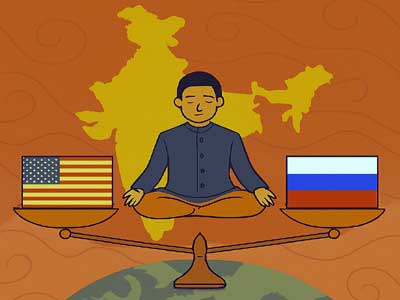
India’s foreign policy today stands at a ‘diamond crossing’. It is a place where roads do not force a single direction, where relationships remain flexible, and where choices are guided by interest rather than ideology. In a world shaken by uncertainty and shifting power centres, India has chosen not to lock itself into rigid alliances. Instead, it keeps its options open and moves carefully, dealing with different powers on different issues.
This approach has become even more relevant after Donald Trump’s return to the White House in January 2025. His unpredictable style, marked by blunt language, tariff threats, and distrust of multilateral institutions, has deepened global instability.
Read in Hindi: बहुध्रुवीय दुनिया में संतुलन की 'भारतीय' कला
Old certainties have faded. Traditional alliances look strained. Trust between nations has weakened. In this environment, countries are thinking less about loyalty and more about survival.
Trump’s second term has clearly accelerated the move towards a multipolar world. His “America First” agenda revived trade wars and pushed the United States away from global agreements, including climate commitments. Many long-time partners felt exposed. European nations began investing more seriously in their own defence structures, quietly admitting that they could no longer depend fully on Washington.
In Southeast Asia, countries adopted a cautious balancing act, engaging both the United States and China without fully committing to either. African nations, backed by young populations and rich resources, spoke more confidently in global forums and demanded fairer climate funding.
In West Asia, countries such as Saudi Arabia began expanding their diplomatic and economic ties beyond the United States, including partnerships linked to the India-Middle East-Europe Economic Corridor.
All this confirms a simple truth. The old world order, dominated by one power, is gone. Institutions like NATO are under internal stress. The United Nations often appears slow and outdated. Power is now spread across regions, interests, and issue-based coalitions.
India fits naturally into this new reality. It has learned to stay friendly with rivals and allies at the same time. On the Israel-Palestine issue, India supports Israel’s right to security while also backing the idea of an independent Palestinian state. During the Gaza conflict escalation in 2025, India avoided taking extreme positions. It abstained from some UN resolutions critical of Israel but continued humanitarian assistance to Palestinians. This careful balance allows India to maintain strong defence cooperation with Israel while preserving goodwill in the Arab world.
A similar pragmatism is visible in India’s stance on the Russia-Ukraine war. India has repeatedly spoken in favour of sovereignty and dialogue, yet it has not cut off energy ties with Russia. In fact, India continued importing large quantities of discounted Russian oil in 2025, helping protect its economy from global price shocks. At the same time, it participated in international peace efforts without blindly endorsing any one side’s full demands. This approach frustrated some Western capitals but served India’s national interest.
India’s relationship with the United States also reflects this maturity. It remains a close partner, especially in technology, defence, and the Indo-Pacific, through platforms like the Quad. Yet it does not hesitate to push back when American trade policies hurt Indian interests. Even as US tariffs on Indian steel remained, bilateral trade crossed the 200 billion dollar mark. Cooperation and disagreement now coexist without drama.
China presents an even more complex picture. Border tensions in Ladakh continue, and trust remains limited. Yet trade between the two countries crossed 100 billion dollars in 2025. India imports key electronics while simultaneously trying to reduce dependence through domestic manufacturing. Diplomatic engagement continues, as seen in the Modi-Xi meeting at the SCO summit in Tianjin, which led to limited troop disengagements. At the same time, India strengthens partnerships in the Indo-Pacific to balance China’s influence. Competition and cooperation run side by side.
India’s role in groupings like BRICS further underlines its independent thinking. As BRICS chair in 2026, India promoted trade in national currencies, focusing on practical benefits rather than ideological battles over the dollar. It also kept relations with the European Union warm through ongoing free trade talks. Elsewhere, India upgraded its presence in Afghanistan, protecting strategic interests despite the difficult political environment. With France, it deepened cooperation in artificial intelligence, treating technology as a strategic asset. In South Asia, even after tensions with Pakistan, India continued building regional links through infrastructure and connectivity projects with neighbours like Nepal and Bangladesh.
The larger pattern is clear. India prefers issue-based partnerships over permanent camps. During the 2025 G20 Summit, it spoke strongly for the Global South, pushing for debt relief and fair development financing. It avoided the Cold War habit of dividing the world into fixed blocks.
This path is not without risks. Rising rivalry between the United States and China will test India’s strategic autonomy. Domestic economic pressures also shape foreign policy choices more than ever. Still, India’s ability to mind its own business while building multiple friendships has helped it not just survive but grow in influence.
In a fractured world, India’s diamond crossing offers a useful lesson. Flexibility, patience, and clarity of national interest may matter more than loud slogans or rigid loyalties. As multipolarity becomes the new normal, India’s approach could point the way to a more balanced and realistic global order, one where interests matter more than old ideological divides.
Related Items
The biggest ‘Cosmic Con’ of ‘Power Brokers’
Western Media is ‘tough’ on India but ‘soft’ on China!
An Indian traveller’s eye-opening lessons in the ‘Art of Living’