
 Samiksha Bharti News Service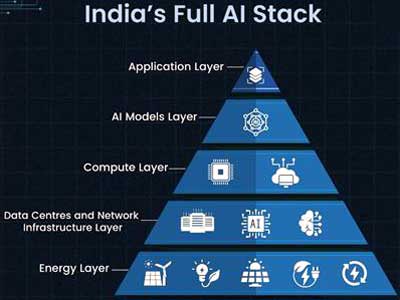
The future of technology in India is guided by a simple but powerful idea: the democratisation of AI. Artificial Intelligence should not remain limited to a few companies, institutions, or countries. Instead, it must be developed and used in a way that benefits every citizen, supports public welfare and collective well-being. This vision of AI for Humanity places people at the centre of technological progress, ensuring that innovation serves society rather than the other way around.
Realising this vision requires AI to function reliably at scale and integrate seamlessly into everyday life across healthcare, education, agriculture, finance, and public services. Such population-scale impact is made possible through a strong and integrated AI stack, which brings together the tools, systems, and infrastructure needed to build, deploy, and operate AI applications effectively. So, India is working on ‘India AI Stack’.
Read in Hindi: एआई का 'लोकतंत्रीकरण’ कर रहा है भारत
An AI stack is the complete set of tools and systems that work together to build and run AI applications. These applications range from everyday tools such as virtual assistants like Siri and Alexa, and personalised recommendations on platforms like Netflix and Spotify, to advanced systems used in healthcare diagnostics, financial fraud detection, and transportation. The AI stack brings together hardware, software, and platforms that help collect data, train AI models, and use them in real life, ensuring AI works smoothly from start to finish.
The AI stack is made up of five layers, each playing a critical role. The AI stack makes artificial intelligence work in the real world, from the apps people use every day to the data, computing power, networks, and energy that run behind the scenes. Together, these layers ensure AI solutions are scalable, reliable, and capable of delivering impact at a population scale.
The Application Layer represents the user-facing component of the AI stack. It includes AI-powered apps and services such as health diagnostic tools, farming advisory platforms, chatbots, and language translation applications. This layer turns complex AI processes into simple, user-friendly services that people can easily use. Indian startups are developing AI applications tailored to local languages, contexts, and sector-specific needs, accelerating adoption across the economy.
In agriculture, AI-powered advisory tools are improving sowing decisions, crop yields, and input efficiency, with select state-level deployments such as Andhra Pradesh and Maharashtra, reporting productivity gains of up to 30–50 per cent.
In healthcare, AI applications are enabling early detection of tuberculosis, cancer, neurological disorders, and other conditions, strengthening preventive and diagnostic care.
In education, the National Education Policy 2020 integrates AI learning through CBSE curricula, DIKSHA platforms, and initiatives such as YUVAi, equipping students with practical AI skills.
In justice delivery, e-Courts Phase III deploys AI and ML for translation, case management, scheduling, and citizen-facing services, improving efficiency and transparency through vernacular access.
In weather and disaster management, IMD uses AI for advanced forecasting of rainfall, cyclones, fog, lightning, and fires, with tools such as Mausam GPT supporting farmers and disaster response.
In essence, the application layer is where AI delivers real value by translating advanced capabilities into accessible, user-centric services. When deployed at scale across priority sectors, it enables AI to move beyond experimentation and become embedded in everyday decision-making and service delivery. This widespread adoption is what ultimately determines the social and economic impact of AI.
AI delivers a transformative impact when applications are adopted at scale, much like the internet and mobile technologies. AI applications are increasingly deployed across sectors, including agriculture, healthcare, education, manufacturing, transport, governance, and climate action. India is pursuing an ‘AI diffusion’ strategy, leveraging AI across sectors at a population scale.
Across the country, AI-enabled applications are helping farmers make informed decisions, supporting clinicians in early diagnosis, and enhancing the efficiency of public service delivery. Further, by prioritising real-world use cases and large-scale adoption, the application layer ensures that AI delivers tangible benefits and directly improves citizens’ lives.
The AI Model Layer acts as the brain of AI systems. AI models are trained on data to recognise patterns, make predictions, and make decisions. For example, they help detect diseases from X-rays, predict crop yields, translate languages, or answer questions through chatbots. These models provide intelligence to the applications, enabling them to deliver meaningful AI-powered results to users.
Indian startups are building full-stack and domain-specific AI models aligned with Indian languages, healthcare needs, and public service delivery. For example, Sarvam AI is developing large language and speech models for Indian languages to support voice interfaces, document processing, and citizen services.
Bhashini, under the National Language Translation Mission, hosts 350+ AI models covering speech recognition, machine translation, text-to-speech, OCR, and language detection, strengthening multilingual access to digital services.
The AI model layer is the core intelligence that determines how effectively applications can understand, predict, and respond to real-world needs. By developing sovereign, India-centric models and shared repositories, this layer ensures that AI capabilities are relevant, trustworthy, and aligned with local languages and priorities. Strengthening this foundation enables scalable innovation while reducing dependence on external model ecosystems.
Early advances in AI models were driven by a few technology leaders with access to large-scale compute, but the emergence of open-source models has lowered entry barriers, reduced costs, improved transparency, and enabled localisation across languages and contexts. Building on this shift, India is developing a sovereign, inclusive, and application-oriented AI model ecosystem focused on national priorities and population-scale needs, particularly in public services, healthcare, agriculture, and governance, while aligning with local languages, regulatory frameworks, and cultural diversity, thereby strengthening technological self-reliance and delivering real-world impact across sectors.
Compute Layer, the muscle of AI, provides the computing power required to train and run AI models. During training, compute processes vast amounts of data so the model can learn and improve. Today, this power comes from advanced processing chips such as NVIDIA’s Blackwell Graphics Processing Unit, Google’s Tensor Processing Units, and Neural Processing Units, which allow AI systems to operate efficiently and at scale.
The compute layer is the critical enabler that determines the scale, speed, and sophistication of AI innovation. By expanding shared, affordable access to high-performance computing and simultaneously strengthening domestic chip and supercomputing capabilities, India is reducing structural barriers to AI development. This approach ensures that computing power supports broad-based innovation across research, startups, and public institutions, rather than remaining concentrated in a few hands.
Access to high-end AI compute has largely been shaped by high costs and the concentration of advanced hardware among a few technology firms and countries, limiting participation by smaller players. In contrast, India is expanding affordable and shared access to computing through government-supported cloud infrastructure under the IndiaAI Mission.
The IndiaAI Compute Portal provides access to over 38,000 GPUs and 1,050 TPUs at subsidised rates of under ₹100 per hour, compared to global rates exceeding ₹200 per hour. By combining cloud-based platforms, national missions, and public infrastructure with efforts to build domestic chip design, semiconductor manufacturing, and supercomputing capabilities, India is reducing entry barriers, strengthening long-term self-reliance, and ensuring that AI innovation can scale across sectors without being constrained by compute availability.
Data Centres and Network Infrastructure Layer form the home and highways of AI. Data centres are where AI systems are stored and operated, while networks like the internet, broadband, and 5G move data between users, computers, and AI models. Together, they ensure AI works reliably, quickly, and reaches users wherever they are. Without strong networks and data centres, AI applications would not function or scale effectively.
The data centres and network infrastructure layer provide the foundational backbone that enables AI systems to operate at scale and in real time. By strengthening connectivity and expanding domestic data centre capacity, India is ensuring that AI services remain reliable, responsive, and widely accessible. This integrated approach supports secure, scalable AI deployment across sectors while anchoring digital capabilities firmly within the national ecosystem.
The Infrastructure Layer is the backbone of AI deployment, with major technology companies investing heavily in high-capacity data centres and high-speed networks. India is strengthening this foundation through the wide-scale development of digital connectivity and domestic data centre infrastructure. Investments by both global and Indian technology companies are helping ensure that AI models, data, and innovation ecosystems are hosted within the country.
By improving connectivity, expanding data centre capacity, and keeping digital infrastructure within national jurisdiction, India is creating a resilient and scalable environment for AI adoption across sectors.
Energy Layer keeps the entire AI stack running. AI data centres consume large amounts of electricity because powerful computers are needed to train and operate AI systems. Even as technology becomes more efficient, AI still requires a steady and reliable power supply. Clean and affordable energy is therefore essential to support the sustainable growth of AI infrastructure.
The energy layer underpins the reliability and sustainability of the entire AI ecosystem. By ensuring adequate, affordable, and increasingly clean power supply, India is enabling energy-intensive AI infrastructure to scale without compromising grid stability. This transition towards a resilient and low-carbon energy mix supports long-term AI growth while aligning technological advancement with national climate and sustainability goals.
The rapid expansion of AI and data centres is driving a substantial increase in electricity demand globally, with global data centre power consumption projected to more than double by 2030, reaching around 945 TWh annually as AI-driven workloads grow rapidly. In India, this trend comes as the power sector undergoes a historic transformation.
The country’s total installed electricity capacity has surpassed 500 GW, with non-fossil fuel sources accounting for over 51 per cent of that capacity, achieving a major clean energy milestone ahead of the 2030 target. This expansion of clean, affordable, and secure energy strengthens the power system’s ability to support energy-intensive, continuously operating AI and data-centre workloads, aligning AI infrastructure growth with sustainable and resilient energy supply.
Overall, building a robust AI stack is both a technological priority and a social commitment for India. By strengthening every layer, including applications, AI models, compute, digital infrastructure, and energy, India is enabling the democratisation of AI and ensuring that its benefits reach citizens at a population scale. The focus on real-world use cases across agriculture, healthcare, education, justice, and disaster management demonstrates how AI can directly improve service delivery, productivity, and public welfare while remaining inclusive, sovereign, and aligned with national priorities.
Through affordable access to computing, indigenous model development, secure data infrastructure, and sustainable energy systems, India is creating an AI ecosystem that is scalable, resilient, and future-ready. This integrated approach ensures that AI innovation is not constrained by cost, infrastructure, or energy availability, while supporting long-term self-reliance. Anchored in the vision of AI for Humanity, India’s AI stack positions technology as a tool for inclusive growth, social equity, and well-being, advancing welfare for all and happiness for all in the digital era.
Related Items
Western Media is ‘tough’ on India but ‘soft’ on China!
10 countries, 17 destinations and one Yamuna in the heart…
From 'Beacons' to 'Landmarks', India’s changing ‘Lighthouse’ story…