
 Brij Khandelwal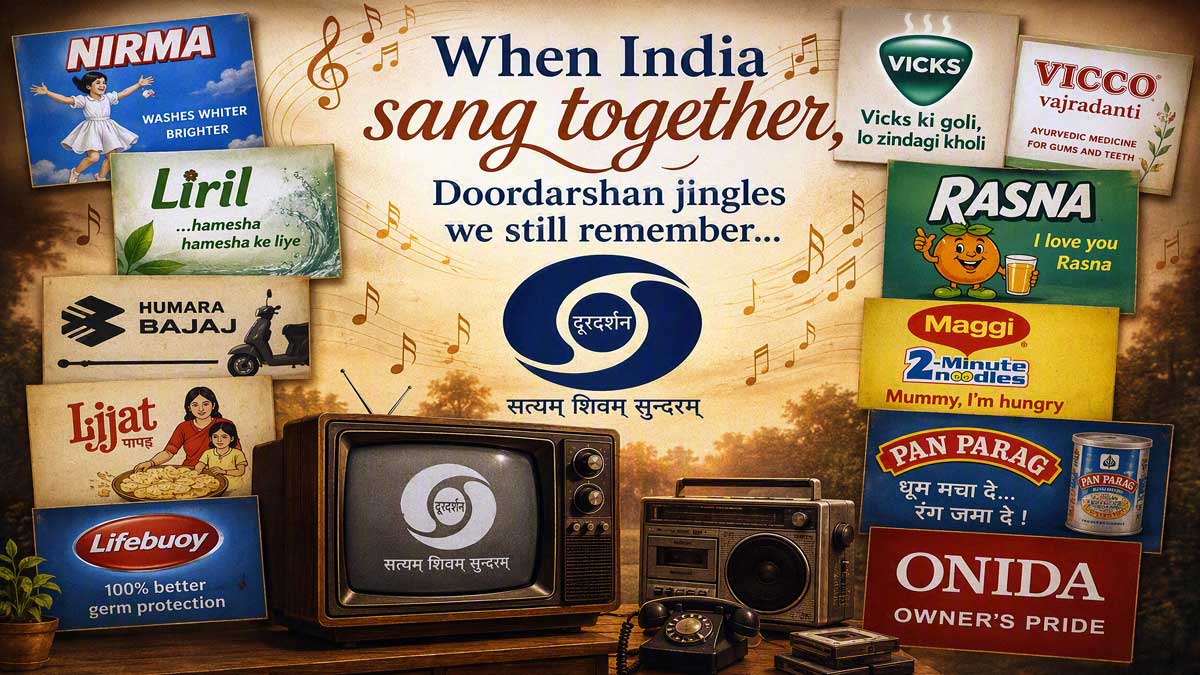
Once upon a time, India had only one television channel, one national conversation and, almost miraculously, one collective memory.
The television set arrived in the drawing room like a new member of the family. Antenna adjustments were serious business. Sunday meant Ramayan and Mahabharat. Wednesday meant Chitrahaar. And between programmes came advertisements that nobody rushed to skip. In fact, the advertisements often became the programme.
Also read: जब पूरा हिंदुस्तान गाता था दूरदर्शन के ये यादगार ‘जिंगल’…
The years from the 1970s to the 1990s were the golden age of Doordarshan advertising. Cable television had not yet invaded our homes. The internet was not even a distant dream. Social media had not taught us to scroll every three seconds.
An advertisement had time to breathe. A jingle had time to settle into the mind. Simplicity was not a weakness. It was the secret weapon. Some ten jingles and advertising lines that became part of India's collective consciousness are still recalled by boomers.
‘Washing powder Nirma’ was not merely an advertisement. It was a national chorus. The spinning white dresses, the cheerful music and the promise of “doodh si safedi” entered every Indian kitchen. Children sang it, mothers sang it, and even fathers secretly knew every word. Hema, Jayaa, and Sushma are grandmoms now. Nirma proved that an advertisement did not need Shakespearean poetry. Give India a simple tune and repeat it often enough. The nation will do the marketing for you.
‘Buland Bharat ki buland tasveer, Hamara Bajaj’. Here was advertising with a patriotic heart. The Bajaj scooter was more than a vehicle. It represented the rising Indian middle class, family outings, office journeys, school runs and weekend escapes. The scooter carried two generations, sometimes three. It also carried the aspirations of a country beginning to discover its economic confidence.
Then came the unforgettable “la la la la…” of Liril. The waterfall, the freshness and the carefree imagery turned a humble soap into a symbol of freedom. Suddenly bathing was no longer a routine chore. It was an adventure. The advertisement sold freshness, but cleverly sold a little fantasy too.
‘Tandurusti ki raksha karta hai Lifebuoy.’ Lifebuoy did not flirt with consumers. It marched straight into the battlefield against germs. Its message was simple: wash, stay healthy and keep disease away. The beat was sturdy, almost military. Yet the idea stayed with generations because it connected a product with an everyday concern—health.
‘Vicks ki goli lo, khich-khich door karo.’ What could be simpler? A problem appeared. Vicks arrived. Problem disappeared. That was the genius of early Indian advertising. No complicated brand philosophy, no celebrity shouting into the camera, no fifty-second lecture on lifestyle. Just a memorable situation and an equally memorable solution.
‘Vicco Turmeric, nahi cosmetic.’ Four words did the job. The yellow tube became familiar in millions of Indian homes. The advertisement cleverly connected modern packaging with traditional Ayurveda. It was proudly Indian without becoming preachy. Vicco understood an important truth: sometimes heritage itself is a powerful brand ambassador.
‘I love you, Rasna.’ That little declaration turned a powdered drink into summer itself. Rasna belonged to the age when children waited for holidays, cousins arrived from other cities, and mothers prepared something cold in the kitchen. It was inexpensive, cheerful and perfectly suited to an India where the refrigerator was still becoming a household necessity. Even today, Rasna can taste like childhood.
Then came the revolution in the kitchen. Maggi spoke directly to impatient children and equally impatient mothers. “Fast to cook, good to eat” was almost a manifesto for a changing India. The two-minute noodle became a cultural phenomenon. Hunger had met convenience, and the Indian mother had found a new ally.
‘Pan Parag se swagat kijiye.’ Baratis, celebrities, celebration and unmistakable Indian hospitality came together in one memorable commercial. It was colourful, theatrical and unabashedly filmi. ‘Pan Parag’ understood something advertising agencies sometimes forget: Indians enjoy drama, especially when there is a wedding involved.
‘Neighbour’s envy, owner’s pride.’ And then came the devil. Onida made television ownership sound deliciously wicked. The television was no longer just an appliance. It was a status symbol. The campaign used humour and a touch of mischief. In an India slowly entering the age of consumerism, Onida captured the changing mood perfectly.
There were many more. Lijjat Papad’s irresistible “kurram kurram,” memorable Amul campaigns, memorable Bajaj commercials and, of course, Mile Sur Mera Tumhara, which was advertising of a different and much larger kind, a musical salute to India's diversity.
The great names of Indian advertising, Piyush Pandey, Prahlad Kakkar and several other creative pioneers, helped establish a language of advertising that was witty, emotional and distinctly Indian.
Today, the advertising universe has exploded. Television competes with YouTube, Instagram, reels, shorts and a thousand digital platforms. Attention spans have shrunk.
Creativity is often designed for instant consumption and instant disappearance. The television set is no longer the “electronic nipple” around which the family gathers. The mobile phone has become the new empowering dildo. Reels crawl into our pockets like cockroaches and demand attention every few seconds.
Shock, titillation, noise and manufactured controversy often replace wit. An advertisement appears today and vanishes tomorrow. Its shelf life can be shorter than a political promise.
Perhaps that is what we miss most about Doordarshan. Not merely the jingles. We miss the India that listened together. One channel. One drawing room. One family. One song. And sometimes, one whole nation humming “Washing powder Nirma” in perfect, glorious, ridiculous unison.
Related Items
Collective action and behaviour change transforming rural sanitation
“Only five minutes…” has shaken France and forced India to think…
India building its semiconductor future…