
 Brij Khandelwal
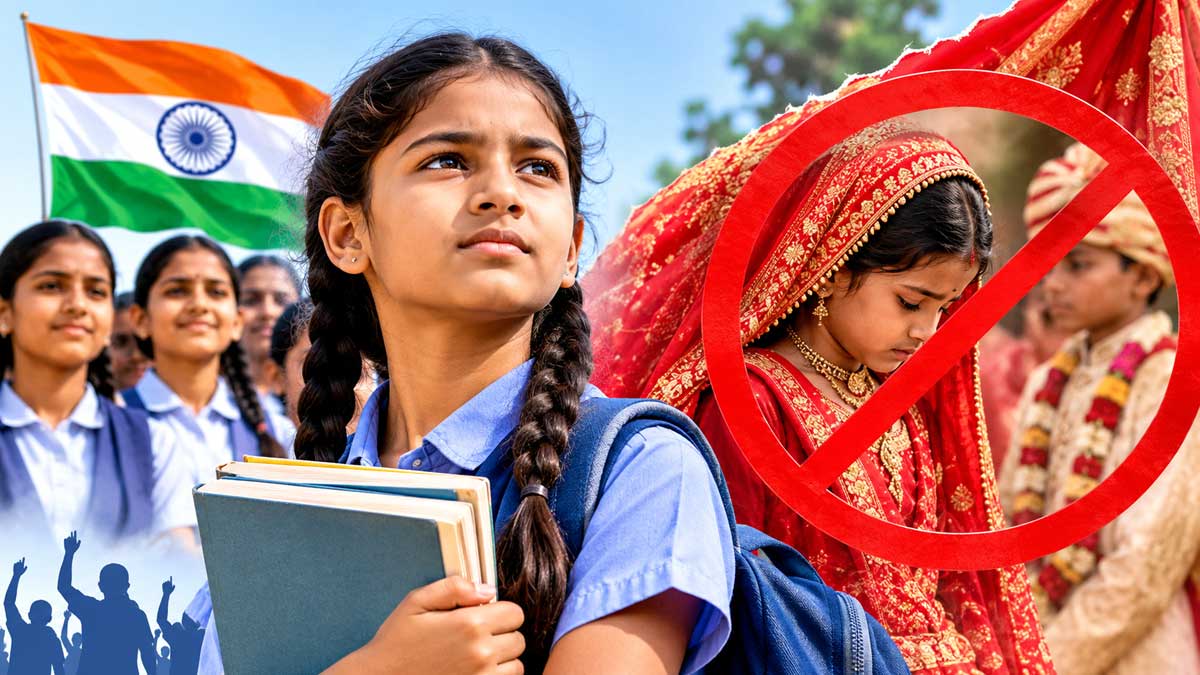
In the tall glass buildings of Hyderabad, 28-year-old Anita sits late into the night, working on her laptop. She is a software engineer. She wants a promotion. A better salary. Financial independence. Marriage? “Not now,” she says calmly. First, her career. Then everything else.
In a small village in Rajasthan, 15-year-old Rani’s life is very different. The henna on her hands had barely dried when she was sent to her husband’s home. School stopped. Games ended. Childhood quietly slipped away. Two girls. One country. The only difference is circumstances.
In cities, marriage has become a choice. In many villages, it is still often a compulsion. Somewhere, young women wait to ‘settle down’ after building careers. Elsewhere, daughters are hurriedly married off, seen as a ‘burden’. This is our uncomfortable truth.
Recently, this issue was discussed openly at a community awareness programme at the Community Health Centre of Aligarh Muslim University. The programme was titled ‘Baal Vivah Mukt Bharat: Our Responsibility’. Doctors, social workers, and teachers spoke clearly and firmly. Child marriage is not a tradition to be defended. It is a violation of a child’s rights.
The laws are clear. The Prohibition of Child Marriage Act sets the minimum legal age of marriage at 18 for girls and 21 for boys. The Protection of Children from Sexual Offences Act (POCSO) treats any sexual act involving minors as a serious crime. The Juvenile Justice Act focuses on the protection and rehabilitation of children.
There is also an important helpline number, 1098. It is a 24-hour child helpline. Anyone can report a case anonymously. The message is simple: silence allows injustice to grow. Speak up. Yet, despite strong laws, the ground reality remains difficult.
Doctors at the programme explained that early pregnancy is dangerous for both mother and child. Teenage girls face a higher risk of complications and even death during childbirth. Premature births, low birth weight babies, and severe anaemia are common problems.
According to UNICEF, millions of girls in India are still married before the age of 18 every year. Data from the National Family Health Survey shows that around 23 per cent of women aged 20 to 24 were married before turning 18. The percentage was higher in the past. There has been progress. But the journey is far from over.
Child marriage is not only a health issue. It is also an education issue. Once married, most girls drop out of school. Without education, they remain financially dependent. Poverty continues into the next generation.
The problem is more common in rural areas. The reasons are familiar: poverty, fear about safety, dowry concerns, and social pressure. Many parents believe that marrying their daughters early will reduce their responsibility. In truth, it often begins a cycle of hardship.
Studies show that even one additional year of schooling can significantly reduce the risk of child marriage. Education is the strongest weapon against this practice. Birth registration is also crucial. Accurate age records prevent false claims and illegal marriages.
The government has launched initiatives to address the problem. The Ministry of Women and Child Development’s campaign ‘Baal Vivah Mukt Bharat’ aims to eliminate child marriage by 2030. Pledge programmes are being held in villages. Awareness drives are taking place in schools. Complaints can now be filed through digital portals.
International organisations such as the United Nations Population Fund and UNICEF are supporting adolescent girls with education, health services, and life skills training.
Some states have shown positive results. West Bengal’s Kanyashree Prakalpa scheme has helped delay the marriage of thousands of girls by encouraging them to stay in school. In parts of Rajasthan, some villages have proudly declared themselves ‘child marriage–free’.
Still, challenges remain. Many cases are never reported. Social pressure silences witnesses. Poverty continues to push families into early marriages.
At its heart, this is a battle of mindsets. Until daughters are treated as equals, this practice will not fully disappear. Panchayats, schools, police, families, and the media must work together.
The distance between Anita and Rani is not just the distance between a city and a village. It is the distance between opportunity and compulsion. Between dreams and denial.
India is changing. Its daughters are moving forward. But that change must reach every corner of the country.
Child marriage is not destiny. It is a wrong decision. And every wrong decision can be corrected. What we need is courage. Awareness. And justice.
The day every Rani gets time to dream before being asked to marry, that will be the day India truly becomes free.
Related Items
India's exports gain momentum across FTA Partners and beyond
Will India's golden seed sprout from the ashes of West Asia!
Rise of India’s Electric Vehicles Ecosystem…