Latest News: Indian share markets will be open for trading on Sunday, February 01, as the Union Budget is being presented on that day * Key Highlights of Economic Survey 2025–26: GDP & GVA Growth Estimates for FY 2026: First advance estimates at 7.4% and 7.3% respectively * India’s Core Growth Projection: Around 7%, with real GDP growth for FY 2027 expected between 6.8% and 7.2% * Central Government Revenue: Rose to 11.6% of GDP in FY 2025 * Non-Performing Assets: Declined to a multi-decade low of 2.2% * PMJDY Accounts: Over 552 million bank accounts opened by March 2025; 366 million in rural and semi-urban areas * Investor Base: Surpassed 120 million by September 2025, with women comprising ~25% * Global Trade Share: India’s export share doubled from 1% in 2005 to 1.8% in 2024 * Services Export: Reached an all-time high of $387.6 billion in FY 2025, up 13.6% * Global Deposits: India became the largest recipient in FY 2025 with $135.4 billion * Foreign Exchange Reserves: Hit $701.4 billion on January 16, 2026—covering 11 months of imports and 94% of external debt * Inflation: Averaged 1.7% from April to December 2025 * Foodgrain Production: Reached 357.73 million metric tons in 2024–25, up 25.43 MMT from the previous year * PM-Kisan Scheme: Over ₹4.09 lakh crore disbursed to eligible farmers since inception * Rural Employment Alignment: “Viksit Bharat – Jee Ram Ji” initiative launched to replace MGNREGA in the vision for a developed India by 2047 * Manufacturing Growth: 7.72% in Q1 and 9.13% in Q2 of FY 2026 * PLI Scheme Impact: ₹2 lakh crore in actual investment across 14 sectors; production and sales exceeded ₹18.7 lakh crore; over 1.26 million jobs created by September 2025 * Semiconductor Mission: Domestic capacity boosted with ₹1.6 lakh crore invested across 10 projects * Railway High-Speed Corridor: Expanded from 550 km in FY 2014 to 5,364 km; 3,500 km added in FY 2026 * Civil Aviation: India became the third-largest domestic air travel market; airports increased from 74 in 2014 to 164 in 2025 * DISCOMs Turnaround: Recorded first-ever positive PAT of ₹20,701 crore in FY 2025 * Renewable Energy: India ranked third globally in total renewable and installed solar capacity * Satellite Docking: India became the fourth country to achieve autonomous satellite docking capability * School Enrollment Ratios: Primary – 90.9%, Upper Primary – 90.3%, Secondary – 78.7% * Higher Education Expansion: India now has 23 IITs, 21 IIMs, and 20 AIIMS; international IIT campuses established in Zanzibar and Abu Dhabi * Maternal & Infant Mortality: Declined since 1990, now below global average * E-Shram Portal: Over 310 million unorganised workers registered by January 2026; 54% are women * National Career Service Portal: Job vacancies exceeded 28 million in FY 2025 and crossed 23 million by September 2026

Bangalore tackles the plastic menace in its own way...


Grappling with the plastic menace has been probably the biggest challenge of rapid urbanization. Plastic has become a part of everyone’s day-to-day life and hence it was always going to be a daunting task to get rid of it completely. However, unperturbed by the monumental task that it is, cities have geared up to take it on.

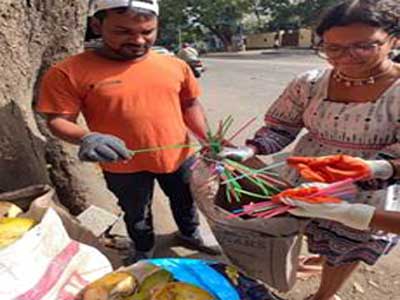
Karnataka’s capital Bengaluru is one of the cities that have employed innovation in getting everyone’s daily life rid of plastic use. Under the Swachhata Hi Seva Campaign, the "No Straw Nariyal Challenge" has been launched as a groundbreaking endeavor by the Bruhat Bengaluru Mahanagara Palike to address the pervasive issue of plastic waste associated with tender coconut vendors in every nook and corner of the city.

Despite tireless efforts to curb single-use plastic, BBMP officials observed that many coconut vendors were persistently using plastic straws. The predicament was further exacerbated by the fact that paper straws, though less harmful, were both costlier and less readily available, making it difficult for vendors to transition away from plastic.

Read in Hindi: प्लास्टिक के खतरे से यूं निपट रहा है बेंगलुरु...

In response to this challenge, the BBMP decided to employ a proactive approach. The "No Straw Nariyal Challenge" was introduced not only to discourage the use of plastic straws but also to encourage the concept of "bring your own cup”. Through a series of awareness campaigns, the BBMP aimed to instill eco-conscious practices among both vendors and consumers. Vendors were not only urged to eliminate plastic straws but also incentivized to embrace sustainable alternatives like serving coconut water without straws or offering eco-friendly options. This innovative step fostered a sense of responsibility among the coconut vendors as well as the public, highlighting that even the smallest changes in our daily routines can collectively make a substantial impact in the fight against plastic pollution across the vibrant streets of Bengaluru.

The Challenge was conducted engaging around 50 coconut vendors at different spots in the city. The challenge was volunteered by Indian Plogman & Cupman, an NGO, and participants of the BBMP Marshals unit. A long journey always begins with the first step and the BBMP has just taken that right one.