
 Samiksha Bharti News Service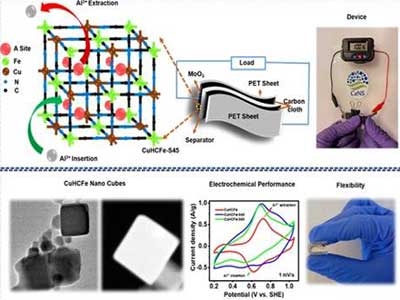
A novel battery technology has been developed by scientists that makes the battery flexible enough to fold like a piece of paper and also is safe enough to touch without any worry. Commonly used Lithium-ion batteries are prone to overheating and explosion.
Researchers in Bengaluru from the Centre for Nano and Soft Matter Sciences, an autonomous institute under the Department of Science and Technology, in collaboration with the Centre for Nano Science and Engineering at the Indian Institute of Science, have developed a novel battery technology that could serve as an alternative to traditional lithium-ion batteries commonly used in phones, laptops, electric vehicles, and wearable devices.
This new battery uses aluminium, one of Earth's most abundant metals, and a water-based solution. This combination makes it safer, cheaper, and much kinder to our environment. It could protect from battery explosions and environmental hazards, and also reduce the power requirement of our devices.
Although aluminium has great potential because it can store and release energy efficiently, scientists faced problems in practically using it due to its complicated chemistry. The Bengaluru scientists solved these problems by tweaking materials at the microscopic level. They designed a unique cathode from a special material called copper hexacyanoferrate, pre-filled with aluminium ions. They paired this with an anode made from molybdenum trioxide, creating a powerful battery that’s not just effective but also flexible enough to bend without breaking.
This innovative battery stores energy efficiently and reliably, maintaining 96.77 per cent of its power after 150 charge-discharge cycles, limiting reduction in battery life over extended daily use.
It stays functional even when bent or folded completely in half. To showcase this, scientists powered an LCD continuously, even while the battery was bent at extreme angles. This could help develop gadgets in future that can be rolled up for fabricating wearable devices seamlessly integrated into clothing.
The scientists used advanced microscopic tools, including electron microscopes and spectroscopic techniques, to ensure the battery's components were perfectly balanced for high performance. They rigorously tested the battery to confirm its efficiency, durability, and flexibility, ensuring it can stand up to real-world use. This innovation has promising implications for everyday applications. Potential developments could include flexible smartphones, safer electric vehicles, and wearable devices integrated into clothing. Moreover, the use of aluminium, an abundant and environmentally friendly resource, supports broader sustainability goals.
This work represents a significant stride in multivalent ion battery technology. With ongoing improvements, such batteries could soon become standard in many aspects of our daily lives and position the country at the forefront of developing safe, sustainable, and next-generation energy storage solutions that align with global environmental goals.
Related Items
An Indian traveller’s eye-opening lessons in the ‘Art of Living’
Are Indian borders just lines on a map!
How the 'Indian Solar Revolution' is transforming rural lives…