
The sun has barely risen over a village in Uttar Pradesh. A farmer is already in his field, checking his crop, worrying about the weather and calculating his next loan instalment. His wife is in the kitchen, stretching yesterday's leftovers. Their son has a degree but no job. Their daughter needs money for college. The old parents need medicines. Fertiliser costs, electricity bills and household expenses are waiting.
The wheat or potato crop may fetch a good price, or it may not. The middleman will take his cut. The bank wants its instalment. The family dreams of a motorcycle, a better roof and decent education for its children. But these dreams keep getting postponed.
The village looks different today. Smartphones have entered almost every pocket. Concrete houses have replaced mud walls. A new highway may pass nearby. Politicians arrive with promises, loudspeakers and cameras. Government schemes come and go. Yet the farmer's basic struggle remains familiar: uncertain income, rising expenses, mounting debt and an insecure future.
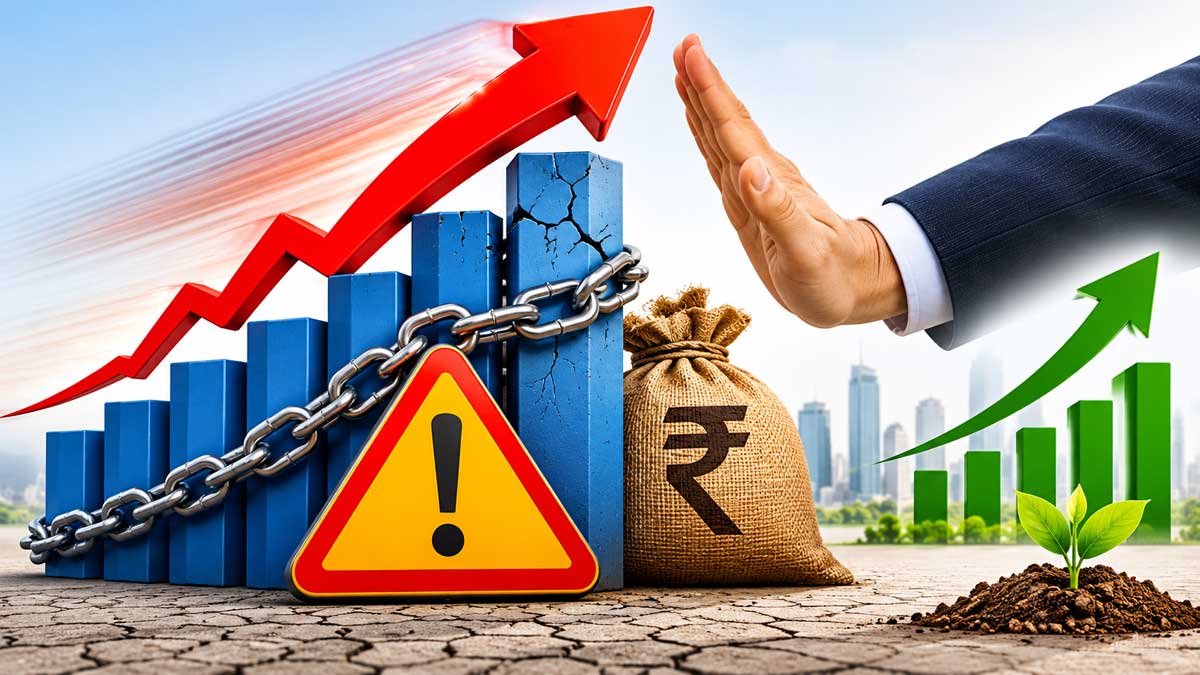
Now switch on the television. The government announces India's spectacular growth story. GDP is rising. Corporate profits are booming. Billionaires are multiplying. India is marching towards developed-nation status.
The farmer looks at his household budget and wonders: Where is that development hiding? This is the uncomfortable question behind India's economic success story. The country may be getting richer, but are ordinary Indians getting better off?
The Modi government celebrates economic growth, declining poverty and India's global ambitions. But GDP measures the size of the economic pie, not how it is divided.
India's services sector contributes more than half of its economic output. Finance, real estate, information technology and professional services are expanding rapidly. These sectors often reward people who already possess education, capital and connections.
Agriculture, meanwhile, employs a huge share of India's workforce but contributes a much smaller share of national output. Manufacturing has struggled to create enough jobs for millions entering the labour market. This is not merely an economic imbalance. It reflects a deepening class divide.
The World Inequality Report 2026 presents a disturbing picture. India's richest 10 per cent receive approximately 58 per cent of national income. The bottom 50 per cent receive just 15 per cent.
The wealth gap is even more shocking. The richest 10 per cent own around 65 per cent of national wealth. The top one per cent alone control nearly 40 per cent. The bottom half owns barely 6.4 per cent.
Think about it! Half the population owns a tiny fraction of the country's wealth, while a privileged minority controls the lion's share.
A rising GDP means little to a struggling family if its own share remains unchanged. The real question is not whether India is becoming richer. It is whether Indians are becoming more prosperous. But when corporate profits rise, why do workers' wages and employment opportunities not rise at the same pace?
Investment is essential. Industry is necessary. But public money and tax concessions must carry public responsibilities. If big companies receive generous relief, society deserves something in return: more jobs, better wages and greater accountability.
GST created a common indirect tax framework. But indirect taxes can hurt poorer households harder because they spend a larger share of their income on everyday necessities. The rich can save and invest. The poor must spend almost everything to survive.
The government's infrastructure spending has produced highways, airports and industrial corridors. These are important. But development cannot be measured only in kilometres of concrete and tonnes of steel. Schools, hospitals, secure employment and decent wages deserve equal attention.
One India enjoys luxury apartments, expensive cars, private universities and specialised hospitals. The other struggles with insecure jobs, costly education, medical bills and uncertain incomes.
Young graduates run from one recruitment examination to another. Informal workers survive without adequate social protection. Farmers remain vulnerable to weather, markets and debt. Women continue to face barriers to safe and fairly paid employment.
As public commentator Prof Paras Nath Chaudhary observes, "If the rising tide lifts only the yachts, it cannot be called public welfare." The issue is not opposition to private enterprise. It is opposition to an economic system where privilege grows faster than opportunity. A leftist economic argument begins with a simple principle: those who create wealth deserve a fair share of it.
Workers are not machine attachments. Farmers are not cheap food-producing units. Small traders are not disposable casualties of economic restructuring.
India needs fairer taxation, including effective taxation of large fortunes and capital gains. Labour-intensive industries and small businesses deserve stronger support. Public schools, hospitals and skill-development institutions need serious investment.
Farmers need better market access, affordable credit and reliable procurement. Workers need decent wages, social security and safe workplaces. Affordable housing and public transport must become development priorities.
Government should measure progress not only through GDP but also through real wages, household incomes, wealth concentration and economic mobility.
India's demographic advantage will not last forever. Millions of young people are entering the job market. They need opportunities, not endless promises.
Economic inequality weakens consumer demand, restricts mobility and increases social tensions. When wealth becomes concentrated, economic power can also translate into political influence.
Free rations and election-time relief cannot substitute for economic justice. People need decent jobs, good schools, affordable healthcare and secure incomes.
The question is not whether India needs growth. Of course, it does. The real question is: Growth for whom? A rising GDP cannot be the final certificate of national progress if ordinary families remain trapped in economic insecurity. The real test of development is not how far the richest have travelled. It is how much the poorest have moved forward.
India needs an economy where wealth creators are not left empty-handed. Prosperity must be a shared national achievement, not a private celebration of the privileged few.
Related Items
The rise of India’s floriculture economy…
Tracing the transition from Analogue to Digital TV Broadcasting in India
India’s decisive battle against child marriage